Fox’s planned acquisition of Roku has moved another major step closer to completion.
Shareholders on both sides have now approved the transaction, clearing one of the biggest corporate hurdles in a deal valued at approximately $22 billion.
Roku shareholders approved the merger agreement with 81.5% of outstanding voting power supporting the transaction. Fox shareholders separately approved the stock issuance needed to complete the acquisition.
But Roku users should understand one important point immediately:
The deal has not closed yet.
Regulatory approvals and other customary closing conditions are still required.
Until those steps are completed, Roku remains an independent company, and users should not expect their home screen, devices, accounts, or apps to suddenly change overnight.
The bigger question is what could happen once Fox gains control of one of the largest connected-TV platforms in the world.
What Could the Fox–Roku Deal Mean for Roku Users?
In the short term, probably very little.
Roku devices should continue working normally, Roku OS should continue receiving updates, and existing apps should remain available while the transaction moves through the remaining approval process.
Longer term, Fox could use Roku’s platform to deepen integration between The Roku Channel, Tubi, Fox Sports, Fox News, and other Fox-owned content.
Fox says the combination would unite its premium live content and advertising business with Roku’s streaming platform, home-screen technology, and direct relationship with more than 100 million streaming households.
That could eventually influence content discovery, advertising, live programming, and the way Fox services are surfaced across Roku OS.
What Fox has not announced is a plan to turn Roku into a closed Fox-only ecosystem.
Fox–Roku Deal at a Glance
| Area | Confirm Detail | What It Could Mean For Users |
|---|---|---|
| Deal Value | About $22 billion | Roku becomes part of a much larger media company |
| Roku Shareholder Vote | 81.5% of outstanding voting power approved | Major shareholder hurdle cleared |
| Fox Vote | Stock issuance approved | Fox can proceed with transaction structure |
| Roku Reach | More than 100 million streaming households | Gives Fox major connected-TV distribution |
| Key Assets | Roku OS, Roku devices, The Roku Channel | Could see tighter integration with Fox services |
| Fox Assets | Sports, news, entertainment and Tubi | More live and free content could appear across Roku |
| Current Status | Not yet closed | No immediate user-facing change required |
| Remaining Step | Regulatory approvals | Deal can still face review before completion |
Why Fox Wants Roku
This deal is not mainly about selling streaming boxes.
Roku’s biggest strategic value is the platform behind those boxes.
Roku controls the software experience on millions of televisions and streaming devices, including the home screen, search, recommendations, advertising surfaces, and The Roku Channel.
Fox brings a very different set of strengths.
It owns major live sports rights, television networks, news programming, entertainment assets, and Tubi.
Fox says combining those businesses with Roku would create a broader media and technology platform built around content, advertising, and direct viewer relationships.
That matters because the company would not need to reach Roku viewers only through a separate app.
It would own the platform itself.
Could Fox Content Become More Prominent on Roku?
This is one of the most obvious possibilities.
Fox owns a large catalog of sports, news, and entertainment programming.
It also controls Tubi, while Roku already operates The Roku Channel.
Once both businesses sit inside the same company, there are clear opportunities to make those services work more closely together.
That could mean stronger promotion of Fox programming on the Roku home screen.
It could mean easier access to Tubi.
It could mean more live sports discovery.
It could also mean Fox content appearing more prominently in search or recommendations.
But none of those changes have been formally announced as final product decisions.
That distinction matters.
Fox has explained the strategic benefits of combining content and distribution, but it has not published a roadmap showing exactly where every Roku interface element will move.
What Happens to The Roku Channel?
The Roku Channel could become one of the most important assets in the combined company.
Roku has steadily expanded it from a simple free-video destination into a broader streaming service with free movies, shows, live channels and subscription options.
Fox already operates Tubi, another major free ad-supported streaming service.
That creates an obvious overlap.
The two services could remain separate.
They could share advertising technology.
Their catalogs could become more coordinated.
Or Fox could eventually create deeper integration between them.
Fox’s official acquisition announcement specifically highlights both Tubi and The Roku Channel as important parts of the combined streaming business.
For users, the key thing to watch is whether the services remain independent destinations or start functioning more like connected parts of one platform.
Will Roku OS Become More Focused on Content Discovery?
Probably, although Roku was already moving in that direction before the acquisition.
The platform has been evolving beyond a basic grid of apps.
Recommendations, personalized search, subscription management, and content discovery are becoming larger parts of the home screen experience.
PlayerSDK recently covered Roku Labs and Roku’s expanding platform experiments, which shows how Roku has already been testing utility apps, new home-screen ideas, and deeper platform features.
Fox ownership could accelerate this evolution.
A company with large amounts of premium content has a strong incentive to help users discover programming before they even open an app.
That makes the Roku home screen strategically valuable.
Could Roku Devices Become More Expensive?
There is no confirmed announcement suggesting that Fox plans to raise Roku hardware prices because of the acquisition.
Roku has historically used affordable hardware as one way to expand the number of households using its platform.
That strategy makes sense because Roku can earn revenue after the device sale through advertising, content distribution, and platform services.
Fox would likely value that reach.
Making Roku hardware dramatically more expensive could reduce the number of users entering the ecosystem.
That does not mean pricing can never change.
Streaming-device prices across the industry have already been rising.
But there is currently no evidence that shareholder approval itself means a Roku player or Roku TV will suddenly become more expensive.
Will Existing Roku Apps Keep Working?
There is no announced reason they would stop.
Roku depends heavily on being a broad streaming platform with support from many major video services.
The platform becomes less attractive if users believe it only exists to promote Fox-owned services.
Fox itself says the transaction is designed to create a stronger streaming platform for consumers and content partners.
That wording matters.
Third-party streaming apps remain essential to Roku’s value.
Netflix, YouTube, Disney+, Prime Video, Plex, and many other services are a major reason people buy Roku hardware.
Turning the platform into a closed ecosystem would undermine the scale Fox is paying billions of dollars to acquire.
What Could Change About Advertising?
Advertising may be one of the biggest areas of change.
Roku has a direct relationship with viewers through its home screen, streaming platform, and advertising technology.
Fox brings major live television audiences and Tubi’s digital advertising business.
The combination creates a large pool of viewing behavior, advertising inventory, and connected-TV reach.
Fox says the deal is designed partly to improve monetization and strengthen its position in connected television advertising.
For users, that could eventually mean more personalized promotions or tighter integration between Roku advertising and Fox content.
Whether that results in noticeably more advertising or simply more targeted advertising remains unknown.
What About Roku Privacy and Viewing Data?
This area deserves attention, but users should avoid assuming changes that have not happened.
Fox has highlighted Roku’s first-party data and direct viewer relationships as strategic strengths of the acquisition.
That makes Roku data valuable to the combined company.
However, any actual changes to how data is collected, shared, or used would still need to comply with privacy policies and applicable law.
Users should watch for updates to Roku’s privacy notices once the deal closes.
Until then, speculation about entirely new data practices would be premature.
Could Fox Prioritize Its Own Sports Content?
This is one of the more plausible long-term outcomes.
Fox owns major live sports rights, including football, baseball, motorsports, and international events.
Live sports remain one of the strongest reasons viewers still choose television platforms rather than purely on-demand apps.
Roku already has sports-discovery features.
Combining those features with Fox’s live sports portfolio could make sports more prominent across Roku.
That could include improved game discovery, deeper home-screen recommendations, or stronger integration with Fox-owned streaming services.
Again, this is a logical strategic possibility rather than a confirmed interface change.
What Does the Deal Mean for Roku Hardware Competition?
Roku competes with Apple TV, Google TV, Fire TV, and other platforms.
Ownership by Fox changes the strategic balance.
Apple controls hardware, software, and services.
Amazon combines Fire TV with Prime Video and a major advertising business.
Google combines its television platform with YouTube, Gemini, and its broader services ecosystem.
Fox acquiring Roku would create another vertically connected competitor combining content, advertising, and the television operating system.
For buyers trying to compare these ecosystems, PlayerSDK’s streaming device comparison provides a side-by-side look at hardware, HDR support, storage, and other device capabilities.
The acquisition does not change those specifications today.
It could change how each platform competes for attention over time.
Will Roku Still Develop New Features?
There is no indication that Fox intends to freeze Roku development.
That would undermine the value of the acquisition.
Roku has recently been experimenting with home-screen improvements, personalized discovery, and Roku Labs.
The company’s platform technology is one of the main assets Fox is purchasing.
Fox specifically highlights Roku’s consumer interface and home-screen technology as strategic benefits.
That suggests continued software investment is more likely than abandonment.
The more interesting question is which direction that investment takes.
Future Roku features may increasingly connect content discovery with Fox-owned programming and advertising.
What Happens to Roku Founder Anthony Wood?
Roku founder and CEO Anthony Wood is expected to retain an ongoing role after the deal closes and join Fox’s board of directors.
That is significant because it suggests Fox does not plan to immediately remove Roku’s existing leadership influence from the combined business.
Keeping Roku leadership involved may help preserve continuity around the platform’s product strategy and device ecosystem.
Of course, ownership still changes who ultimately controls major business decisions.
Is the Acquisition Guaranteed to Close?
No.
Shareholder approval is a major milestone, but it is not the final step.
Fox and Roku still need regulatory approvals in the United States and certain other jurisdictions, along with other customary closing conditions.
The companies expect the transaction to close in the first half of 2027.
Until then, users should treat any dramatic predictions about Roku OS, devices or apps as speculation.
The most accurate current statement is:
The shareholders have approved the deal, but Fox does not yet own Roku.
Should Roku Users Do Anything Right Now?
No immediate action is necessary.
There is no reason to replace a working Roku device because of the merger vote.
There is also no announced requirement to create a Fox account, move subscriptions or change application settings.
Roku devices should continue operating normally while the regulatory process continues.
Users who want to understand how Roku currently compares with other hardware can use PlayerSDK’s streaming device comparison, while those focused more on playback apps can use the media player comparison.
For now, the deal is more important strategically than practically.
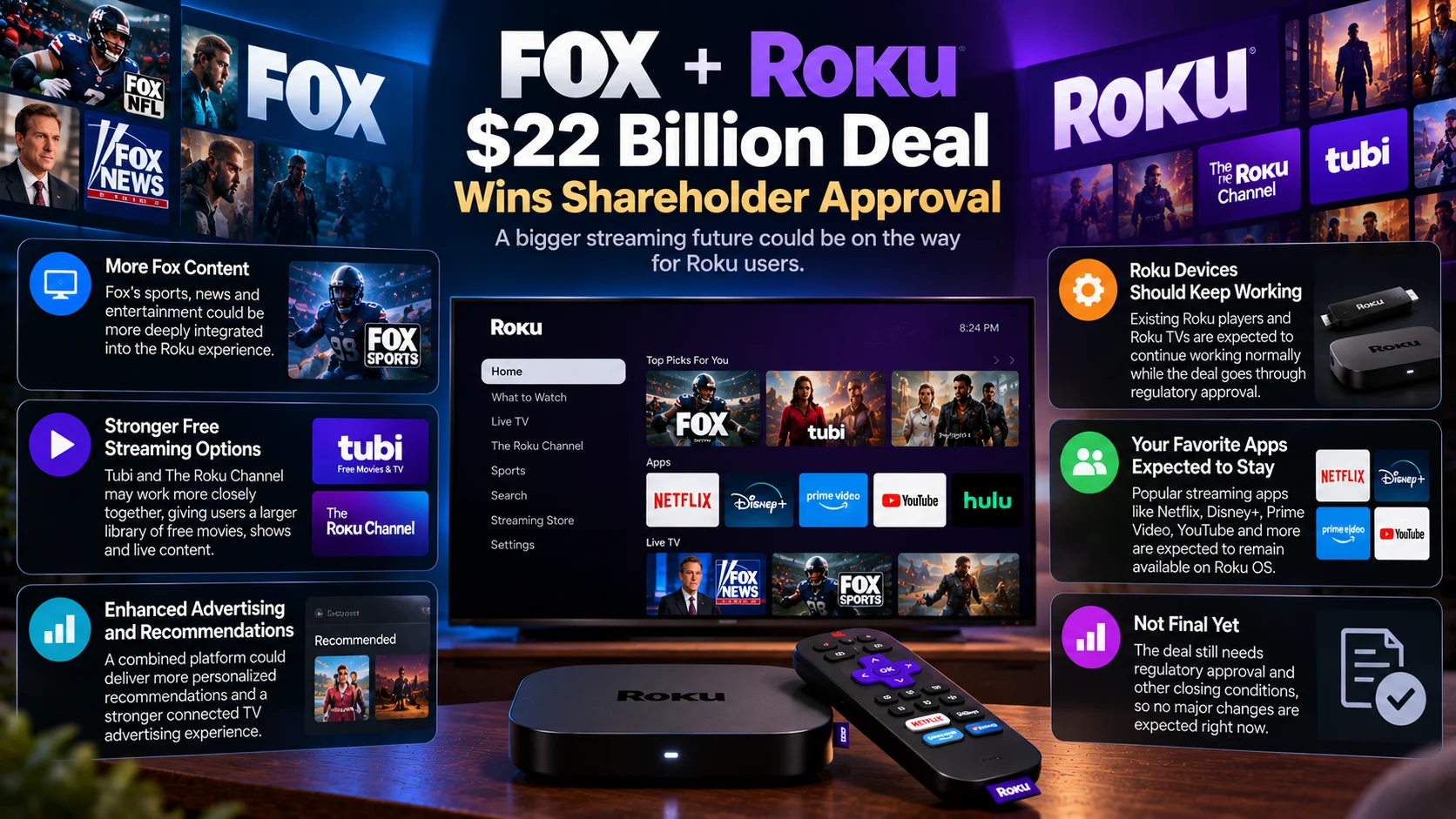
Final Verdict
The Fox Roku acquisition has cleared one of its biggest remaining corporate hurdles after shareholders approved the transaction.
Roku shareholders supported the merger with 81.5% of outstanding voting power, while Fox received the approval required for its part of the stock transaction.
But Roku users should not expect an immediate transformation.
The acquisition still requires regulatory approval and has not closed.
In the short term, Roku devices, Roku OS, The Roku Channel and third-party applications should continue operating as they do now.
The longer-term impact could be much more significant.
Fox would gain control of a television platform reaching more than 100 million streaming households, while Roku would become part of a company with major sports, news, entertainment and free-streaming assets.
That combination could reshape content discovery, advertising, sports integration and the role of The Roku Channel.
The key word is could.
There is not yet enough evidence to say exactly how Roku’s interface or hardware strategy will change after the acquisition closes.
For users, the smartest approach is to keep watching the platform rather than reacting to speculation.
Roku is not disappearing.
If anything, the deal shows just how valuable the television home screen has become.
Frequently Asked Questions
1) Has Fox officially bought Roku?
Not yet. Shareholders have approved the transaction, but regulatory approvals and other closing conditions are still required.
2) How much is Fox paying for Roku?
The transaction values Roku at approximately $22 billion in enterprise value, with Roku shareholders receiving a combination of cash and Fox Class A shares.
3) Did Roku shareholders approve the deal?
Yes. Roku’s SEC filing shows 81.5% of outstanding voting power supported the merger proposal.
4) Will Roku devices stop working?
There is no indication that existing Roku devices will stop working because of the deal. The acquisition has not closed, and Roku continues operating normally.
5) Will Fox remove apps from Roku?
No such plan has been announced. Third-party apps remain a central part of Roku’s platform value.
6) What could happen to The Roku Channel?
Fox could potentially integrate it more closely with Tubi and Fox-owned content, but no final restructuring has been announced.
7) Will Roku show more Fox sports?
It is possible because Fox has highlighted its live sports portfolio as a strategic benefit of the merger, but specific Roku sports-interface changes have not been announced.
8) Will Roku become more expensive?
There is no confirmed plan to raise Roku hardware prices because of the acquisition.
9) What happens to Roku founder Anthony Wood?
Fox says Anthony Wood will retain an ongoing role and join the Fox board after the transaction closes.
10) When is the Fox–Roku deal expected to close?
The companies expect completion in the first half of 2027, subject to regulatory approval and other closing conditions.
Want to understand where Roku stands against Apple TV, Google TV, Fire TV and other streaming platforms?
Use PlayerSDK’s streaming device comparison to compare hardware, HDR support, storage and platform capabilities, and read PlayerSDK’s Roku Labs coverage to see how Roku’s software platform is already evolving before the Fox deal closes.