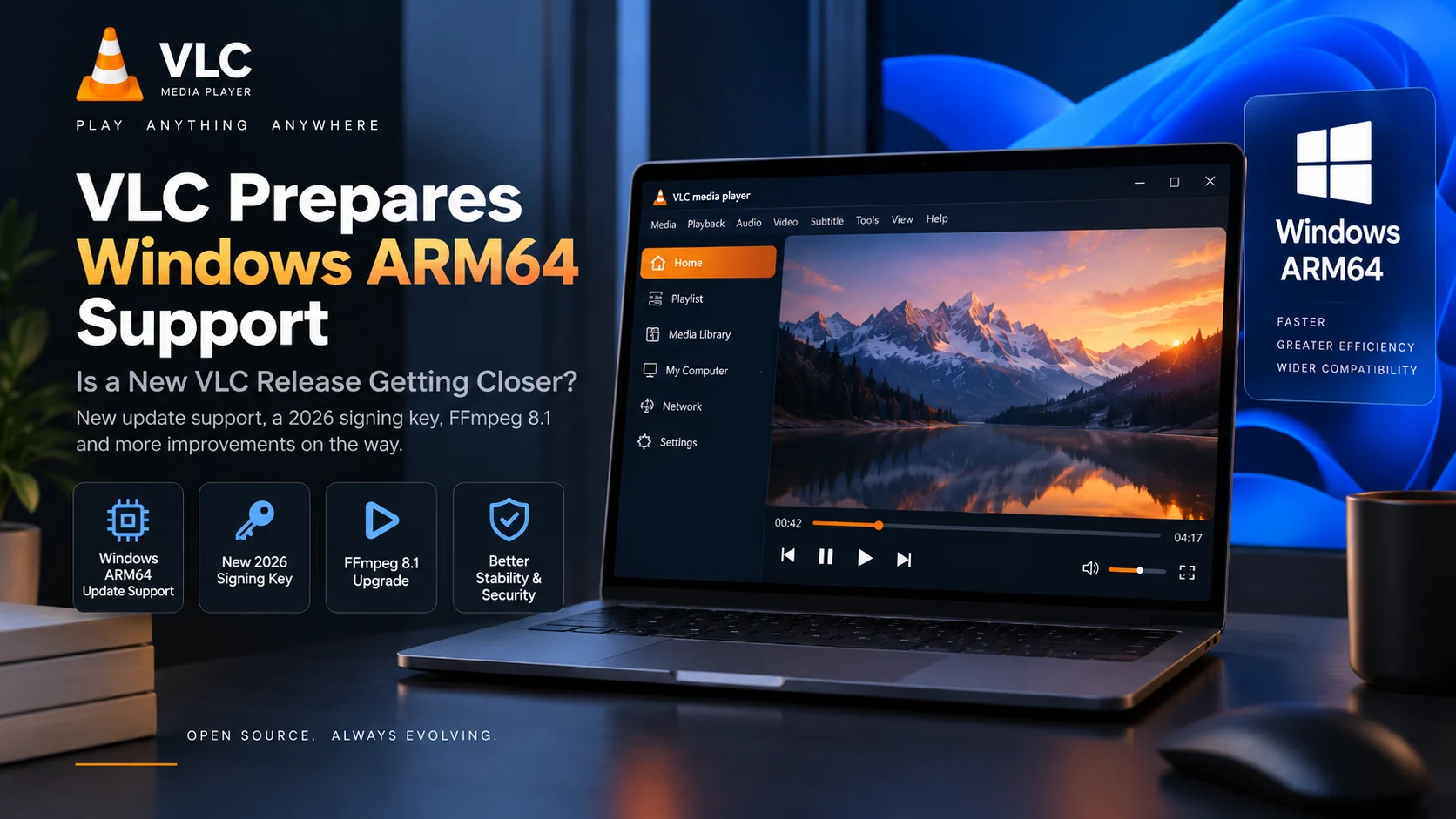
VLC Media Player appears to be nearing its next desktop maintenance release. On September 17, VideoLAN developers pushed a large collection of changes to VLC’s 3.0.x branch, including a commit explicitly titled “prepare for 3.0.24.” The same batch also added Windows ARM64 support to VLC’s update mechanism and introduced a new VideoLAN 2026 release-signing key. However, an important clarification: Windows ARM64 support is not brand new to VLC.
VideoLAN officially released native Windows ARM64 builds with VLC 3.0.23 in January 2026, and ARM64 installers, ZIP packages, 7-Zip archives, and MSI packages are already available from VLC’s Windows download page. What is new in the September code is ARM64 support in VLC’s update system, making the recent changes more accurately described as improving the native ARM64 release and update pipeline rather than introducing ARM64 playback.
Combined with months of VLC 3.0.24 development, upgraded FFmpeg components, security work, and recent release-preparation commits, the activity strongly suggests that another VLC 3. The maintenance release is moving toward completion. VideoLAN has not announced an exact public release date, so users should not treat 3.0.24 as officially released yet.
What Exactly Happened on September 17?
VideoLAN’s development repository saw substantial activity around VLC’s long-running 3.0 branch.
A September 17 push to the 3.0.x branch contained 93 commits affecting 89 files. Among them were updates to translations, codecs, demuxers, audio handling, security, Windows components, and release infrastructure. The final portion of that batch included a commit explicitly preparing the branch for VLC 3.0.24.
Three details stand out.
The first is a new VideoLAN Release Signing Key 2026. The second adds win-arm64 support to VLC’s internal updating code. The third is the direct “prepare for 3.0.24” commit.
Individually, none of these guarantees that a public release will arrive immediately.
Together, however, they are typical examples of the kind of infrastructure and versioning work that becomes important as software moves closer to distribution.
VLC 3.0.24 Development at a Glance
| Area | Current Development | Why It Matters |
|---|---|---|
| Windows ARM64 | ARM64 builds already exist; updater support is now being added | Better native update handling on ARM-based Windows PCs |
| Release status | 3.0.x branch now contains “prepare for 3.0.24” commit | Indicates active release preparation |
| Signing | New VideoLAN 2026 release-signing key | Supports verification of future official releases |
| FFmpeg | Moving to FFmpeg 8.1 in the 3.0.24 branch | Modernized codec and multimedia foundation |
| Codecs | OpenAPV plus ATRAC3/ATRAC9 support planned | Broader media-format compatibility |
| Captions | CEA-708 closed-caption support in MP4 | Better accessibility and metadata handling |
| Networking | RIST, SRT listener and SFTP improvements | More capable professional/network playback workflows |
| Security | Multiple parser and memory-safety fixes | Stronger handling of malformed media |
| Windows | DirectShow, UWP and audio fixes | Better Windows stability and compatibility |
Windows ARM64 Is Already Supported in VLC 3.0.23
The biggest misconception around the latest commits is that VLC is only now gaining Windows-on-ARM support.
That is not correct.
VideoLAN released VLC 3.0.23 on January 8, 2026, and specifically listed Windows ARM64 support as one of the release’s major additions. The official VLC Windows page currently provides dedicated ARM64 installers as well as ARM64 MSI, ZIP and 7-Zip packages.
That means users of modern Windows-on-ARM PCs can already run a native ARM64 version of VLC instead of relying only on x86 or x64 emulation.
The September change appears to complete another part of that experience: VLC’s own updater now understands the Windows ARM64 target.
For users, that difference may sound small, but it matters.
Native application support is only one part of a platform transition. Installers, update systems, packaging, code signing, crash handling and build infrastructure also need to understand the architecture.
Without those pieces, an ARM64 application can technically exist while still feeling less mature than its traditional x86-64 counterpart.
Why ARM64 Matters for Windows Media Players
Windows-on-ARM hardware has become increasingly important as more laptops and compact PCs use ARM processors.
Native ARM64 applications can avoid the translation layer required when traditional x86 applications run through emulation.
That can potentially improve startup efficiency, battery usage, and overall integration with ARM-based systems, although the actual difference depends on the application and workload.
For a media player, native support is especially useful because video playback can already involve several demanding components: decoding, rendering, subtitle processing, filters, and hardware acceleration.
VLC supporting ARM64 throughout more of its distribution infrastructure therefore makes the application more practical on the growing Windows-on-ARM ecosystem.
The current work is less about adding a flashy viewer-facing feature and more about making VLC behave like a first-class native Windows ARM application.
The Stronger Signal Is VLC 3.0.24
The ARM64 updater change is only one part of a much larger story.
VLC’s upcoming 3.0.24 release has been in development for several months.
In May 2026, VideoLAN developers committed changes preparing 3.0.24 beta1. Development notes at the time already included FFmpeg 8.1, OpenAPV support, and ATRAC3/ATRAC9 decoding.
The release notes were expanded again in June with a substantially larger list of fixes and features.
Now, on September 17, the branch received another large integration batch followed by the explicit “prepare for 3.0.24” commit.
That progression provides much stronger evidence of an approaching maintenance release than the ARM64 change by itself.
Still, VideoLAN has not published an official 3.0.24 launch announcement as of September 18.
FFmpeg 8.1 Is a Major Under-the-Hood Upgrade
One of the biggest technical changes planned for VLC 3.0.24 is an upgrade from FFmpeg 4.4 to FFmpeg 8.1 in the 3.0 branch.
FFmpeg is one of the most important multimedia frameworks underneath VLC.
It provides extensive codec, container, and stream-processing functionality, so moving several major FFmpeg generations forward can bring updated format support, decoding improvements, bug fixes, and modernized multimedia components.
VLC’s 3.0 branch is mature software, which makes such a large multimedia-library update particularly noteworthy.
Rather than leaving VLC 3.x frozen while work continues toward VLC 4, VideoLAN is continuing to modernize the stable branch.
For everyday users, many improvements may not be obvious as buttons or menus.
Instead, they can appear as media files that open more reliably, have fewer crashes with unusual content, or support formats that previously required another player.
OpenAPV and Additional Audio Codec Support
The 3.0.24 development notes also include new decoding support.
VLC is adding an OpenAPV decoder, with OpenAPV support available through both FFmpeg 8 and the OpenAPV library.
The planned release additionally lists ATRAC3 and ATRAC9 decoding.
ATRAC formats are associated with Sony audio ecosystems and older media libraries, so this will not affect every VLC user. But broader codec support has always been central to VLC’s appeal.
VLC became popular partly because users could throw unusual media files at it without first worrying about which codec pack was installed.
Continuing to add and update decoding support preserves that strength.
Better Closed Captions and Subtitle Handling
Accessibility and subtitle handling are another focus of the upcoming release.
Current 3.0.24 notes include CEA-708 closed-caption support in MP4, improved subtitle-language detection based on filenames and SSA/ASS metadata, and WebVTT CSS parsing fixes.
These improvements can help VLC interpret media libraries more accurately.
For example, when a video contains several subtitle tracks, improved language detection can help the player present useful information rather than forcing the viewer to manually test multiple unidentified tracks.
Better caption support is also important for professionally produced media and accessibility workflows.
VLC 3.0.24 Includes Significant Security Work
The planned release is not focused only on new formats.
VideoLAN’s current development notes describe fixes for multiple classes of security-sensitive problems, including out-of-bounds access, integer overflows, double-free conditions, and use-after-free issues across parsers, codecs, and demuxers.
The release notes also mention additional hardening around Matroska and EBML parsing.
Media players process files created by many different tools and downloaded from many sources, so defensive handling of malformed input is particularly important.
A corrupted or maliciously constructed media file can trigger code paths that ordinary testing may rarely encounter.
This is one reason even users who do not care about new codecs should keep media players updated.
Windows Gets More Than ARM64 Work
Windows users should expect several other improvements in the 3.0.24 branch.
VideoLAN’s development notes include NV12 DirectShow capture support, better UWP compatibility, fixes for Windows multimedia-device crashes, leaks, and deadlocks, and generation of debug symbols for Windows packages.
The September commit batch also contains a fix related to Windows session volume and mute reporting. Developers reverted an earlier change because external volume changes—for example, through the Windows Volume Mixer—could leave VLC with stale state information.
These changes reinforce the idea that 3.0.24 is a substantial maintenance update rather than simply a version-number bump.
Networking and Professional Streaming Also Improve
VLC is used for more than opening local MP4 files.
The application and its underlying framework are widely used with network streams, professional transport protocols, and media-testing workflows.
The upcoming branch includes a move toward librist for RIST input and output, SRT listener-mode support, and improved SFTP authentication, including public-key options and ED25519 host-key support.
These changes are especially relevant to broadcasters, developers, and technical users.
VLC’s strength has always been that the same program can serve casual desktop users while also offering advanced networking features.
VLC 3.0.24 appears to continue investing in both audiences.
What Does the New 2026 Signing Key Mean?
One of the September 17 commits updates VLC with a VideoLAN Release Signing Key 2026, generated on September 14 and configured with an expiration in 2036.
Software signing helps users and update systems verify that a package or update genuinely comes from its expected publisher and has not been improperly modified.
Updating the embedded signing infrastructure before a release is therefore a practical release-engineering task.
It should not be interpreted as proof that VLC 3.0.24 will launch on a particular date.
However, when it appears alongside version-preparation commits and updater changes, it adds to the evidence that VideoLAN is actively readying its distribution pipeline.
Is VLC 3.0.24 Releasing Soon?
The development signs are strong, but there is no official date yet.
VLC 3.0.24 reached a beta-preparation stage months ago, received expanded release notes in June, and on September 17 received a large 3.0.x update ending with a direct “prepare for 3.0.24” commit.
That makes it reasonable to say VLC 3.0.24 is getting closer.
It would not be accurate to claim the final version is already available or to predict a specific release day.
For now, VLC 3.0.23 remains the official stable Windows release shown on VideoLAN’s download site.
Final Thoughts
The latest VLC development activity is more significant than the phrase “Windows ARM64 support” initially suggests.
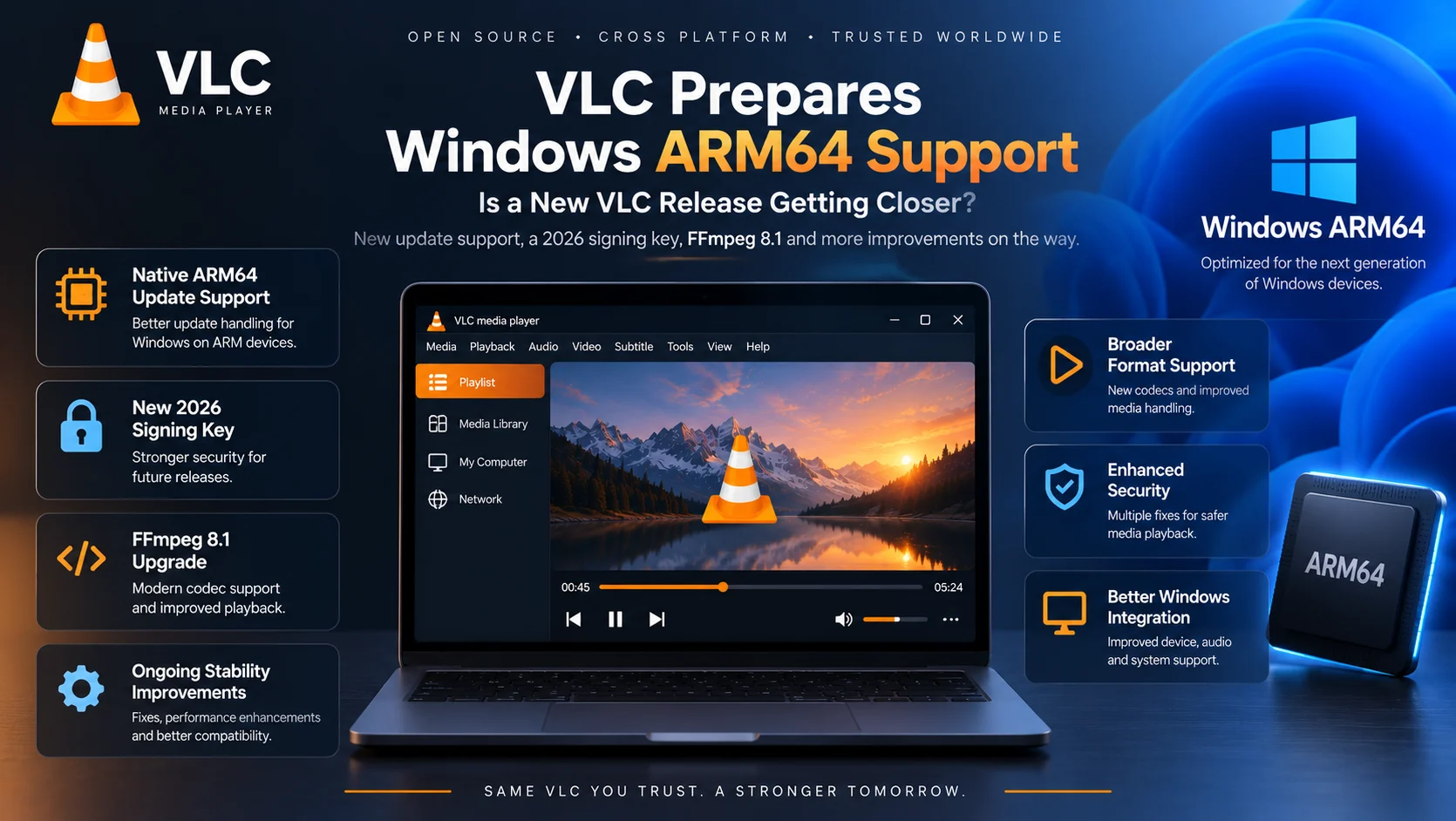
VLC already runs natively on Windows ARM64 through version 3.0.23. The new September change adds ARM64 awareness to VLC’s update infrastructure, helping make the Windows-on-ARM experience more complete. The bigger story is VLC 3.0.24.
VideoLAN has now committed explicit release-preparation changes while also updating its signing key, upgrading the multimedia stack toward FFmpeg 8.1, adding new codec support, improving captions and subtitles, fixing Windows issues, expanding networking capabilities, and addressing numerous security problems.
There is still no confirmed public release date. But the September 17 commits provide the clearest recent indication that VLC’s next 3. The maintenance release is moving closer to completion. For VLC users, particularly those on Windows-on-ARM hardware, this is a release worth watching.
FAQs About VLC Windows ARM64 and VLC 3.0.24
1) Does VLC support Windows ARM64 already?
Yes. VLC 3.0.23 introduced official Windows ARM64 support, and VideoLAN currently provides native ARM64 installers, MSI files, ZIP packages, and 7-Zip packages.
2) What changed with Windows ARM64 in September 2026?
VideoLAN added Windows ARM64 handling to VLC’s internal update system. This improves the release/update infrastructure for native ARM64 builds rather than introducing ARM64 playback for the first time.
3) Is VLC 3.0.24 available now?
Not as an officially announced final release as of September 18, 2026. VideoLAN’s stable Windows download page still lists VLC 3.0.23.
4) Is VLC 3.0.24 close to release?
Recent development strongly indicates active release preparation. On September 17, VideoLAN pushed a commit explicitly titled “prepare for 3.0.24,” alongside a new release-signing key and other release infrastructure changes. No final date has been announced.
5) Will VLC 3.0.24 use FFmpeg 8?
Current development notes specify an upgrade to FFmpeg 8.1, replacing the much older FFmpeg 4.4 foundation in the VLC 3.0 branch.
6) What new codecs are coming to VLC 3.0.24?
The current development notes include OpenAPV decoding and ATRAC3/ATRAC9 support, along with fixes affecting existing codecs and packetizers.
7) Should Windows ARM users wait for VLC 3.0.24?
Users do not need to wait simply to get native ARM64 playback. Official ARM64 packages already exist for VLC 3.0.23. VLC 3.0.24 should improve that experience further once the final release becomes available.
Stay Updated with the Player SDK Guide Hub
Video players evolve continuously, often through technical changes that are easy to miss until they affect playback, codecs, hardware compatibility, or application development. That’s why we created the Player SDK Guide Hub.
The Player SDK Guide Hub covers the latest VLC, Kodi, Plex, mpv, MPC-HC, Fire TV, Google TV, Roku, Apple TV, and other media player and streaming device updates, including codec upgrades, operating-system support, playback improvements, new APIs, security fixes, hardware compatibility, and major release developments.
Whether VLC 3.0.24 officially launches, Windows ARM64 support expands further, FFmpeg changes VLC’s playback capabilities, or another major video player receives an important update, our Guide Hub helps explain what changed, which users and devices are affected, why it matters, and what developers and streaming teams should watch next.
Explore the Player SDK Guide Hub for the latest video-player news, streaming-device updates, technical guides, codec developments, and media-platform insights.