Roku’s biggest developer event of the year begins today.
The Roku Developer Summit 2026 runs September 23–24, marking the tenth anniversary of Roku’s annual developer conference. Roku says the event will be simulcast for developers watching remotely and will include major updates to the Roku SceneGraph, or RSG, SDK, with new capabilities intended to streamline application development and improve app performance.
That makes this year’s summit particularly important for teams building and maintaining Roku streaming applications.
Roku has already been making significant changes throughout 2026. Roku OS 15.3 added new SceneGraph and BrightScript capabilities, Roku OS 16.0 is now publicly documented in preview form, the developer documentation platform received AI-assisted search and editing tools, and developers are preparing for new certification requirements involving RSG 1.3.
The summit is expected to connect many of those changes into a broader roadmap.
Importantly, Roku has not yet publicly detailed every RSG announcement planned for the keynote, so this article separates what Roku has officially confirmed for the event from already-public platform changes that provide context for what developers should watch.
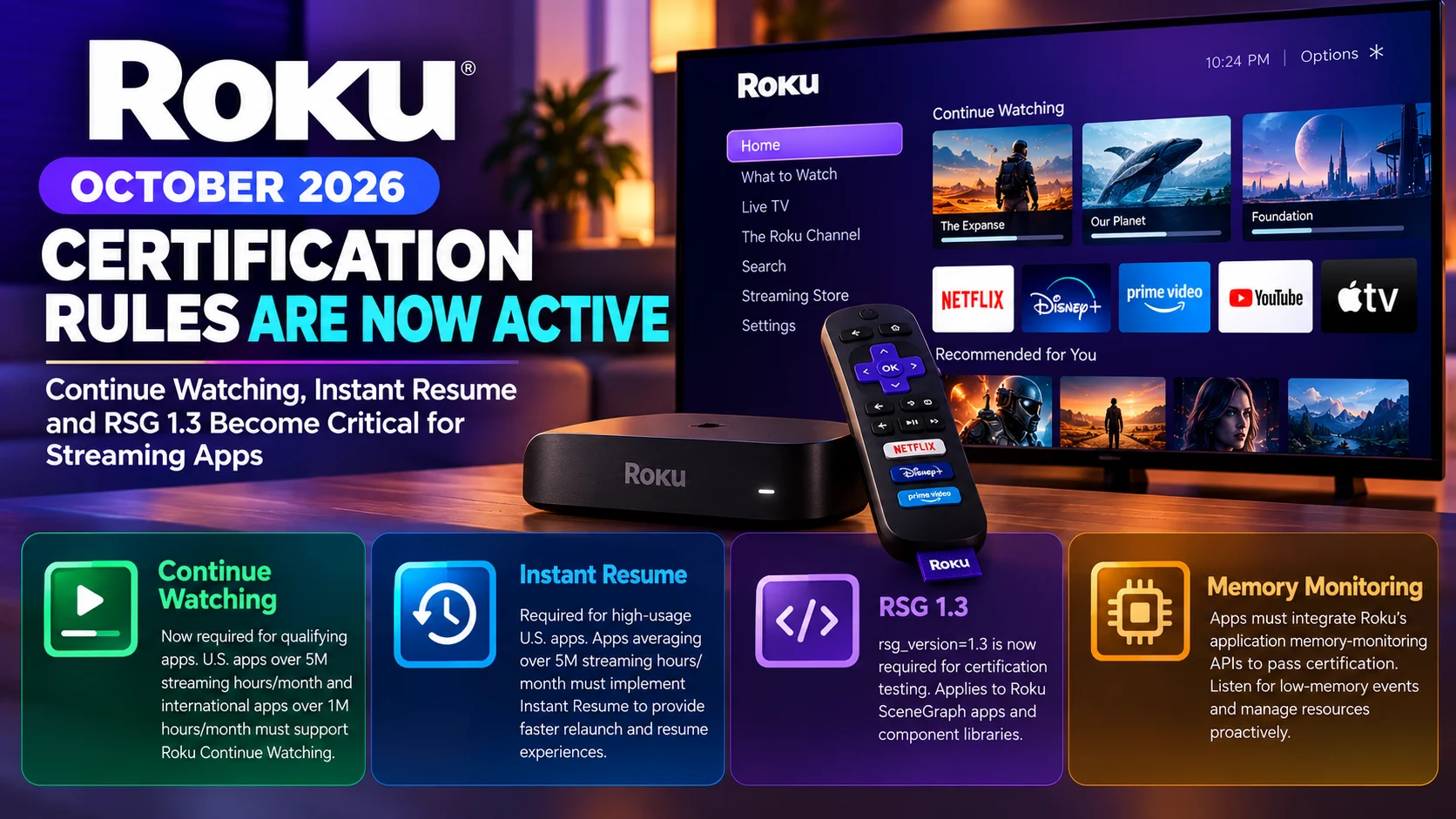
What Is Roku Developer Summit 2026?
Roku Developer Summit is the company’s annual event for application developers, streaming services, and technical teams building on the Roku platform.
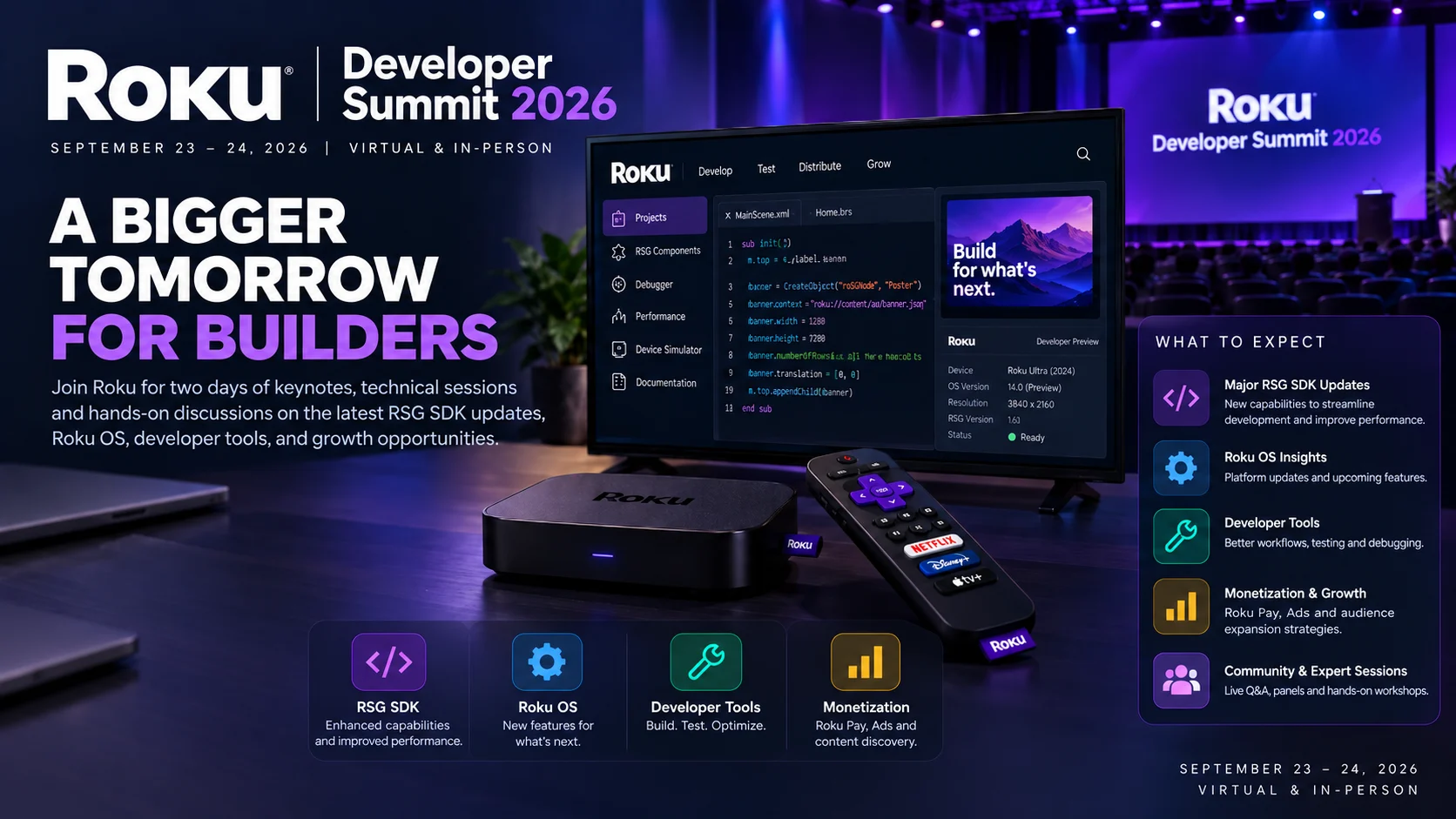
The 2026 edition takes place on September 23 and September 24 and is the event’s tenth annual edition. Roku says it will include a keynote, live Q&A sessions, community-led panels, workshops, and technical sessions.
Roku has specifically identified three broad areas for this year’s program: Roku OS and an enhanced RSG SDK, developer tools from both Roku and the community, and business topics including Roku Pay, Roku Ads, audience growth, and content discovery.
For developers, however, the biggest technical headline is straightforward:
Roku says major RSG SDK updates are coming.
Roku Developer Summit 2026 at a Glance
| Area | What Roku Has Confirmed or Already Published | Why Developer Should Care |
|---|---|---|
| RSG SDK | Major updates planned for the summit | Could affect UI architecture, workflows and app performance |
| Roku OS | Enhanced Roku OS/RSG capabilities are part of the summit agenda | Platform changes can affect rendering, networking and compatibility |
| Developer tools | Roku and community tools will be covered | Faster debugging, testing and optimization workflows |
| App performance | Roku says new SDK capabilities are designed to improve performance | Important for lower-powered devices and large SceneGraph apps |
| RSG 1.3 | Public docs require rsg_version=1.3 for certification from Oct. 1, 2026 | Existing applications may need manifest and architecture changes |
| Monetization | Roku Pay, Roku Ads and audience growth are on the agenda | Relevant to subscription and ad-supported apps |
| Content discovery | Discovery is an official summit topic | May affect how streaming apps surface content across Roku |
RSG SDK Is the Main Developer Story
Roku’s announcement says the company is preparing to unveil major updates to the RSG SDK with features intended to streamline development workflows and improve application performance.
RSG, short for Roku SceneGraph, is one of the core technologies behind modern Roku applications.
Developers typically combine BrightScript with SceneGraph’s XML-based UI system to create screens, grids, playback interfaces, focus behavior, dialogs, and other television experiences. Roku describes BrightScript and SceneGraph together as its purpose-built SDK for streaming applications.
Because SceneGraph sits at the center of the Roku app architecture, major changes can affect considerably more than visual styling.
Improvements in data transfer, rendering, node handling, or component architecture can influence startup time, memory use, focus responsiveness, and overall UI performance.
That is why this summit matters even to teams that are not planning a major redesign.
RSG 1.3 Is Already Becoming Important
One major RSG change is already public.
Roku’s current manifest documentation says developers must set rsg_version=1.3 by October 1, 2026, to continue passing certification testing. Roku says this version includes APIs for transferring node data that improve application performance.
That deadline arrives just days after Developer Summit 2026.
The timing makes RSG 1.3 especially relevant to this year’s event, although developers should distinguish between the already-published certification requirement and whatever additional RSG announcements Roku makes during the summit.
Component libraries are affected as well.
Roku’s ComponentLibrary documentation says the library’s manifest should also be used with rsg_version=1.3 to take advantage of the current performance-oriented model.
For large Roku applications that rely heavily on SceneGraph nodes and reusable component libraries, this is a change worth reviewing immediately.
Roku OS 16.0 Provides More Context
Another important piece of the developer roadmap is Roku OS 16.0.
Roku recently published a preview of developer-facing OS 16.0 changes. The release includes several new SceneGraph and BrightScript capabilities, though Roku’s beta program remains subject to NDA until broader rollout.
One notable addition is the new Effect node.
It allows GPU-accelerated effects such as rounded corners, borders, and gradients to be applied to compatible SceneGraph nodes, including Poster and Rectangle. Roku also exposes a supported field so applications can determine whether the effect is available on the current hardware.
For TV interfaces, this is a significant UI capability.
Developers previously had to use artwork assets or more complicated structures for some visual effects. Native effect support can potentially simplify those implementations and provide a more flexible design system.
ArrayGrid Focus Customization Gets Better
Roku OS 16.0 also adds the ArrayGrid.focusFeedbackPoster field.
That gives developers direct access to the Poster node used for the grid’s focus indicator. The practical advantage is that the visual focus state can more closely match custom item shapes—including layouts using rounded or asymmetric corners.
Focus behavior is critical on television.
Unlike a phone, where users simply tap an item, Roku applications are generally navigated using directional remote input. Viewers need an obvious indication of which tile currently has focus.
Making that focus treatment more customizable should help developers create interfaces that look more consistent while remaining easy to navigate.
Roku OS 16 Expands Networking APIs
The OS 16.0 preview also introduces new networking capabilities.
BrightScript gains WebSocket support through providing bidirectional communication with remote WebSocket servers. Roku has also added support for server-sent events through roUrlTransfer.
These capabilities could be useful for applications that require more dynamic server communication.
Examples might include live application state, real-time metadata, interactive experiences, or frequently refreshed data.
It is too early to assume how broadly Roku developers will adopt them, but they represent a substantial expansion compared with conventional request-response networking.
Other Roku OS 16 Changes Developers Should Watch
The publicly available Roku OS 16 release notes include several additional platform changes.
Conditional-compilation rules are being relaxed, the maximum BrightScript stack depth is increasing, various ifDraw2D operations now return Boolean success values, and roTextureRequest gains a SetDrawable() function.
These changes are more technical than new UI effects, but they can still influence how developers structure applications.
Stack-depth increases, for example, may help more complex code paths, while explicit success values can make drawing operations easier to validate.
The important distinction is that these features are already visible in Roku’s public OS 16 preview documentation. They should not automatically be described as new Summit 2026 announcements unless Roku specifically presents them as such during the event.
Developer Tools Will Be Another Major Theme
Roku says developer tools will be a core part of the 2026 summit, covering both first-party Roku tools and community-created resources.
Roku’s current developer toolkit already includes tools for remote control, deep-link testing, stream testing, automated app testing, and debugging. The platform supports Selenium-based WebDriver APIs and Robot Framework integration for test automation. During 2026, Roku has also continued investing in performance diagnostics.
Its developer resources highlight Perfetto-based app tracing, which can help developers inspect resource consumption and understand performance behavior. Roku demonstrated Perfetto tracing in a February 2026 webinar. For streaming teams supporting large application catalogs, improvements in automated testing and observability can be just as valuable as new SDK APIs.
A feature is useful only if teams can reliably test it across multiple device generations.
The Roku Cloud Emulator Is Still Worth Watching
One developer tool announced at the 2025 Developer Summit remains particularly interesting.
Last year Roku announced a Roku Cloud Emulator, described as a hosted Roku OS environment accessible through a web browser and scheduled for 2026.
As recently as August 2026, a Roku representative said the Cloud Emulator was not yet available for public use.
Roku has not publicly confirmed, in the sources available before today’s summit announcements, that the emulator will launch during Developer Summit 2026.
Still, because it was originally scheduled for 2026, developers will naturally be watching for an updated timeline.
A browser-accessible Roku environment could significantly change testing workflows, especially for distributed teams and automated CI systems that currently depend heavily on physical Roku hardware.
Roku Has Also Modernized Its Documentation Platform
Developer workflow improvements are not limited to SDK code.
Earlier this year Roku introduced Ask AI, an intelligent search and suggested edits to its developer documentation portal.
Ask AI allows developers to ask questions in natural language and receive answers backed by Roku documentation. Intelligent search improves indexing of developer references, while Suggested Edits lets developers propose documentation improvements through a Markdown-based workflow.
Those features are already live, so they are not Developer Summit 2026 announcements.
But they show a broader pattern: Roku is trying to reduce friction not only in the runtime SDK but throughout the process of finding information, debugging problems, and contributing feedback.
That context makes Roku’s promise of workflow-focused RSG changes especially interesting.
Monetization and Growth Are Also on the Schedule
The summit is not purely a programming conference.
Roku says sessions will also cover Roku Pay, Roku Ads, audience growth, and content discovery.
Those areas matter because a streaming application is rarely just a player.
Subscription apps need account and purchase flows. Ad-supported services need advertising integrations. Content providers need their catalog to surface effectively to viewers.
Roku’s summit format traditionally combines technical architecture with these business and discovery topics, allowing teams to look at the entire application lifecycle rather than only code.
Why Roku App Performance Matters So Much
Performance is one of Roku’s stated priorities for the upcoming RSG SDK changes.
That matters because the Roku ecosystem includes hardware with varying levels of CPU, memory, and graphics capability.
An application that feels responsive on newer premium hardware may behave very differently on an older or lower-cost device.
Roku has spent years optimizing SceneGraph structures, memory handling, and rendering behavior to keep applications usable across that range.
The new RSG 1.3 data-transfer APIs and upcoming SDK changes appear to continue that direction. Roku explicitly connects its planned Summit SDK announcements with improved app performance.
For developers, that makes performance testing across the supported device matrix essential.
What Streaming App Teams Should Do During the Summit
The first priority should be separating announcements that require immediate action from those that are future-facing.
The October 1 RSG 1.3 certification requirement already has a concrete deadline. Teams publishing or updating Roku applications should verify their manifest configuration and related component libraries now rather than waiting for future OS rollouts.
Meanwhile, newly announced SDK capabilities can be evaluated against existing architecture.
Developers should pay particular attention to whether new APIs affect SceneGraph data transfer, component design, memory management, rendering performance, automated testing, or compatibility requirements.
The summit’s keynote and technical panels should provide the clearest guidance once Roku publishes the full details.
Final Thoughts
Roku Developer Summit 2026 arrives at an important moment for Roku developers.
The event begins September 23 with Roku promising major RSG SDK updates focused on better developer workflows and stronger application performance.
At the same time, developers are already dealing with meaningful platform changes.
RSG 1.3 becomes a certification requirement on October 1, Roku OS 16.0 introduces new UI and networking APIs, SceneGraph customization is expanding, and Roku continues investing in testing, tracing, and developer tooling.
The key thing to watch today is not simply how many new APIs Roku announces.
It is how those APIs change the way Roku applications are built, tested, and optimized across the platform’s large device ecosystem.
Once Roku publishes the summit keynote and full technical announcements, developers should compare the new RSG capabilities against their current architecture, performance profile, component libraries, and certification pipeline.
For Roku development teams, the next few days could shape a significant part of the platform roadmap heading into 2027.
FAQs About Roku Developer Summit 2026
1) When is Roku Developer Summit 2026?
Roku Developer Summit 2026 takes place September 23–24, 2026. It is Roku’s tenth annual developer summit and will be simulcast for developers watching remotely.
2) What is Roku expected to announce?
Roku has confirmed that it plans to unveil major RSG SDK updates designed to streamline development workflows and enhance application performance.
3) What is RSG?
RSG stands for Roku SceneGraph, Roku’s XML-based UI framework used alongside BrightScript for building Roku streaming applications.
4) Is RSG 1.3 required?
Roku’s current manifest documentation says applications must be used with rsg_version=1.3 by October 1, 2026, to continue passing certification testing.
5) Is Roku OS 16 part of the summit?
Roku has said Roku OS updates will be covered at the summit. Separately, Roku has already published a public developer preview of Roku OS 16.0 APIs, including the Effect node, ArrayGrid focus customization, WebSockets, and server-sent events.
6) Is the Roku Cloud Emulator available now?
Not yet according to the latest public Roku statement located before the summit. Roku announced the emulator in 2025 for a planned 2026 release, but a Roku representative said in August that it was not yet publicly available.
7) Will the summit cover monetization?
Yes. Roku says the program includes Roku Pay, Roku Ads, audience growth, and content discovery in addition to SDK and developer-tool sessions.
Stay Updated with the Player SDK Guide Hub
DK changes can quickly affect app architecture, performance, certification requirements, and playback workflows.
The Player SDK Guide Hub tracks the latest developments across Roku, Fire TV, Google TV, Android TV, Apple TV, Android Media3, ExoPlayer, Plex, Kodi, VLC, and other streaming-device and media-player platforms.
We follow developer summits, release notes, OS updates, SDK changes, playback improvements, and new APIs to explain what changed, which applications and devices are affected, why it matters, and what streaming teams should test next.
Explore the Player SDK Guide Hub for the latest Roku developer news, streaming-device release notes, player SDK updates, and practical platform insights.