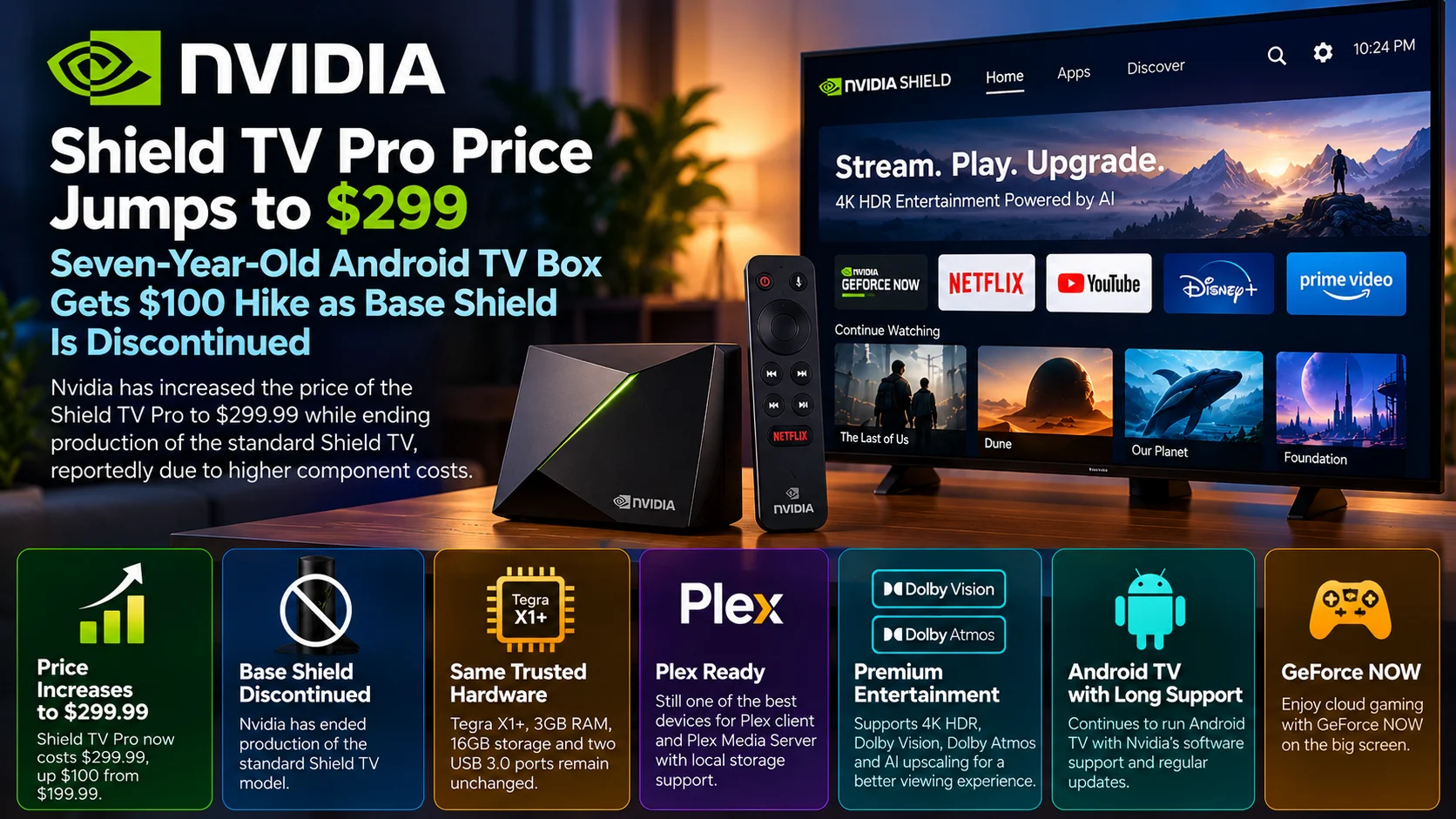
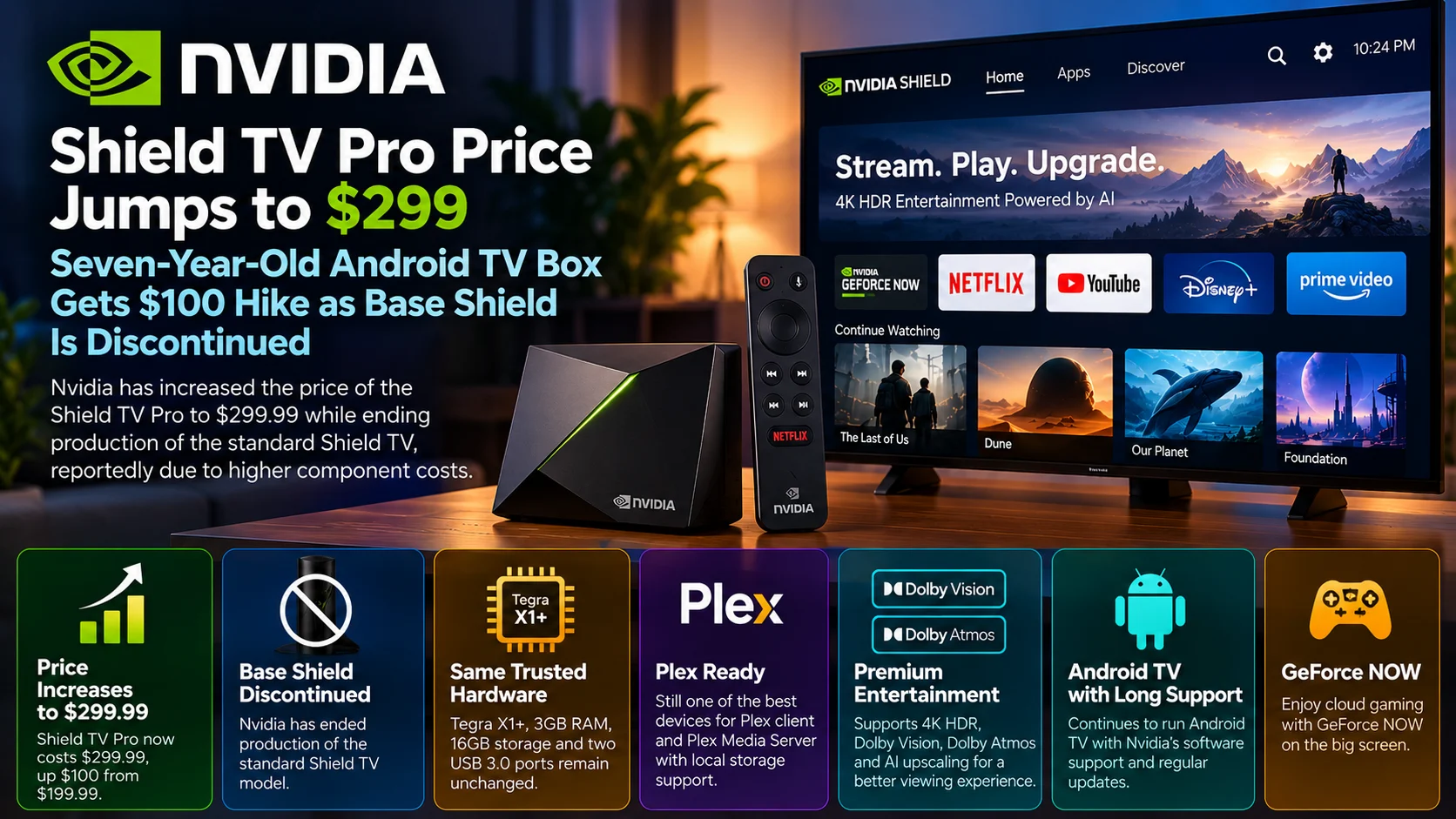
Nvidia has made an unexpected change to one of the longest-running premium streaming devices on the market: the Shield TV Pro now costs $299.99, a $100 increase from its previous $199.99 price.
At the same time, Nvidia has ended production of the standard tube-shaped Shield TV, leaving the Pro model as the main remaining device in the Shield streaming lineup. Nvidia says higher component costs, including memory, contributed to the new pricing.
The unusual part is that this is not a new Shield TV generation.
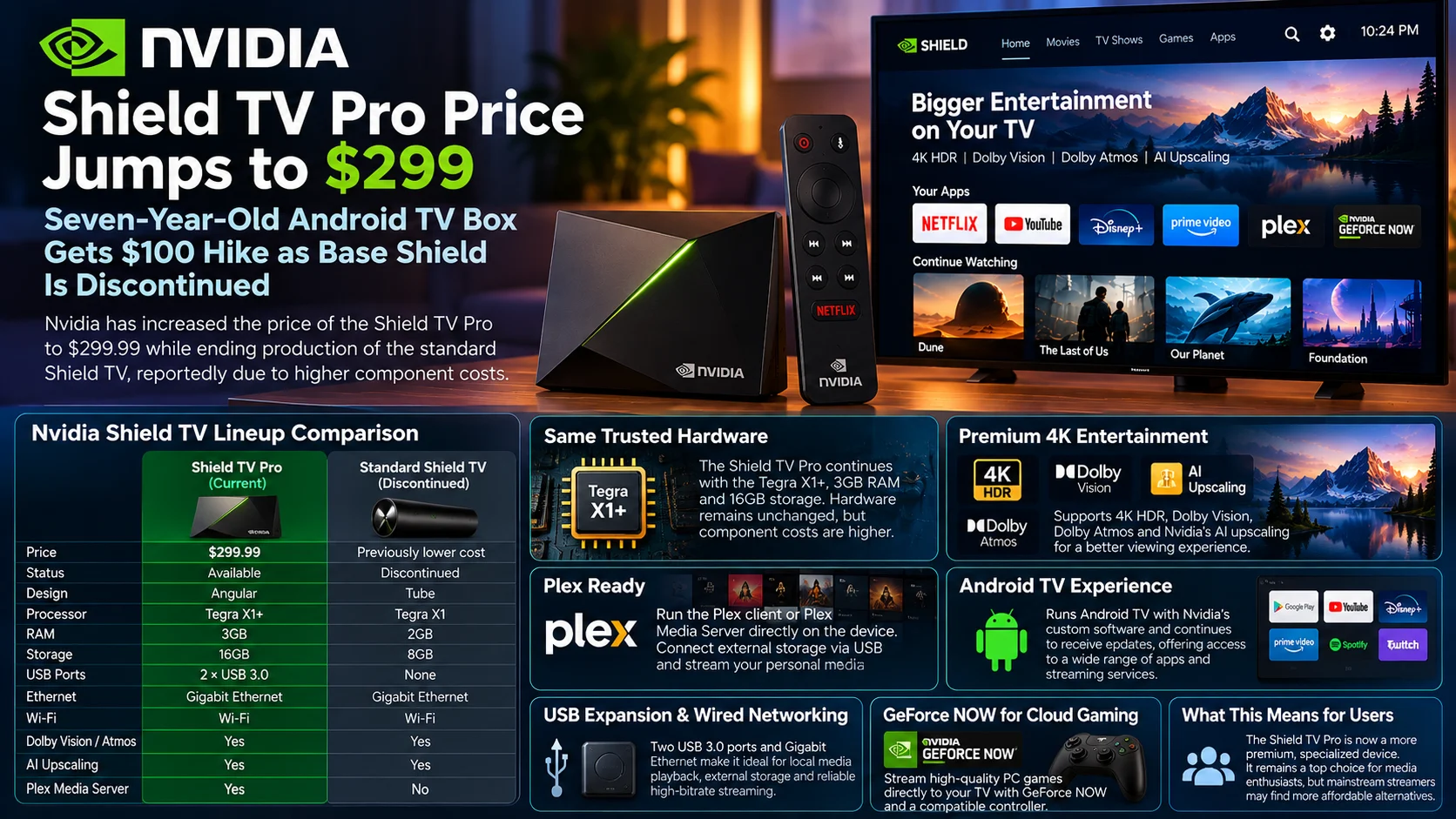
The hardware remains based around the familiar Tegra X1+ platform with 3GB of memory, 16GB of internal storage, Gigabit Ethernet, two USB 3.0 ports, and Nvidia’s AI-assisted upscaling technology.
That makes the price increase particularly significant. Consumers are being asked to pay considerably more for essentially the same hardware that has already spent years in the market.
Yet the Shield TV Pro remains difficult to replace for a specific group of users.
For ordinary Netflix and YouTube streaming, there are dramatically cheaper devices. For enthusiasts running Plex, large local media libraries, external storage, advanced audio systems, or GeForce NOW, however, the Shield still combines capabilities that many newer streaming boxes do not offer in one package.
Nvidia Shield TV Pro Price Change at a Glance
| Area | Previous Situtaion | New Situation |
|---|---|---|
| Shield TV Pro price | $199.99 | $299.99 |
| Standard Shield TV | Sold as a lower-cost model | Production discontinued |
| Processor | Tegra X1+ | Unchanged |
| Memory | 3GB RAM | Unchanged |
| Storage | 16GB internal | Unchanged |
| Expansion | Two USB 3.0 ports | Still available |
| Networking | Gigabit Ethernet, Wi-Fi | Still available |
| Premium media features | Dolby Vision, Dolby Atmos, AI upscaling | Still supported |
| Plex capability | Plex client and Plex Media Server support | Remains a major advantage |
| Software platform | Android TV | Continues receiving Nvidia software support |
Nvidia’s own Shield product page now lists the Shield TV Pro at $299 and continues to highlight Dolby Vision HDR, Dolby Atmos, AI upscaling, Plex Media Server, USB expansion, and GeForce NOW as its primary differentiators.
Why Did the Shield TV Pro Get More Expensive?
Nvidia says rising component costs are behind the change.
The company specifically pointed to increased costs for components, including memory.
That explanation is important because the Shield TV Pro remains in active production rather than being sold entirely from an old stockpile.
Manufacturing an older device does not guarantee that its production costs remain frozen.
Memory, storage, packaging, logistics, and other components still need to be sourced at current market prices.
Normally, however, consumer electronics move in the opposite direction.
Older hardware tends to become cheaper as newer generations replace it.
That is what makes this situation unusual: instead of receiving a discount late in its life cycle, the Shield TV Pro is now significantly more expensive.
For consumers waiting for the device to become cheaper, the strategy has effectively reversed.
The Standard Nvidia Shield TV Is Going Away
The price increase is only half of the story.
Nvidia has also discontinued production of the standard Shield TV.
That model used a cylindrical design and originally served as the more affordable entry point into the Shield ecosystem.
It shared many of the Pro model's core streaming features but had less memory, less storage, and fewer expansion capabilities.
The base device had already become difficult to find at major retailers, and Nvidia’s own store stopped prominently offering it before reports confirmed production had ended.
That leaves the Shield TV Pro carrying the product family on its own.
For Nvidia, simplifying the lineup may make sense if the lower-cost model no longer has enough sales volume or manufacturing margin to justify continued production.
For customers, though, it removes the cheaper way to enter Nvidia's streaming ecosystem.
Why the Shield TV Pro Still Has Loyal Users
Looking only at age and price makes the Shield TV Pro appear difficult to recommend.
Looking at its complete feature set explains why the device has survived for so long.
The Tegra X1+ processor remains sufficiently fast for Android TV navigation and high-quality media playback.
The device supports 4K HDR output, Dolby Vision, Dolby Atmos, and Nvidia’s AI upscaling feature, which can enhance lower-resolution content when displayed on a 4K television.
It also includes features increasingly uncommon on mainstream streaming boxes.
Two full-size USB 3.0 ports allow external drives and other compatible devices to be connected directly.
Gigabit Ethernet provides a reliable wired connection for high-bitrate local streaming.
Expandable storage gives enthusiasts more flexibility than fixed-storage streaming sticks.
Those capabilities matter little to someone who only watches subscription streaming services, but they can be extremely valuable in a serious home-media setup.
Plex Is Still One of Shield TV Pro’s Biggest Advantages
Plex remains one of the strongest reasons the Shield TV Pro continues to have a dedicated audience.
Most streaming devices can run the Plex client.
The Shield TV Pro goes further by supporting Plex Media Server directly on the device.
That means a Shield can act as both the playback device connected to a television and a small home Plex server.
Users can attach compatible external storage through USB, index their personal media, and make that library available to other Plex clients on the local network.
It is not necessarily the ideal replacement for a powerful NAS or dedicated server, especially for demanding transcoding workloads.
But for smaller libraries and relatively straightforward home setups, it offers something most streaming boxes cannot.
At $299.99, however, this use case becomes more complicated.
Once a streaming box reaches this price range, buyers may start comparing it with mini PCs, entry-level NAS hardware, and other devices capable of running dedicated media-server software.
Local Media Playback Remains a Major Strength
Shield TV’s reputation is also heavily tied to local media.
Many mainstream streaming devices are designed primarily around services such as Netflix, YouTube, and other cloud platforms.
Enthusiast libraries can be much more demanding.
Users may have high-bitrate 4K files, Blu-ray backups, large MKV containers, advanced surround-sound tracks, subtitle files, and content stored on local NAS systems.
For that audience, networking, codec behavior, and storage flexibility can matter more than whether the home screen has the latest visual redesign.
The Shield TV Pro’s combination of powerful hardware, Android applications, and wired networking has allowed it to remain relevant even while much newer streaming products have entered the market.
The Missing AV1 Support Is Becoming Harder to Ignore
Age does create disadvantages.
One of the most obvious is AV1.
AV1 has become increasingly important for modern streaming because it can provide improved compression efficiency compared with older codecs.
Many newer televisions, streaming devices, and chips include hardware AV1 decoding.
The Shield TV Pro predates widespread AV1 hardware support and does not offer the same modern decoding capability.
That omission was easier to accept at $199.99.
At nearly $300, buyers naturally expect fewer compromises.
This is the central tension around the Shield TV Pro's new price.
The device remains unusually capable in several enthusiast areas while simultaneously carrying hardware limitations associated with an older generation.
Android TV Is Another Consideration
The Shield TV Pro continues to run Nvidia’s customized Android TV software.
Nvidia lists the platform as Android 11 and distributes its own Shield Experience software upgrades.
Nvidia deserves credit for providing unusually long software support compared with many television devices.
Streaming hardware is often abandoned relatively quickly after manufacturers move to new models.
Shield has been different.
That long support period has helped preserve its reputation among enthusiasts.
At the same time, consumers paying $299.99 may reasonably expect a more modern software foundation than they would have accepted at the previous price.
A future hardware refresh would solve much of that concern, but the current pricing change does not introduce a new processor or platform generation.
AI Upscaling Still Differentiates the Shield
One Shield feature that remains useful is AI upscaling.
Rather than simply scaling lower-resolution video to match a 4K display, Nvidia applies machine-learning processing intended to recover more apparent detail.
The feature is especially useful for users who watch a mixture of older HD television, lower-resolution media, and modern 4K content.
Many televisions already contain sophisticated image processors, so the benefit varies by setup.
Nevertheless, Nvidia’s implementation remains one of the Shield’s recognizable differentiators.
It also demonstrates why the Tegra X1+ hardware has remained more capable than its age would suggest.
GeForce NOW Adds Another Use Case
Shield TV Pro is not only a media player.
Nvidia continues to promote GeForce NOW as a key part of the experience.
With a compatible controller, keyboard, or mouse, Shield users can stream games from Nvidia’s cloud platform to the television.
This gives the box another role that inexpensive streaming sticks may not handle as well.
Users who combine local media, Plex, cloud gaming, and premium streaming can therefore extract considerably more value from the Shield than someone buying it exclusively for video services.
Still, the higher device price changes the calculation.
Consumers now need to value several of these capabilities simultaneously for the Shield TV Pro to make sense financially.
$299 Changes the Competition Completely
At around $200, Shield TV Pro occupied a premium but understandable position.
At $299.99, expectations rise dramatically.
A buyer interested only in popular streaming services can purchase other competent streaming devices for a fraction of the cost.
Even users who want premium television hardware now have several alternatives across Apple TV, Google TV, Fire TV, Roku and smart-TV platforms.
Shield’s advantage is therefore no longer price-to-performance in a conventional streaming sense.
Its argument is specialization.
The product makes the most sense for users who specifically need combinations such as USB storage, Gigabit Ethernet, Plex Media Server, Android TV flexibility, local media compatibility, and GeForce NOW.
If those capabilities are not important, paying $299 becomes much harder to justify.
Does the Price Increase Mean a New Shield Is Coming?
There is currently no reason to assume that the higher price itself confirms an imminent new Shield generation.
The pricing change applies to the existing Shield TV Pro hardware.
Nvidia has continued supporting the platform and clearly still sees demand for it, but that is different from announcing replacement hardware.
Enthusiasts have wanted a new Shield for years, particularly one with modern codec support, newer HDMI capabilities and an updated processor.
Until Nvidia announces such a product, however, buyers should evaluate the current Shield TV Pro based on what it offers today rather than buying it in expectation of a future upgrade.
Should Existing Shield Owners Upgrade?
For most existing Shield TV Pro owners, the price increase creates no reason to replace a working unit with another identical one.
The hardware features remain essentially the same.
If a current Shield still handles local playback, Plex, streaming applications and audio correctly, keeping it is likely the most sensible option.
In fact, the new price arguably makes existing units more valuable to their owners because replacing one has become more expensive.
Users should focus on keeping their current device updated and ensuring storage and ventilation remain in good condition.
Who Should Still Buy the Shield TV Pro?
The strongest potential buyers are media enthusiasts with specific requirements.
A user who wants a wired 4K Android TV box, external USB storage, Plex Media Server functionality, strong local-media support and GeForce NOW may still find the Shield difficult to replace with one single product.
For mainstream streaming, the situation is different.
Someone whose requirements consist of Netflix, YouTube, Prime Video and other standard apps probably does not need to spend $299.99.
The higher price pushes Shield TV Pro even further away from mass-market streaming and deeper into enthusiast territory.
Final Thoughts
The Nvidia Shield TV Pro moving to $299.99 is one of the most unusual price changes in the streaming-device market.
Instead of replacing the aging product with a newer generation or lowering its price, Nvidia has raised the cost by $100 while discontinuing the cheaper standard Shield TV.
That makes Shield TV Pro an even more specialized product.
Its hardware is no longer modern in every area. AV1 is an obvious omission, and the underlying platform is much older than competing devices introduced more recently.
Yet Shield still offers a combination that is surprisingly difficult to duplicate: Gigabit Ethernet, USB expansion, Plex Media Server, powerful local-media playback, Dolby Vision, Dolby Atmos, AI upscaling, Android TV flexibility and GeForce NOW.
At $299.99, those capabilities need to matter.
For mainstream streaming viewers, Shield TV Pro has become difficult to recommend purely as a Netflix or YouTube box.
For enthusiasts running Plex servers, NAS libraries, large 4K collections and home-theater systems, the decision is more complicated.
The Shield has become more expensive without becoming newer—but it remains relevant because competitors still have not completely replaced what it does
FAQs About the Nvidia Shield TV Pro Price Increase
1) How much does the Nvidia Shield TV Pro cost now?
The Shield TV Pro is now listed at $299.99 in the United States.
2) How much did it cost before?
The previous retail price was $199.99, making the increase approximately $100.
3) Has Nvidia released a new Shield TV Pro?
No. The higher price applies to the existing Shield TV Pro hardware rather than a newly announced generation.
4) Why did Nvidia increase the price?
Nvidia says industry component costs, including memory costs, have increased substantially.
5) Is the standard Nvidia Shield TV discontinued?
Yes. Nvidia has ended production of the lower-cost standard Shield TV, leaving the Pro as the main Shield model.
6) Does Shield TV Pro still support Plex Media Server?
Yes. Plex Media Server remains one of the major differentiating features of the Pro model.
7) Does Shield TV Pro have USB ports?
Yes. It includes two USB 3.0 Type-A ports that can be used with compatible storage and accessories.
8) Does Shield TV Pro support Dolby Vision and Dolby Atmos?
Yes. Nvidia continues to advertise both Dolby Vision HDR and Dolby Atmos support.
9) Does it support AV1 hardware decoding?
The current Shield TV Pro does not provide modern AV1 hardware decoding comparable to many newer streaming platforms.
10) Is Shield TV Pro worth $299?
That depends heavily on the use case. It remains compelling for certain Plex, local-media and enthusiast setups, but ordinary streaming users can find much cheaper alternatives.
Stay Updated with the Player SDK Guide Hub
Streaming hardware changes can directly affect media playback, codecs, local libraries, Plex setups and application-development strategies.
The Player SDK Guide Hub tracks developments across Nvidia Shield, Android TV, Google TV, Fire TV, Vega OS, Roku, Apple TV, Plex, Jellyfin, Infuse, Kodi, VLC, Media3 and other media-player ecosystems.
We cover hardware changes, player releases, playback fixes, platform updates and SDK developments to explain what changed, why it matters and what users and streaming teams should watch next.
Explore the Player SDK Guide Hub for the latest streaming-device, Android TV and media-player developments.