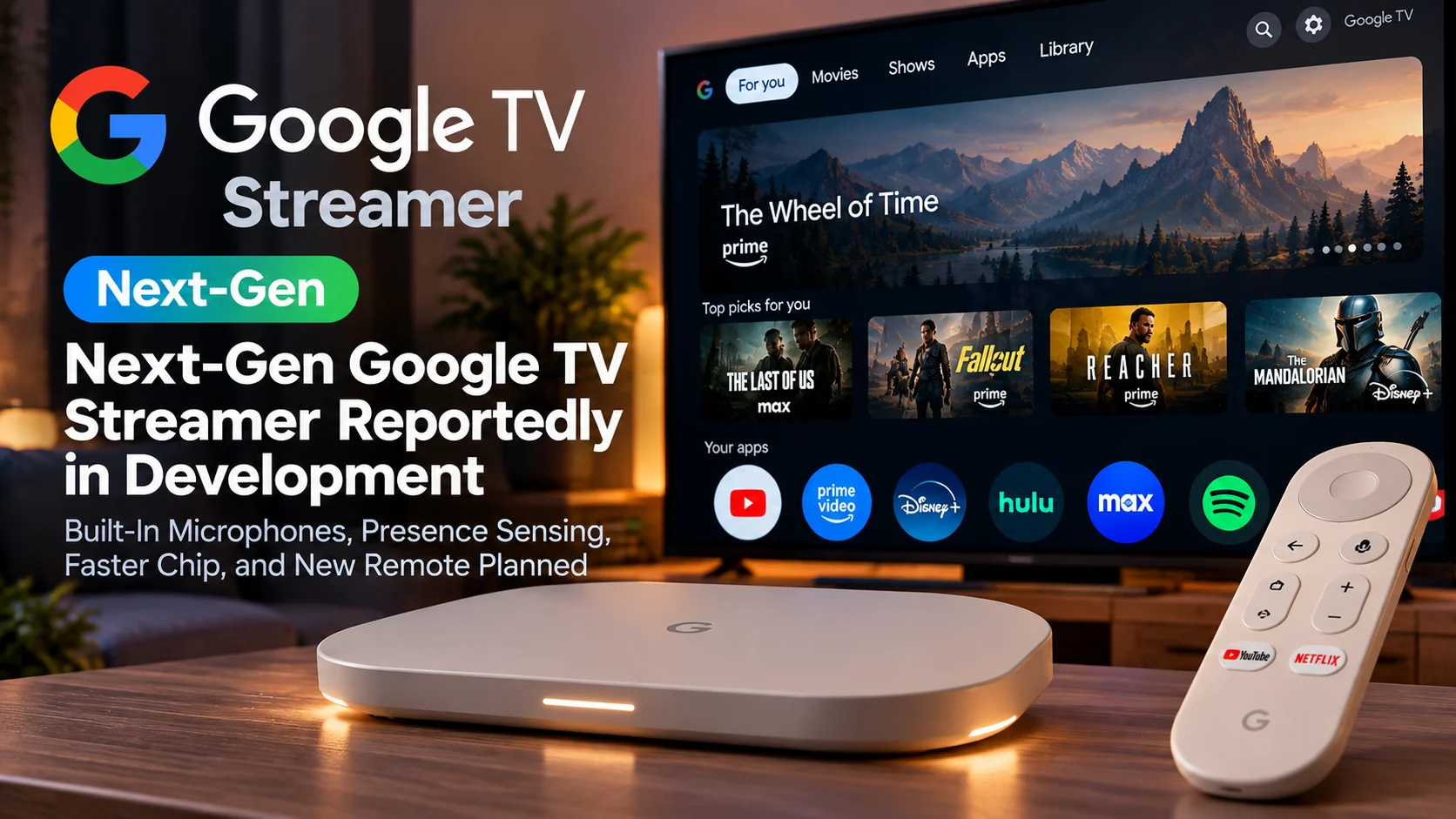
Google is reportedly developing a next-generation Google TV Streamer, and the early hardware details suggest the company may be preparing to turn its streaming box into a much more capable smart-home and entertainment hub.
According to current reporting, the upcoming model could retain the general design language of the existing Google TV Streamer while becoming slightly narrower. The bigger upgrades are expected inside the device and in how users interact with it.
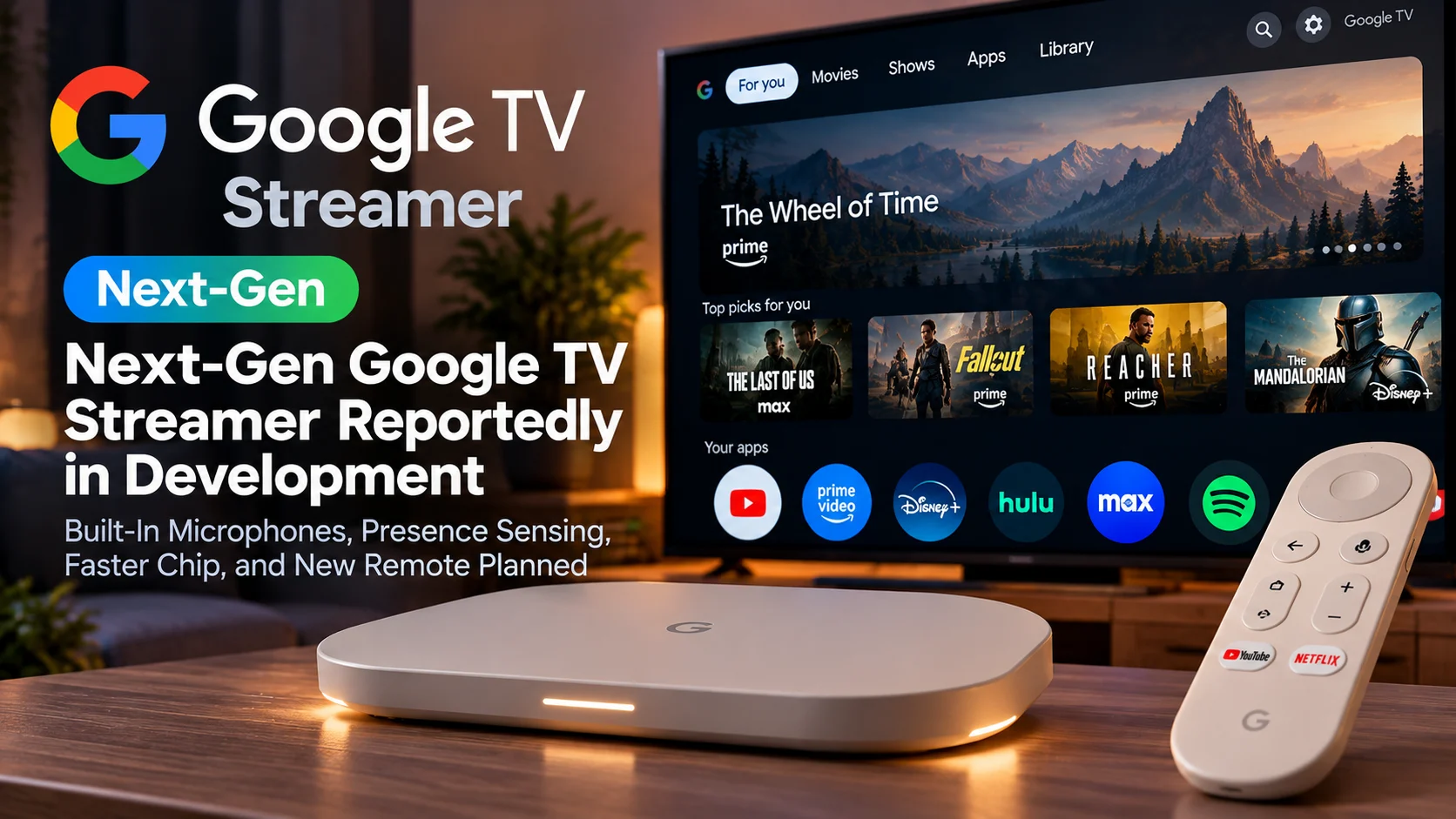
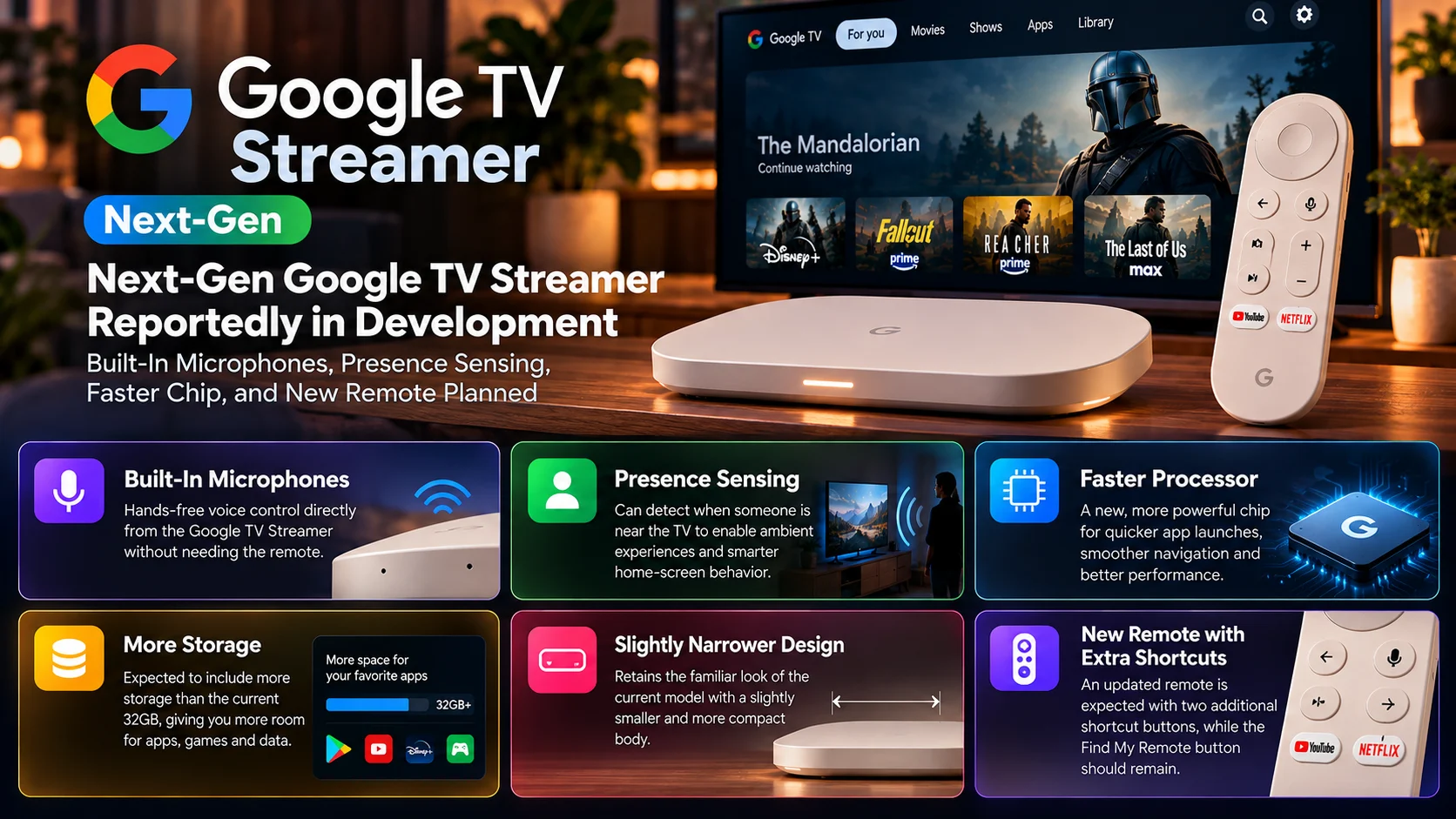
The reported feature list includes built-in microphones for hands-free voice commands, presence sensing, a faster processor, increased storage, and an updated remote with two additional shortcut buttons.
That combination would represent an interesting change in direction. Instead of focusing only on launching apps and playing movies or shows, the next Google TV Streamer could become more aware of the room around it and more deeply integrated with Google’s smart-home ecosystem.
However, the device remains reported, not officially announced. Google has not publicly confirmed the successor, its final specifications, pricing, or release plans. The details should therefore be treated as early development information that may change before a commercial product appears.
Even with that qualification, the reported upgrades provide a useful look at where Google may want its TV hardware platform to go next.
Next-Gen Google TV Streamer: Reported Upgrades at a Glance
| Area | Reported Change | Why It Could Matters |
|---|---|---|
| Voice Control | Microphones built into the streamer | Hands-free Google Assistant or Gemini-style interaction without reaching for the remote |
| Presence Sensing | Device may detect when someone approaches or enters the room | Could enable ambient information and smarter home-screen behavior |
| Processor | Faster chipset planned | Potentially quicker app launches, navigation and heavier smart-TV features |
| Storage | More than the current 32GB capacity | More room for apps, games, downloads and cached data |
| Design | Slightly narrower body | Maintains the current style while reducing the device footprint |
| Remote | Two additional shortcut buttons | Faster access to frequently used services or functions |
| Find My Remote | Hardware button expected to remain | Makes locating a misplaced remote easier |
Built-In Microphones Could Change How Google TV Is Used
The most interesting reported change is the addition of microphones directly to the Google TV Streamer.
The current style of television voice control normally depends on pressing a microphone button on the remote before speaking. That works, but it still requires the user to find and hold the remote.
Built-in microphones would remove that dependency.
Users could potentially issue a hands-free command, such as asking Google to play a show, pause media, adjust connected smart-home devices, or search for content without physically touching the controller.
For a device positioned underneath a television, that could make voice interaction feel much closer to using a smart speaker.
The success of this feature would depend heavily on microphone quality, wake-word detection, and privacy controls. A television environment can contain background music, conversations, and loud movie audio, so reliable far-field voice detection would be essential.
If Google gets that right, the streamer could become one of the easiest ways to add room-wide voice control to a television setup.
Hands-Free Commands Could Strengthen the Smart-Home Role
Built-in microphones would also make sense if Google wants the TV Streamer to become a stronger smart-home hub.
Modern televisions often sit in central rooms such as the living room, where people already interact with lights, cameras, thermostats, speakers, and other connected devices.
A Google TV Streamer that can hear voice commands independently could provide another always-available control point.
Instead of finding a phone or remote, a user could theoretically ask the television to show a compatible camera, adjust lighting, or provide information while moving around the room.
This could be particularly useful when paired with Google Home functionality already available through the broader Google ecosystem.
It would also make the streaming device more competitive with entertainment hardware that increasingly combines playback and smart-home features.
Presence Sensing May Be the More Interesting Long-Term Feature
The reported addition of presence sensing could have even broader implications.
Presence sensing allows a device to understand whether someone is near the television without requiring a button press or direct interaction.
Google TV has already demonstrated the concept of adapting a television experience based on whether a person is nearby.
On compatible systems, approaching the television could potentially trigger an ambient experience showing useful information such as weather, time, or other contextual data.
A next-generation streamer with dedicated presence sensing could bring that type of functionality directly to Google’s own hardware.
Instead of the TV being either fully active or completely idle, the screen could respond more intelligently to what is happening in the room.
Google TV Could Become an Ambient Display
Presence sensing creates opportunities beyond simply waking the interface.
When nobody is nearby, the system could prioritize low-distraction artwork or a screensaver.
When someone approaches, additional information could become visible.
That might eventually include weather information, upcoming events, smart-home status, or media suggestions.
The important idea is that the television could become useful even before the user actively opens an app.
Such behavior would move Google TV closer to an ambient computing model where the display adapts to the person rather than requiring every interaction to begin with the remote.
Exactly how Google would implement this on the reported streamer remains unknown, but the hardware capability opens several possibilities.
A Faster Processor Is an Important Upgrade
A faster chip may sound less exciting than presence sensing, but it could be one of the most important improvements in daily use.
Streaming boxes increasingly need to handle more than basic video playback.
Modern interfaces contain high-resolution artwork, animated transitions, live recommendations, smart-home panels, voice features, and increasingly sophisticated software.
Applications themselves are also becoming heavier.
A faster processor could improve app startup time, menu responsiveness, and transitions throughout Google TV.
It could also give Google additional performance headroom for future features without making the interface feel sluggish.
For users who keep a streaming device for several years, extra processing power can have significant long-term value.
More Storage Would Address a Common Limitation
The next Google TV Streamer is also reportedly expected to include more storage than the current model’s 32GB capacity.
Additional storage would be welcome for users who install many applications.
Streaming apps themselves are not always large, but their cached data can grow over time. Games and other entertainment apps can consume substantially more space.
Users who experiment with media players, smart-home tools, and additional Android applications can also fill storage more quickly than expected.
Increasing capacity would give users more flexibility while reducing the need to constantly manage installed applications.
More storage could also become increasingly useful if Google expands gaming, offline content, or other download-heavy features.
A Slightly Narrower Design Is Reportedly Planned
The external design may not change dramatically.
Reports suggest that Google intends to retain the same general approach while making the device slightly narrower.
That would be a sensible evolution.
The existing Google TV Streamer uses a low-profile tabletop design rather than the hidden dongle format associated with older Chromecast hardware.
Keeping that visual identity would help Google establish the Streamer as a recognizable hardware family.
A smaller footprint could also make placement easier on crowded TV stands.
The important changes appear to be concentrated on microphones, sensors, and internal hardware rather than a dramatic redesign.
The Remote Could Gain Two More Shortcut Buttons
The included remote is also reportedly being updated.
Its basic design is expected to remain familiar, but two additional shortcut buttons could join the existing dedicated service buttons.
Exactly how those buttons will be assigned in the final product remains an important question.
Dedicated shortcuts can be convenient when they match services a household regularly uses, but fixed buttons can be less useful when users prefer different platforms.
The best implementation would give users some level of customization.
If Google allows additional buttons to launch apps, smart-home actions, or other functions selected by the user, the new remote could become significantly more useful.
For now, the report simply points to two additional shortcuts.
Find My Remote Should Remain Useful
The physical Find My Remote button on the streaming device is also expected to remain.
This is one of those features that sounds minor until the remote disappears between sofa cushions.
Because the button exists on the streamer itself, users do not need another device simply to locate the controller.
Keeping the feature on the next-generation hardware would be a sensible decision, especially if the new remote becomes even more central to navigation.
Combined with hands-free voice interaction, Google could provide users with several different ways to control the TV rather than relying on one input method.
Faster Hardware Could Improve More Than Navigation
It is tempting to view a processor upgrade mainly as a way to make menus faster, but a stronger chipset could matter in several areas.
Higher-performance hardware could help with complex interface rendering, voice processing, future AI-assisted functionality, and smart-home workloads.
It may also provide more flexibility for demanding media applications and advanced video playback.
The exact processor has not been reported, so it would be premature to speculate about specific codec, gaming, or graphics improvements.
What matters is that Google reportedly recognizes the need for more performance rather than keeping the internal hardware largely unchanged.
The Device Could Become More Than a Streaming Box
The combination of built-in microphones, presence detection, stronger hardware, and increased storage suggests Google may be thinking beyond traditional streaming.
A conventional TV box waits for a remote command.
A more advanced Google TV device could instead understand when users are present, accept voice requests from across the room and surface smart-home information alongside entertainment.
That makes the television part of a broader connected-home interface.
Google has multiple reasons to pursue that direction.
The TV is one of the largest screens in most homes, it is often placed in a shared room and it already remains connected to power and the network.
Adding sensors and microphones allows Google to use that position more effectively.
Privacy Controls Will Be Extremely Important
Built-in microphones and presence sensing will inevitably raise privacy questions.
Users will want to know when microphones are active, how presence is detected and whether either feature can be disabled.
Clear hardware indicators and easily accessible settings would be particularly important.
Some users may love hands-free voice controls but prefer not to use presence sensing.
Others may want neither feature enabled.
Google will need to provide straightforward controls if the reported hardware reaches the market.
Good smart-home functionality should provide convenience without forcing users into features they do not want.
Several Major Details Remain Unknown
Despite the amount of reported information, there is still plenty we do not know.
Google has not officially announced the device.
There is no confirmed processor model, exact storage capacity, final remote configuration, price or release schedule.
We also do not know precisely how presence sensing would work or how much of the processing would happen locally.
Even the hardware currently being tested could change before release.
That is why the next-generation Google TV Streamer should currently be viewed as a reported product in development, not a finalized retail device.
Final Thoughts
The reported next-generation Google TV Streamer could be a more significant upgrade than a simple processor refresh.
Built-in microphones could bring hands-free interaction directly to the living room. Presence sensing could allow the television to respond more intelligently when people enter or approach the room. A faster processor and increased storage would address the practical hardware side of the upgrade, while the new remote could make everyday navigation more convenient.
Together, these features suggest Google may want the Streamer to evolve from a conventional entertainment box into a broader smart-home device.
The key limitation is that none of this represents a finished public announcement yet.
Final specifications, pricing, availability and exact software behavior remain unknown.
Still, if the reported development plans make it into the shipping product, the next Google TV Streamer could become one of Google’s most interesting living-room hardware updates.
FAQs About the Next-Gen Google TV Streamer
1) Is Google officially launching a new Google TV Streamer?
Google has not officially announced the next-generation model. Current information comes from reporting about a device said to be under development.
2) Will the new Google TV Streamer have built-in microphones?
Reports indicate that microphones are planned directly on the streaming device, potentially enabling hands-free voice commands.
3) What is presence sensing?
Presence sensing allows a device to detect when someone is nearby. On a TV platform, this could be used to show ambient information or alter the interface when a person approaches.
4) Will users still need the remote for voice commands?
If built-in microphones operate as reported, some voice interactions could work without pressing the microphone button on the remote.
5) Is the processor being upgraded?
A faster processor is reportedly planned, although the exact chipset has not been confirmed.
6) Will the next Google TV Streamer have more storage?
Yes, current reports suggest capacity will increase beyond the existing model’s 32GB, but the final amount has not been revealed.
7) Is Google redesigning the remote?
The remote is reportedly receiving two additional shortcut buttons while maintaining a broadly familiar design.
8) Will Find My Remote still be available?
The hardware button used to locate the remote is reportedly expected to remain on the streaming device.
9) Has the price been confirmed?
No. Pricing for the reported next-generation model has not been announced.
10) Should existing Google TV Streamer owners upgrade now?
There is no officially released successor yet, so users should wait for confirmed specifications before making an upgrade decision based solely on development reports.
Stay Updated with the Player SDK Guide Hub
Streaming hardware is rapidly expanding beyond simple app playback. Voice interaction, smart-home controls, presence awareness, faster processors and increasingly intelligent television interfaces are changing what users expect from devices connected to the biggest screen in the home.
The Player SDK Guide Hub tracks important developments across Google TV, Android TV, Fire TV, Roku, Apple TV, Emby, Jellyfin, Plex, Kodi and modern video-player platforms.
We cover hardware reports, platform updates, media-player releases, playback changes and developer-focused developments to explain what changed, what is confirmed, what remains reported and why it matters for users and developers.
Follow the Player SDK Guide Hub for the latest streaming-device, media-server and video-player updates.