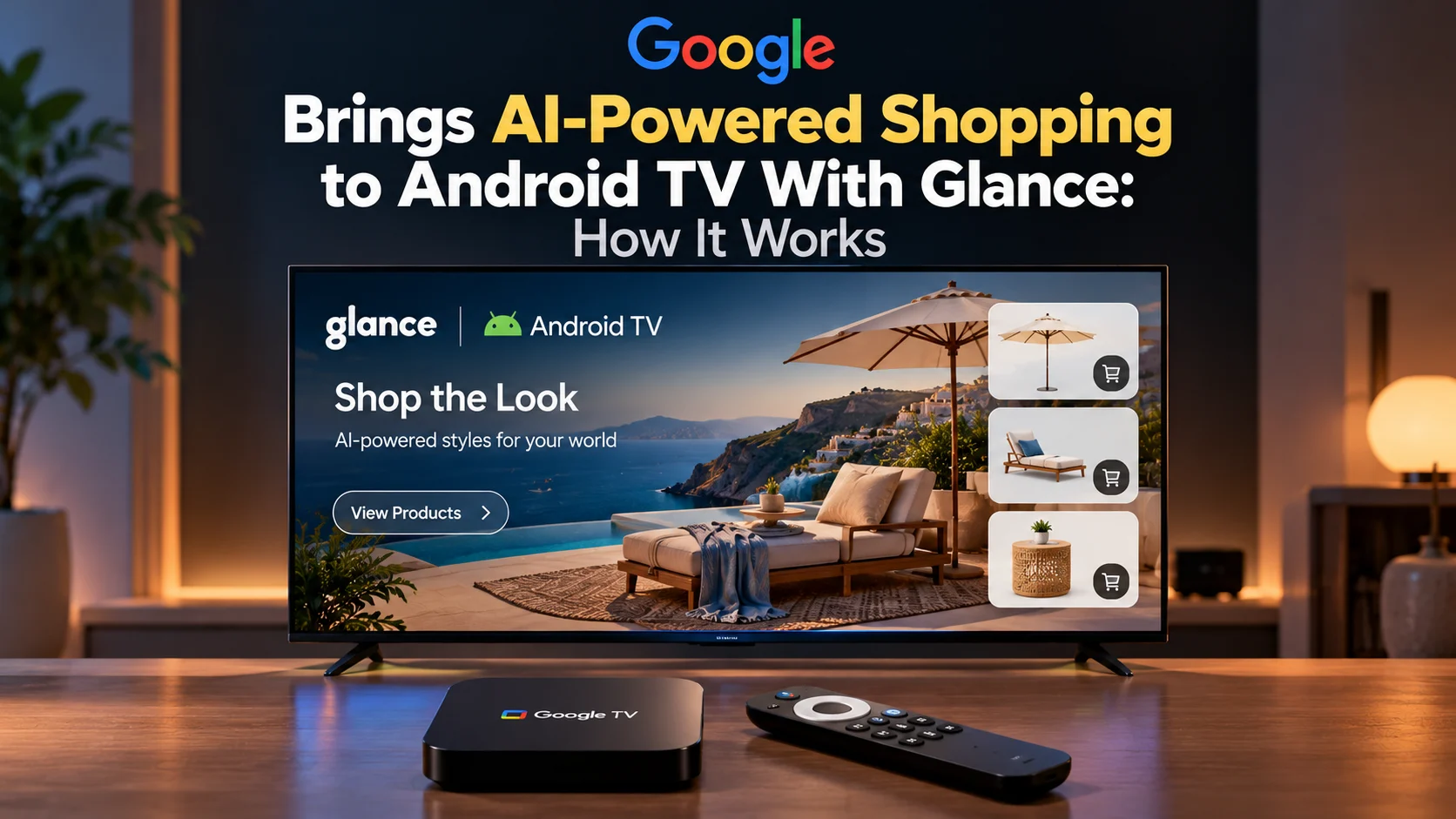
Until now, people have mainly used the television to launch streaming apps, play videos, browse recommendations, and occasionally leave an ambient screensaver running when nothing is playing.
Google and Glance now want that idle screen to become a personalized shopping and discovery surface. Through a new partnership, Glance is bringing its AI-powered commerce experience to supported Android TV devices in the United States, India, and Japan.
Instead of showing only a traditional backdrop when the television is idle, users can opt into a Glance experience that surfaces personalized lifestyle content, AI-generated looks, and products they can explore through participating retailers.
The result is an unusual combination of Android TV, generative AI, and shopping. And importantly, it happens primarily around the TV’s ambient experience rather than appearing over the movie or show you are watching.
What Is Glance AI on Android TV?
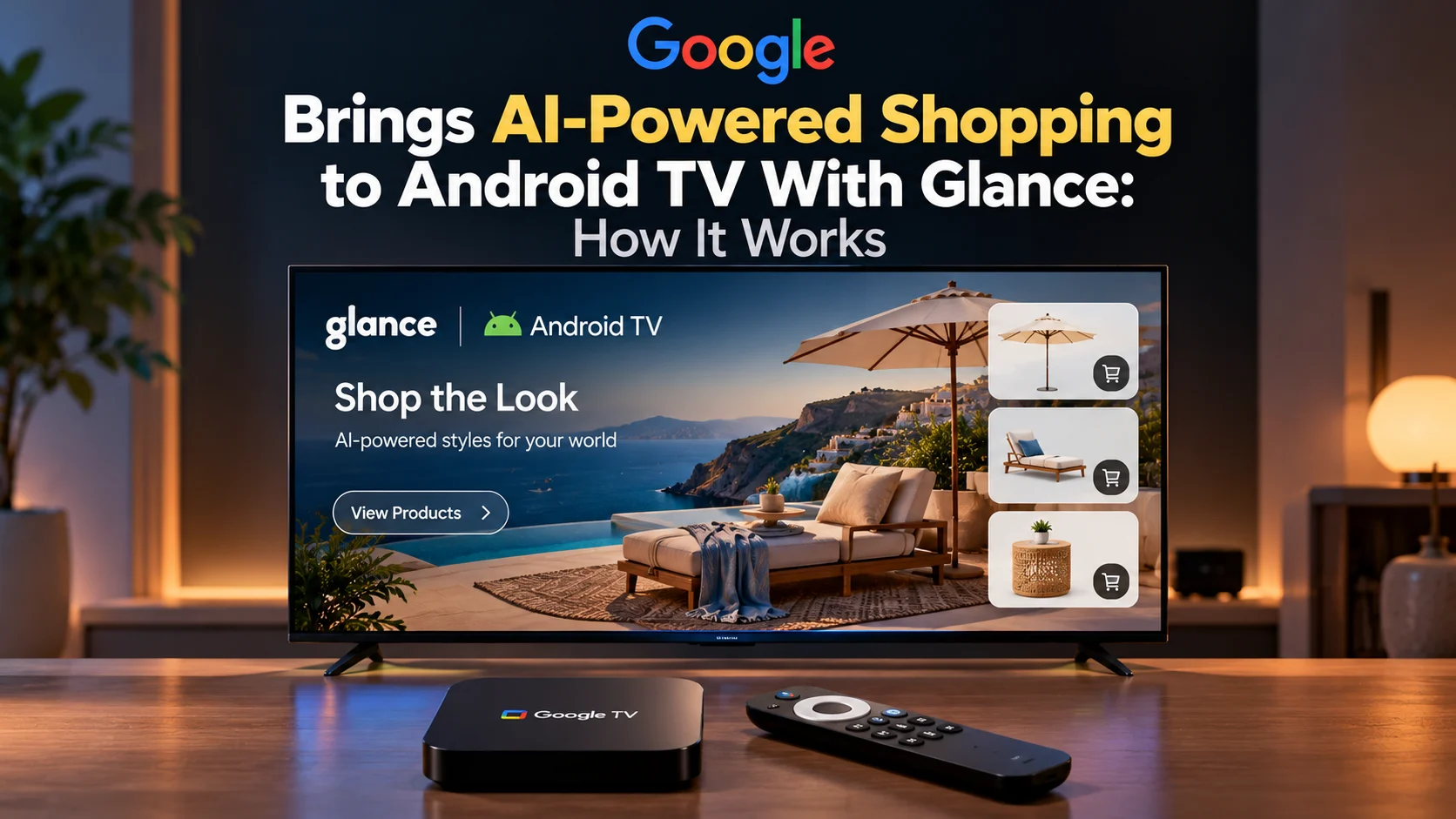
Glance AI on Android TV is an optional AI-powered shopping and discovery experience designed for the television’s ambient screen.
Instead of leaving the TV on a static background, supported Android TVs can display personalized fashion, travel, food, wellness, and lifestyle recommendations.
The experience can show curated looks, suggest products, and help users move from visual inspiration toward items available from retail partners.
Glance describes the system as an intelligent shopping agent that works across multiple surfaces rather than being limited to a traditional shopping application.
The feature is available only on supported hardware and is not equivalent to saying that every Android TV or Google TV device automatically receives it.
Glance AI on Android TV at a Glance
| Features | What It Does | Why It Matters |
|---|---|---|
| AI Ambient Screen | Replaces the normal idle backdrop with personalized content | Makes an unused TV screen interactive |
| Shop the Look | Connects curated looks with purchasable products | Turns visual discovery into shopping |
| AI Personalization | Adjusts recommendations based on preferences and context | Makes suggestions more relevant |
| AI-Generated Looks | Creates styled visual combinations and fashion inspiration | Helps users explore possible styles |
| Lifestyle Discovery | Includes fashion, travel, food, and wellness | Extends beyond traditional TV content |
| Retail Integration | Links selected items to participating retailers | Provides a path from inspiration to purchase |
| Opt-In Control | Users choose whether to enable Glance | Keeps the feature optional |
| Multi-Screen Experience | Works alongside mobile and other Glance surfaces | Lets discovery continue beyond the television |
How Does Glance AI Shopping Work on Android TV?
The idea begins with the television’s idle state. Normally, when an Android TV is not actively playing something, it may display Google Backdrop, artwork, photos, or another screensaver-style experience.
Glance changes that space. Users on compatible hardware can choose the Glance ambient experience, allowing the screen to display high-resolution lifestyle content and shopping inspiration.
The system can surface fashion looks, travel ideas, food-related content, wellness recommendations, and other visual categories.
Glance says its TV platform is designed to turn the connected television into a discovery and shopping surface rather than leaving the display mostly passive. The key difference is that the TV is being used before the viewer opens a traditional streaming app.
Is Shopping Shown While You Watch Movies?
The announced Android TV integration is centered on the ambient or idle screen.
That means the shopping experience is not supposed to randomly place product recommendations over the movie you are watching.
Users choose the Glance experience in place of the standard backdrop or screensaver.
That distinction is important because headlines about “shopping on Android TV” can make the feature sound much more intrusive than the actual implementation.
Glance is trying to make use of moments when the television is already idle.
What Is “Shop the Look”?
Shop the Look is one of the central commerce features.
The TV can present a complete visual style rather than starting with a list of individual products.
A viewer may see a fashion look and then explore products connected to that style through participating retailers.
Glance describes its commerce platform as moving shopping away from traditional search-first behavior and toward visual inspiration and personalized recommendations.
That changes the normal shopping sequence.
Traditional online shopping usually starts with:
Search → Filters → Product page → Compare → Buy
Glance is trying to make it more like:
See a look → Get inspired → Explore matching products → Shop
On a large TV screen, that visual-first model arguably makes more sense than displaying tiny product grids designed for a phone
Does Glance Use Generative AI?
Yes.
Generative AI is a major part of Glance’s platform.
The company says its system combines a Commerce Intelligence Model, a GenAI Experience Model, and a User Understanding layer to create personalized shopping experiences across devices.
The AI can generate visual styling ideas and recommend products based on the user’s context and preferences.
Glance also offers AI-generated personal looks through its broader shopping platform.
Its Google Play TV listing describes a workflow where users can generate AI-styled looks and then view them on the television.
Users should treat these generated visuals as inspiration rather than an exact guarantee of how a garment will physically fit.
Real-world sizing, color, material, and availability still depend on the retailer and product.
Does It Work With Your Phone Too?
This is one of the more interesting parts of Glance’s approach.
The company does not describe its AI shopping system as something that belongs only to the TV.
Its broader strategy is built around one shopping intelligence layer across multiple devices.
A user can interact with Glance on mobile, discover a look, refine preferences, and then potentially see related experiences on a television.
Glance calls this a cross-surface model, with the shopping agent designed to follow users across different parts of the ecosystem.
That makes the TV less like an isolated shopping application and more like another screen in the same discovery journey.
Which Countries Get Glance on Android TV?
The Google partnership is launching across the United States, India, and Japan.
However, availability is device-specific.
The announcement refers to supported Android TV devices, not every product running Android TV or Google TV.
Glance and Google have not published a universal compatibility list covering every manufacturer and model.
That means users should not assume the feature will appear simply because their television runs Android TV.
Regional rollout, device manufacturer support, and firmware can all affect availability.
Is Glance Enabled Automatically?
The important user-facing shopping experience is opt-in.
Users choose whether to replace their normal Google Backdrop-style ambient experience with Glance.
That control matters.
A shopping-focused screensaver is useful only for people who actually want that kind of discovery.
Someone who prefers a traditional photo or artwork screensaver can keep the existing experience instead.
This also makes the rollout different from advertising that simply appears automatically on a home screen.
Is This Android TV or Google TV?
The partnership announcement specifically refers to Android TV devices.
That matters because Android TV OS is the underlying platform used across many television products, while Google TV is a newer interface and discovery experience built on top of Android TV OS.
The two terms are often used interchangeably in everyday discussions, but they are not the same thing.
Compatibility will depend on the supported device rather than the branding printed on the home screen.
PlayerSDK’s Streaming Device Comparison is useful for comparing Android TV and Google TV hardware with other streaming platforms based on operating system, storage, HDR formats, and connectivity.
How Is This Different From Gemini on Google TV?
Glance and Gemini solve different problems.
Gemini for Google TV is Google's conversational AI layer for the television.
It can help users discover entertainment, ask questions, search Google Photos, and interact with TV settings using natural language.
Google has also been expanding Gemini with visually rich responses and AI-generated media capabilities on supported Google TV devices.
Glance is more directly focused on shopping and lifestyle discovery.
Gemini helps you talk to the television.
Glance helps turn an idle television into a personalized commerce surface.
The two experiences show how rapidly smart televisions are moving beyond being simple app launchers.
PlayerSDK has also covered the reported next-generation Google TV Streamer, which points toward a similar broader trend: streaming hardware is increasingly becoming part entertainment device, part smart-home interface and part AI platform.
Does This Change Video Playback?
No.
Glance AI is not a media player and does not change how Android TV handles video codecs, subtitles, HDR, or audio formats.
If you are watching content through Plex, VLC, Kodi, or another video player, those applications still control the playback experience.
Glance operates at the platform and ambient-discovery level.
PlayerSDK’s Media Player Comparison can help users compare actual playback software based on codec support, network playback, subtitles, and other media features.
That separation is useful because “smart TV AI” and “video playback quality” are very different parts of the television experience.
What Data Does Glance Use?
Personalization naturally raises privacy questions.
Glance says its AI systems use contextual and behavioral signals to improve recommendations.
Its broader platform documentation describes signals such as interaction patterns, regional preferences, device information, and content engagement.
The company’s TV privacy policy also explains that AI-powered features may process user inputs and provide personalized product or content recommendations.
Users considering the experience should review the privacy settings and permissions presented on their specific device.
The TV app’s Google Play listing also includes developer-provided data-safety information, which may vary depending on the particular Glance application and region.
Why Is Google Adding Shopping to Android TV?
The television home screen has become strategically valuable.
People may spend hours watching content, but the device also spends plenty of time sitting idle.
Turning that unused screen into a discovery surface gives Android TV another way to keep users engaged.
For Google, the partnership adds another type of interactive experience to the Android TV ecosystem.
For Glance, it expands distribution to more television households.
The official announcement describes the partnership as a way to turn the ambient screen from a passive backdrop into an interactive AI-powered portal for commerce and discovery.
That is probably the clearest explanation of the strategy.
Could Shopping Become a Bigger Part of Smart TVs?
Very likely.
Glance is not the only company exploring commerce on large screens.
The company already supports TV-based shopping experiences through other distribution partners, and its connected-TV business explicitly includes ambient screens, content commerce, and dedicated TV shopping experiences.
Smart TVs are becoming platforms rather than simple displays.
They already combine streaming, gaming, smart-home controls, recommendations, voice assistants, and advertising.
Shopping is a logical next layer.
The bigger question is whether users find it genuinely helpful or simply see it as another attempt to monetize the home screen.
The opt-in design will be important in answering that.
What Are the Main Limitations?
The first limitation is compatibility.
Glance is not available on every Android TV device.
The second is regional availability.
The current Google partnership focuses on three markets.
The third is retail coverage.
A product recommendation is only useful if the relevant brand, size, price and inventory are available through participating retailers.
Finally, AI-generated fashion visuals should not be mistaken for a physical fitting.
They are designed to help users imagine styles and discover products, not guarantee real-world sizing.
Those limitations do not make the concept less interesting.
They simply define what the technology can realistically do today.
Final Verdict
The Google and Glance Android TV partnership represents a notable change in how companies think about the television when nobody is actively watching a video.
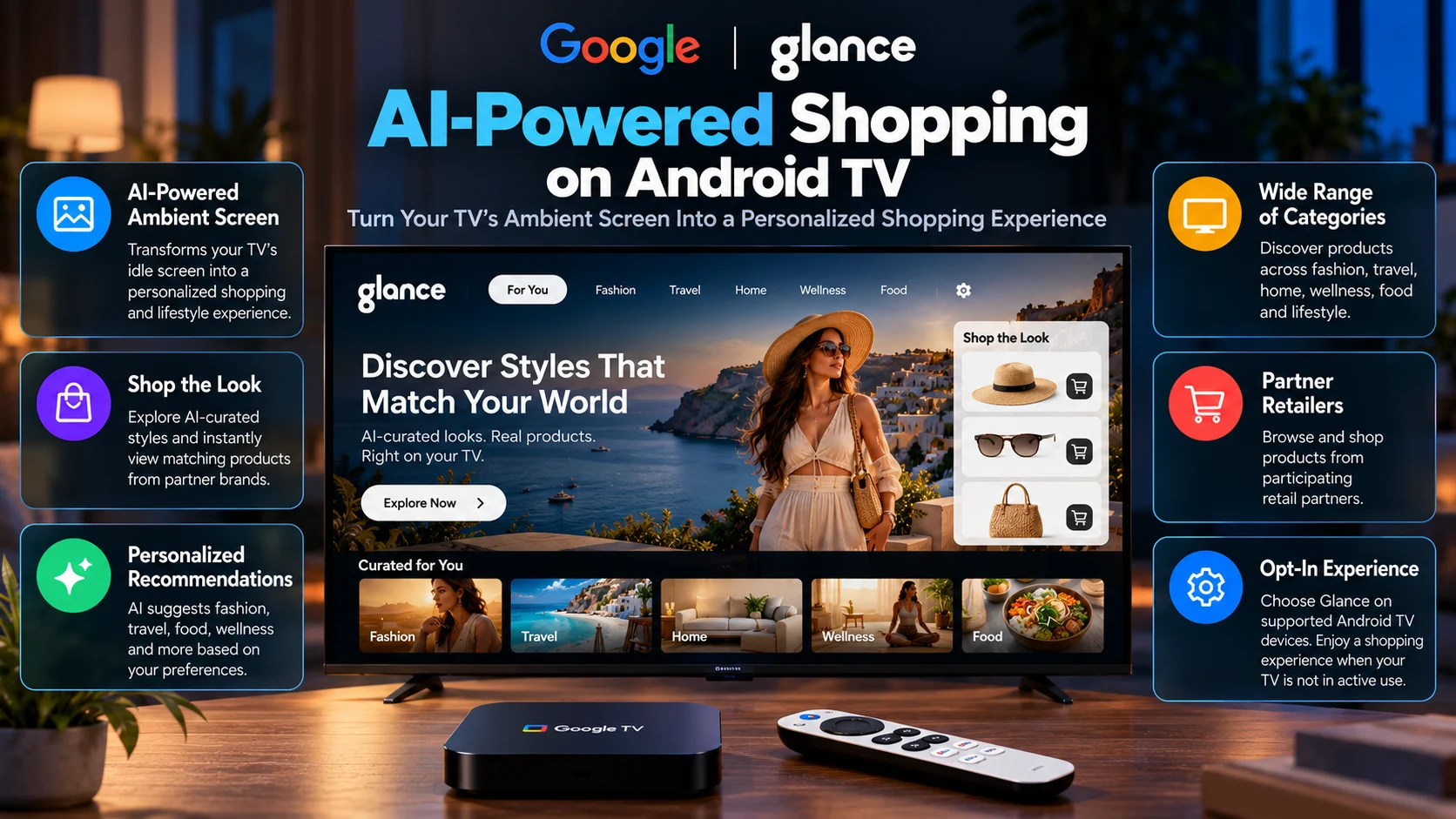
Instead of leaving the screen on a static image, supported Android TVs can now become personalized shopping and lifestyle discovery surfaces.
Glance brings AI-powered recommendations, Shop the Look, generative styling and retail discovery to the ambient experience, while Google provides access to a major television platform.
The strongest part of the implementation is that it is optional.
Users who want a traditional screensaver can keep one.
Users who want a more interactive TV experience can opt into Glance.
The feature does not replace Google TV, Gemini or video players.
It sits alongside them as another layer of the evolving smart-TV experience.
The television is no longer just a screen for watching movies.
Increasingly, it is becoming an AI-powered interface for entertainment, discovery, communication and now shopping.
Frequently Asked Questions
1) What is Glance AI on Android TV?
Glance AI is an optional shopping and lifestyle discovery experience that can run on the ambient screen of supported Android TV devices. It uses AI to surface personalized looks, products, and visual content.
2) Is Glance AI available on every Android TV?
No. The partnership currently refers to supported Android TV devices, and compatibility varies by hardware and region.
3) Where is Glance available?
The Google partnership is launching on supported devices across the United States, India, and Japan.
4) Does Glance replace Google Backdrop?
Users can choose the Glance ambient experience instead of the normal Google Backdrop-style screen. The shopping experience is opt-in.
5) Can you shop directly from Android TV?
Glance allows viewers to discover products and use Shop the Look to move toward purchases through integrated retail partners. Exact purchase flow can depend on the retailer and device implementation.
6) Does Glance show ads over movies?
The announced experience is centered on the television's idle or ambient screen rather than overlaying shopping content on active video playback.
7) What is Shop the Look?
Shop the Look connects AI-curated lifestyle or fashion visuals with related products available from participating retailers.
8) Does Glance use generative AI?
Yes. Glance uses generative AI and commerce intelligence models to build personalized shopping and visual experiences.
9) Is Glance the same as Gemini on Google TV?
No. Gemini is Google's conversational AI experience for television. Glance is focused primarily on personalized shopping and lifestyle discovery.
10) Does Glance affect Plex, VLC, or other video players?
No. Glance operates at the TV platform and ambient layer. Video players still handle codecs, local files, subtitles, and media playback independently.
Build a Smarter Android TV Setup
AI-powered shopping is one example of how quickly Android TV is changing, but your day-to-day experience still depends on the hardware and media software behind the screen.
Use PlayerSDK’s Streaming Device Comparison to compare Android TV and Google TV hardware with other popular streaming platforms based on performance, HDR support, connectivity, storage, and device capabilities.
If you also play local media, network files, or specialized video formats, explore PlayerSDK’s Media Player Comparison to compare players by codec support, playback features, and platform compatibility.
Compare the platform, device, and player together—then build a setup that works for entertainment first, while letting you choose which new AI features actually add value.