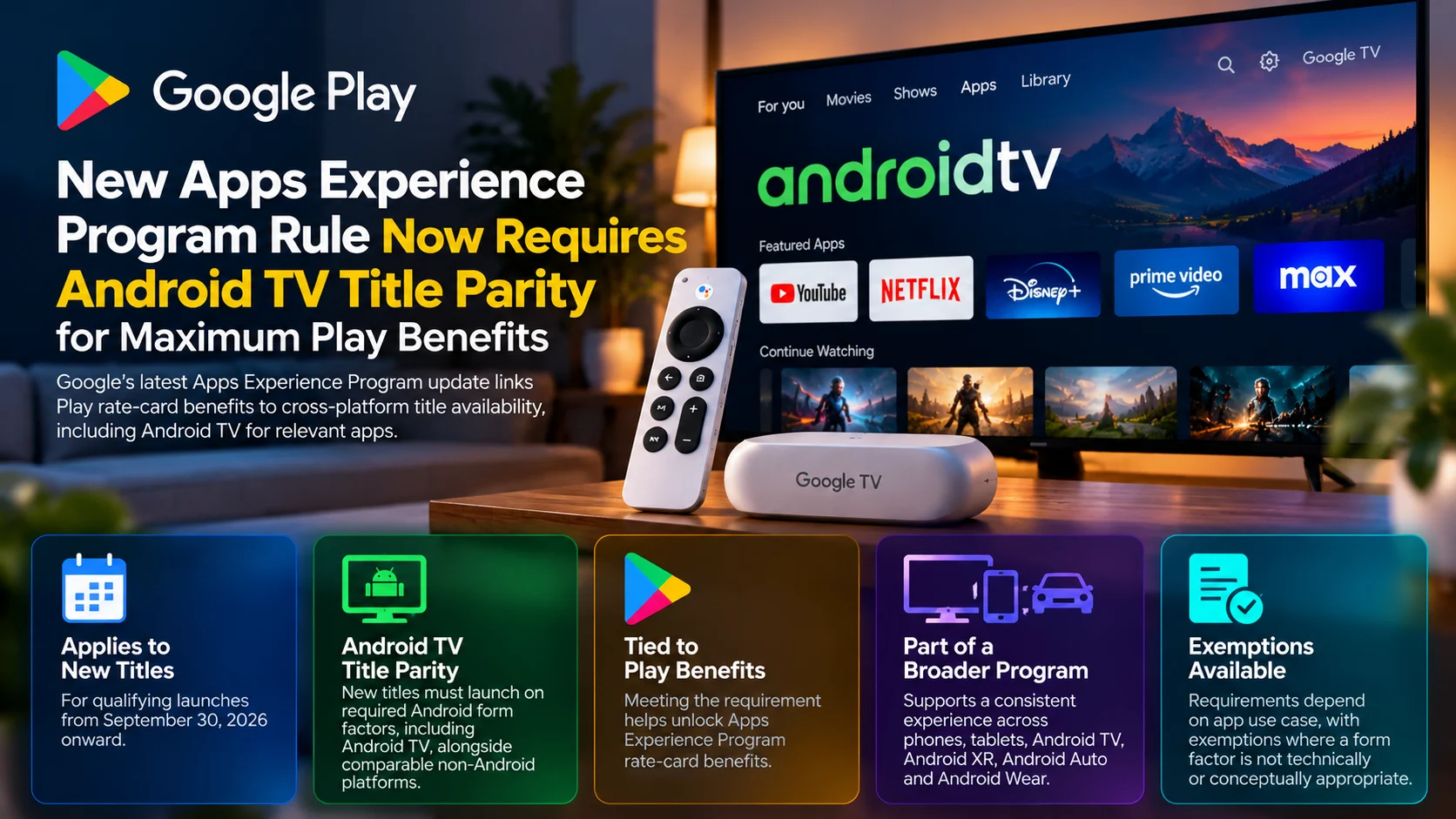
Google has introduced a new cross-platform requirement through its Apps Experience Program, and Android TV developers, especially those building video and audio streaming apps, should pay close attention.
Beginning with titles launched from October 1, 2026, onward, apps seeking the Apps Experience Program’s rate-card benefits are expected to launch on required Android form factors at the same time they become available on comparable non-Android platforms.
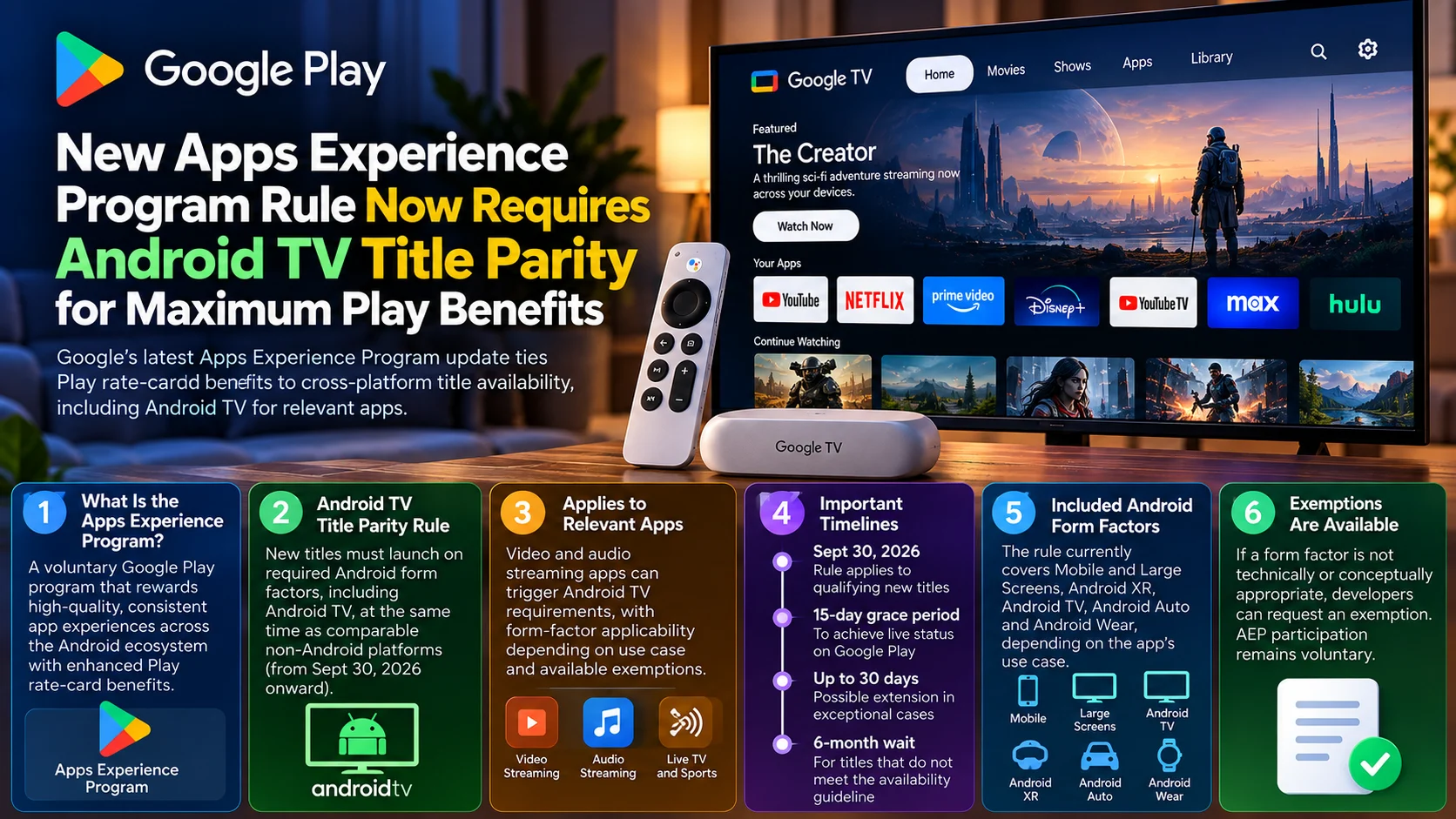
The currently listed Android form factors include mobile and large screens, Android XR, Android TV, Android Auto, and Android Wear. However, which form factors a particular application actually needs to support depends on its use case and available exemptions.
For streaming companies, this makes Android TV especially important.
If a new video-streaming service launches a television application on a comparable non-Android TV platform but delays its Android TV version, that timing can now affect eligibility for the Apps Experience Program’s enhanced Play benefits.
This does not mean every Android application must suddenly build a television interface. Google includes form-factor applicability rules and technical exemptions. But for apps where TV is clearly part of the product experience, Android TV can no longer be treated as an optional second-stage launch if the developer wants to maximize participation in the new program.
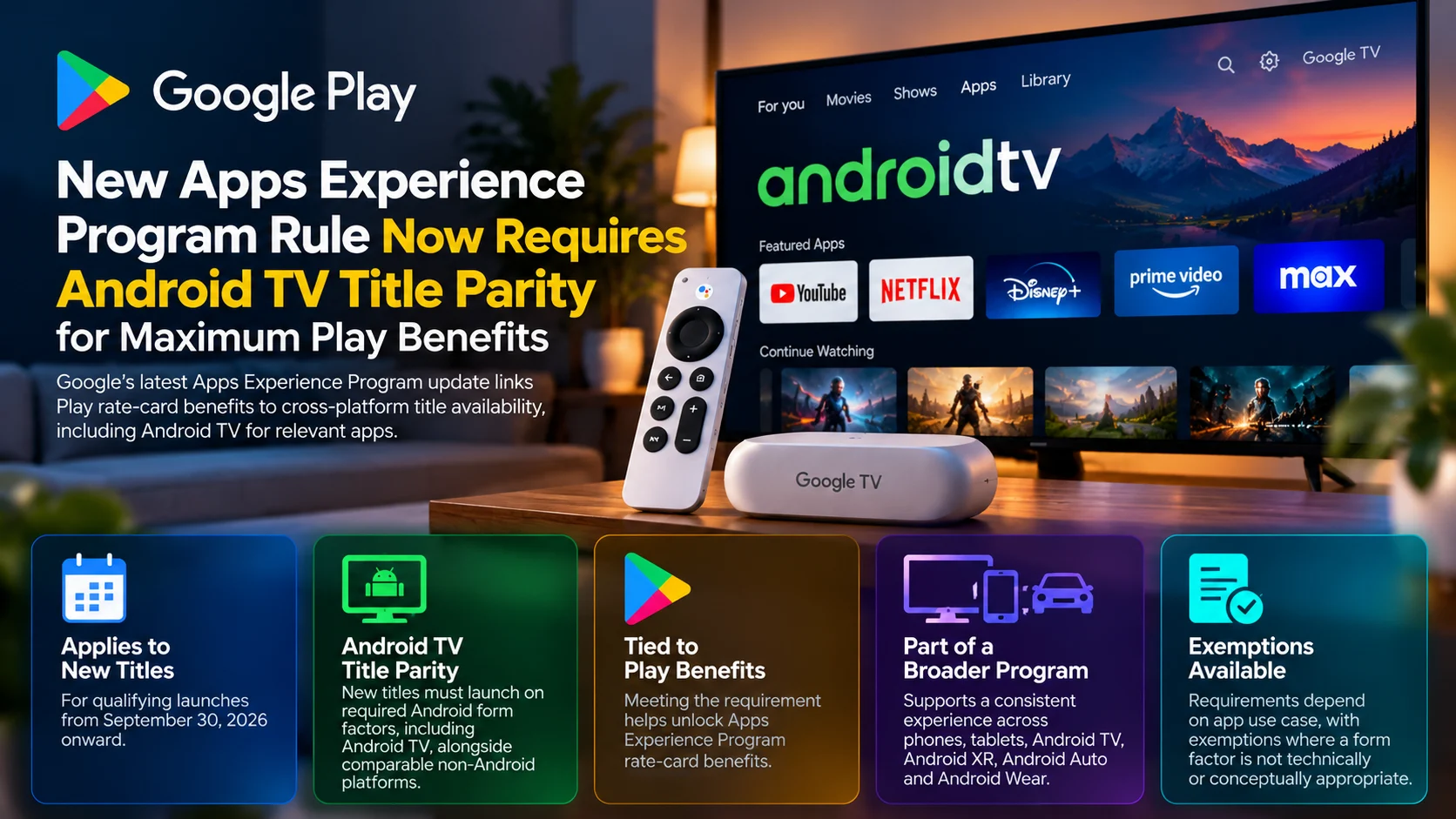
What Is Google’s Apps Experience Program?
The Apps Experience Program, or AEP, is a voluntary Google Play program designed to reward applications that provide high-quality, consistent experiences throughout the Android ecosystem.
Google describes the program around several goals: providing consistent experiences, reaching users across multiple screens, and maintaining stable, smooth application sessions.
Developers do not automatically enter the program.
Applications must identify the guidelines relevant to their use case, meet those requirements, and explicitly enroll through Play Console. Google then validates the application before the applicable program rate card can be applied.
Importantly, Google says participation is voluntary.
Apps that choose not to participate do not lose benefits they already receive through unrelated Google Play programs simply because they skip AEP.
The new rules matter specifically to developers that want to qualify for the Apps Experience Program rate card benefits.
Android TV Title Parity Rule at a Glance
| Area | What Developer Need to Know |
|---|---|
| Effective date | Applies to qualifying title launches from October 1, 2026, onward |
| Main requirement | New titles should launch on required Android form factors alongside comparable non-Android platforms |
| Android TV | Included among currently supported Android form factors |
| Streaming apps | Video and audio streaming use cases can trigger specific TV requirements |
| Delayed Android launch | Can create a six-month wait before AEP rate-card eligibility |
| Standard grace period | Up to 15 days to achieve live status on Google Play |
| Exceptional delay | Up to 30 days may be considered after review for qualifying Google-side or unusually long review issues |
| Program status | AEP is voluntary |
| Exemptions | Available where a form factor is not technically or conceptually appropriate |
Why Android TV Is Especially Important for Streaming Apps
The biggest impact will likely be felt by companies operating across multiple television platforms.
Large streaming services commonly build applications for environments such as smart TVs, Apple TV, Fire TV, Android TV, and Google TV.
Historically, those releases have not always happened at the same time.
A service might launch its new application on one TV ecosystem first and then bring Android TV support several months later.
Under the new Apps Experience Program framework, that launch strategy can have consequences when the platforms are considered comparable.
For applications that support video streaming—including television, movies, live sports, live news, and transactional video—Google’s AEP form-factor documentation identifies TV as a required form factor, subject to the relevant requirements and exemptions. Audio-streaming apps can also fall under the TV requirement.
This makes Android TV support part of a wider cross-device strategy rather than simply another store listing.
What Does “Title Parity” Actually Mean?
The requirement is fundamentally about launch availability.
If a new application title becomes available on a comparable non-Android device category, the developer is expected to make it available on the corresponding required Android form factor at approximately the same time if it wants uninterrupted eligibility for the program rate card.
For television developers, imagine a streaming company launching an entirely new service.
If the company releases that service on another comparable television platform after October 1, 2026, but postpones Android TV for several months, the Android version may no longer meet the AEP title-availability rule immediately.
Google states that titles missing the availability guideline can become eligible after a six-month waiting period, provided the relevant user-experience requirements are then satisfied.
That makes simultaneous platform planning significantly more important.
There Is a 15-Day Grace Period
Google is not treating simultaneous launches as requiring every platform to become publicly available at the exact same minute.
The AEP documentation provides a standard 15-day grace period for developers to achieve live status on Google Play.
This is intended to account for issues such as technical complications, review timing, and soft-launch differences.
Google also describes an extended grace period of up to 30 days in exceptional circumstances, such as a qualifying Google-side technical problem or unusually long application review, subject to manual review.
For development teams, that provides some operational flexibility.
However, the grace period should not be treated as permission to deliberately schedule Android TV several months behind another TV platform.
The broader intent remains cross-platform availability.
Older Existing Titles Receive Different Treatment
There is another important detail for applications that already existed before the new rule.
Google states that the six-month waiting period does not apply when a title was launched on the relevant non-Android form factor before October 1, 2026.
This prevents the new policy from automatically penalizing every historical platform-launch difference.
For example, a streaming application that arrived on a competing television platform years ago but only recently began expanding its Android TV presence is not treated exactly the same as a completely new service launching after the new rule took effect.
That distinction will be important for established media companies with long platform histories.
Title Availability and Feature Availability Are Different Rules
Developers should also avoid confusing title availability with feature availability.
Title availability asks whether the app itself is available on the required Android form factor.
Feature availability addresses whether important capabilities introduced on other platforms also reach Android within the expected timeframe.
Google’s AEP feature-availability guideline says applicable features should be fully launched on Android in an active AEP country within three weeks of their full launch on a non-Android platform in the same country.
The Android version should also support the same core capabilities and use cases rather than providing an obviously inferior substitute.
For streaming companies, this means simply releasing an Android TV shell may not be enough to satisfy the broader spirit of AEP.
The experience itself also matters.
Android TV Apps Need a Quality TV Experience
Google’s form-factor requirement is not only about making an application installable on television hardware.
For supported TV use cases, applications are expected to meet the TV App Guidelines.
This is particularly relevant because television UX differs dramatically from mobile UX.
A phone interface assumes touch input.
Android TV generally relies on directional-pad navigation, remote input, and focus-based interaction.
Content is viewed from several feet away rather than held directly in front of the user.
A streaming application therefore needs proper focus management, readable text, predictable remote navigation, and a player experience designed for the living room.
Simply stretching a mobile interface onto a television would undermine the type of multi-form-factor quality that AEP is intended to encourage.
Streaming Companies May Need to Change Release Planning
For larger media companies, the most significant impact may occur before coding begins.
Cross-platform launches are usually coordinated across several engineering teams.
One group may maintain Android TV.
Another handles Apple platforms.
Separate teams may own web, smart TVs, Fire TV, mobile, or backend services.
Historically, each platform could ship when its implementation was ready.
AEP creates an incentive to coordinate launches more closely.
If a completely new streaming title is scheduled to appear on comparable television platforms, the Android TV team may now need to become part of the critical launch path.
Product managers therefore need to consider Android form-factor readiness much earlier in the planning process.
Video Apps Face Wider AEP Requirements
Android TV parity is only one component of the Apps Experience Program.
Streaming-video applications can trigger a number of additional AEP requirements depending on their supported features and form factors.
Google’s AEP planning documentation identifies video playback as a use case that can trigger TV requirements. Other guidelines address areas such as stability, picture-in-picture, cast support, cross-platform feature availability, and experience quality.
For example, Google’s Cast guideline for qualifying video and audio applications expects Cast support through Media3 or an approved equivalent approach, along with proper output-switching behavior on applicable form factors.
That makes AEP considerably broader than an Android TV publishing rule.
Stability Is Part of the Program Too
The program also establishes technical-quality expectations.
Google documents AEP-specific thresholds around crash rates, ANRs, and excessive slow frames.
These are used to determine program eligibility and are separate from the broader Play Store visibility thresholds developers may already monitor.
Google evaluates relevant stability measurements over a trailing period and specifies minimum session requirements for enforcement of those metrics.
For streaming applications, stability is particularly important because the user session can last hours.
A crash 40 minutes into a movie is much more disruptive than a minor interface issue during a short interaction.
Developers pursuing AEP benefits therefore need to consider playback stability as well as cross-platform distribution.
Android TV Developers Should Review Their Product Matrix
A practical first step is to build a clear platform matrix.
Streaming companies should identify which products are available on mobile, tablets, Android TV, competing television platforms and other relevant form factors.
They should then identify upcoming new titles and determine whether a comparable Android experience is expected under the AEP guidelines.
This becomes especially important for companies operating multiple applications.
A broadcaster may have a main streaming app, separate sports product, free ad-supported television service and regional applications.
Each product may have different Android form-factor requirements.
Treating them as one generic Android release plan could create unnecessary compliance problems.
Exemptions Exist for Apps That Do Not Belong on TV
Google recognizes that not every application makes sense on every device.
The title-availability guideline includes an exemption where a developer can demonstrate that a particular Android form factor would meaningfully degrade the user experience compared with the equivalent non-Android environment, or where there is no viable technical solution for that hardware.
The form-factor rules contain similar provisions for hardware or technical limitations.
This distinction is important.
AEP does not simply require developers to force every phone application onto Android TV.
Instead, requirements are linked to application use cases and comparable platform experiences.
For a major movie-streaming service, television support has an obvious connection.
For an application whose core experience fundamentally depends on hardware unavailable on television devices, an exemption may be relevant.
What Android TV Teams Should Do Now
Development teams targeting AEP should review much more than the Play Console listing.
The Android TV application should be included in future cross-platform launch planning from the earliest product stages.
Teams should verify that the app meets applicable television-quality expectations, remote-navigation behavior and playback requirements.
They should also document cases where an exemption may be justified rather than assuming an unsupported form factor will automatically be ignored.
Most importantly, engineering and product teams should communicate.
A non-Android TV launch made by one part of a company can now have implications for the Android release strategy of another team.
Why Google Is Encouraging Multi-Device Apps
The wider goal behind AEP is clear: Google wants high-quality apps to feel like part of a connected Android ecosystem rather than independent phone applications.
Android now extends across phones, tablets, foldables, TVs, cars, wearables, XR devices and larger-screen computing environments.
The Apps Experience Program provides a financial incentive for developers willing to invest in that broader platform reach.
For streaming companies, television is naturally one of the most important parts of that strategy.
Users frequently begin a subscription or discover content on a phone and then watch the actual movie, sports event or television series on the largest screen in the home.
Android TV parity therefore has a direct relationship with the multi-device experience Google is trying to promote.
Final Thoughts
Google’s new Apps Experience Program title-availability requirement changes the importance of Android TV in cross-platform launch planning.
For streaming companies, Android TV can no longer be viewed only as a secondary port that automatically arrives whenever the TV engineering team is ready.
When a new qualifying title launches on a comparable non-Android television platform, the timing of its Android TV release can now affect access to AEP rate-card benefits.
At the same time, this is not a universal rule forcing every Android application onto every screen.
The program is voluntary, requirements vary by use case and Google provides exemptions for situations where a form factor is technically or conceptually unsuitable.
Streaming apps, however, have a clear reason to pay attention.
Television is already central to their product experience, and Google’s AEP rules explicitly connect video and audio use cases with TV form-factor requirements.
The result is a stronger incentive for product, engineering and release teams to design Android TV support from the beginning instead of treating it as a post-launch expansion.
For developers working on multi-platform video products, Android TV release timing has now become a business consideration as well as a technical one.
FAQs About the Android TV AEP Title-Parity Rule
1) What changed for Android TV developers?
Google’s Apps Experience Program now links its program rate-card benefits to title availability across required Android form factors and comparable non-Android platforms for applicable launches from September 30, 2026 onward.
2) Does every app now have to build an Android TV version?
No. Requirements depend on the app's use case, applicable form factors and available exemptions. Streaming video and audio apps are among the categories where TV support can be required.
3) What happens if an Android TV version launches late?
A title that does not meet the availability requirement may face a six-month waiting period before becoming eligible for AEP rate-card benefits after the requirements are satisfied.
4) Does Google allow a short launch delay?
Yes. The documentation includes a standard 15-day grace period for achieving live status and describes a possible extension to 30 days under qualifying exceptional circumstances.
5) Is the Apps Experience Program mandatory?
No. Google describes AEP as voluntary. Developers choose whether they want to enroll and pursue its rate-card benefits.
6) Is publishing an Android TV app enough?
Not necessarily. The program also includes quality and experience requirements. Relevant TV applications need to meet applicable Android TV guidelines.
7) Are title parity and feature parity the same thing?
No. Title availability concerns when the application itself launches. Feature availability is a separate guideline covering when comparable features reach Android.
Stay Updated with the Player SDK Guide Hub
Platform rules increasingly influence how streaming applications are designed, released and maintained across devices.
The Player SDK Guide Hub tracks developments across Android TV, Google TV, Fire TV, Vega OS, Apple TV, Roku, Android Media3, ExoPlayer, Plex, Jellyfin, Kodi, VLC and other video-player and streaming ecosystems.
We cover SDK changes, app-store requirements, player releases, operating-system updates and cross-device development policies to explain what changed, why it matters and what streaming teams should prepare for next.
Explore the Player SDK Guide Hub for the latest Android TV, Google TV and streaming-app development updates.