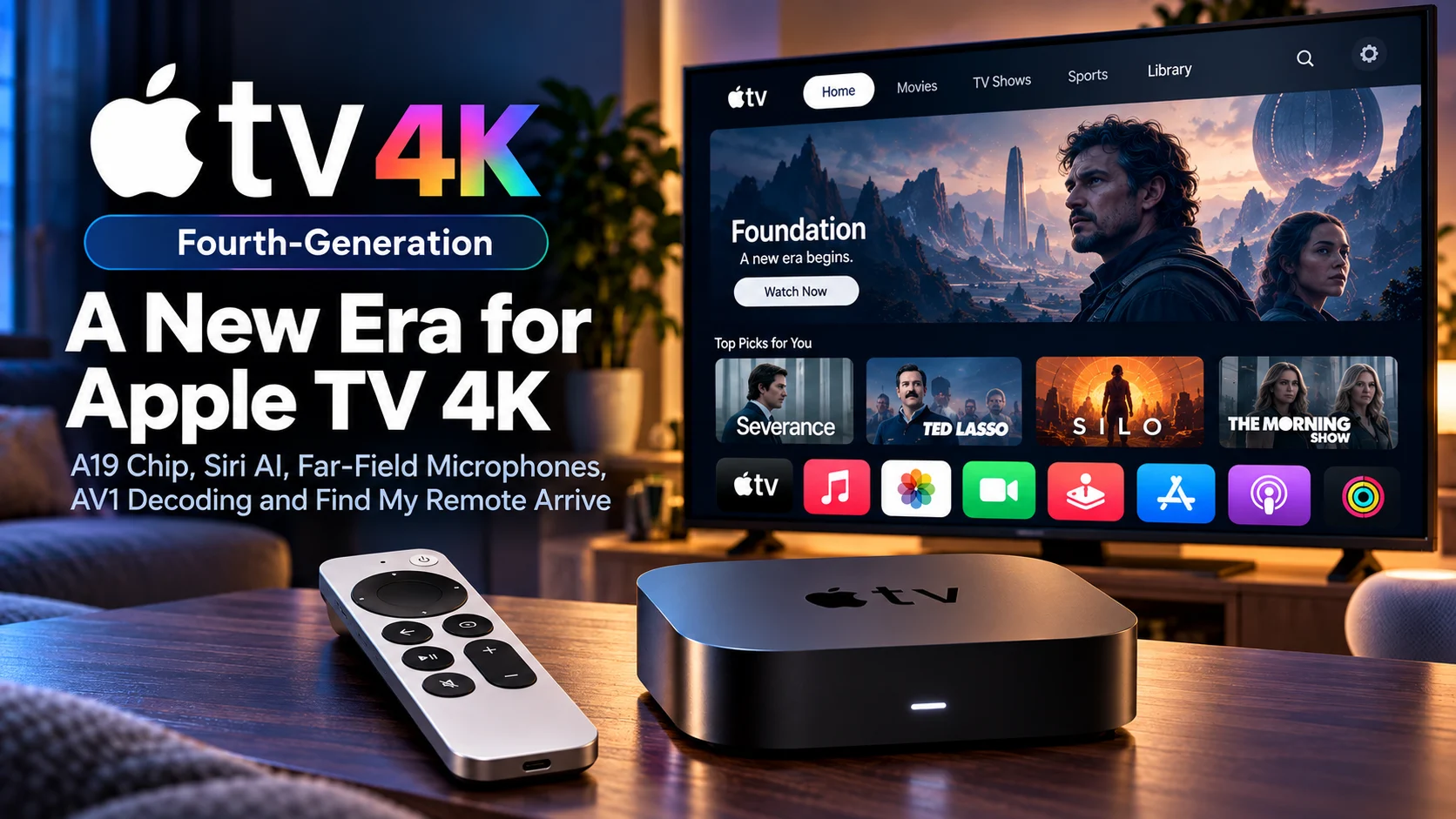
Apple has introduced the fourth-generation Apple TV 4K, delivering one of the platform’s most significant hardware upgrades yet, with a faster A19 chip, dedicated AV1 decoding, built-in far-field microphones, enhanced Siri intelligence, and an upgraded remote experience.
The new model continues Apple’s approach of positioning Apple TV as more than a simple media player. The device increasingly sits at the intersection of premium video playback, gaming, voice interaction, and smart-home control.
The A19 processor provides the foundation for that expansion. Faster CPU and GPU performance should improve navigation, application launches, visual effects, and more demanding tvOS experiences, while a dedicated AV1 decoder strengthens Apple TV’s video capabilities for modern streaming services.
Perhaps the biggest change, however, is the addition of far-field microphones directly to the Apple TV 4K. Users no longer need to rely entirely on the Siri Remote microphone for voice interaction. The device can listen for supported hands-free Siri requests from across the room, bringing the Apple TV experience closer to Apple’s broader intelligent-home strategy.
A redesigned Siri Remote experience, Find My functionality, and deeper HomePod integration round out a hardware refresh that significantly expands what the Apple TV box can do.
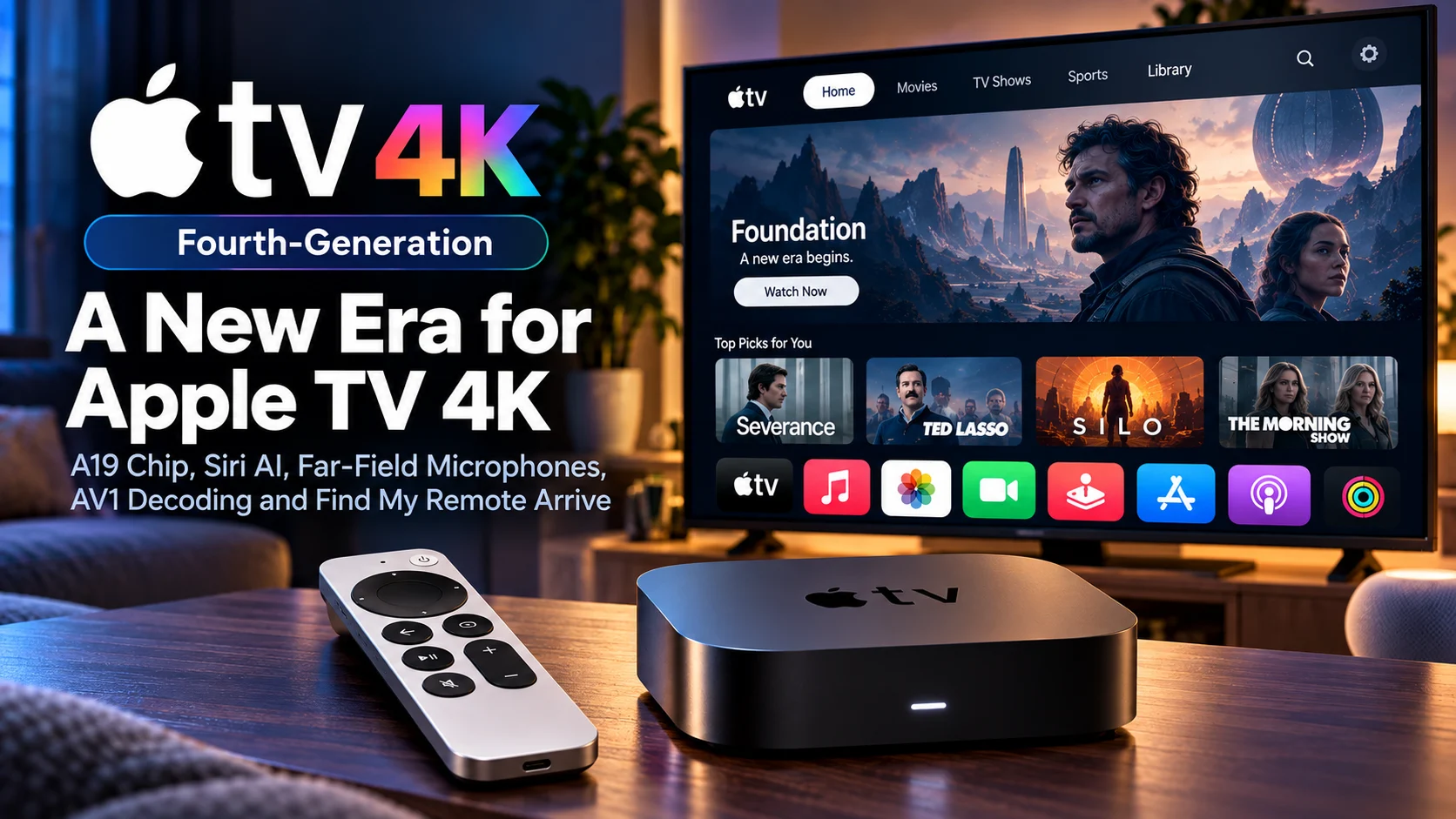
Fourth-Generation Apple TV 4K at a Glance
| Area | What's New | Why It Matters |
|---|---|---|
| Processor | A19 chip | Faster navigation, stronger graphics and more performance headroom |
| Video | Dedicated AV1 decoding | More efficient playback for modern video services |
| Voice | Built-in far-field microphones | Hands-free Siri interaction without picking up the remote |
| Siri | More intelligent contextual assistance | Easier content search and smart-home control |
| Remote | Updated Siri Remote with Find My support | Easier to locate a misplaced remote |
| Smart Home | Stronger Apple Home integration | Makes Apple TV a more capable living-room control hub |
| Audio | Expanded HomePod integration | More flexible home-theater configurations |
| Gaming | Faster graphics performance | Better support for demanding Apple Arcade and tvOS games |
A19 Chip Gives Apple TV Much More Performance Headroom
The A19 chip is the core hardware upgrade in the new Apple TV 4K.
TV streaming interfaces have become substantially more demanding. Modern home screens include high-resolution artwork, animated transitions, live recommendations, previews, voice processing, and increasingly sophisticated applications.
A faster processor benefits all of these tasks.
Apple says the new hardware delivers a major CPU and graphics improvement compared with the previous generation. That should translate into quicker app launches, faster switching between applications, and smoother navigation across tvOS.
The GPU improvement is equally important.
Apple TV is increasingly used for Apple Arcade gaming, interactive fitness applications, and graphically rich interfaces. More graphics performance gives developers additional room to improve visual quality without compromising responsiveness.
For normal streaming users, the biggest difference may simply be that everything feels faster.
AV1 Decoding Is a Major Video Upgrade
The addition of hardware AV1 decoding is one of the most important technical changes for video playback.
AV1 is a modern video codec designed to deliver high image quality at lower bitrates than older standards.
Major streaming platforms increasingly use AV1 because it can reduce bandwidth requirements while maintaining strong visual quality.
Hardware decoding matters because software-based decoding can consume significantly more CPU resources.
With dedicated AV1 support, Apple TV can decode compatible streams more efficiently while reducing processing load.
That can improve playback efficiency, reduce unnecessary power consumption, and give video services more flexibility when delivering high-resolution content.
AV1 is particularly relevant as streaming platforms continue moving toward 4K, HDR, and higher-quality video delivery.
By adding dedicated decoding, Apple TV becomes better prepared for the next phase of streaming formats.
Far-Field Microphones Transform Siri Interaction
The most noticeable hardware change may be the inclusion of far-field microphones directly inside the Apple TV 4K.
Until now, voice interaction has primarily depended on the Siri Remote.
Users normally press the Siri button, speak into the remote and wait for the command to be processed.
Built-in microphones fundamentally change that interaction model.
The Apple TV can now support hands-free voice requests from across the room, allowing users to interact with Siri without first finding the remote.
That could make simple actions much faster.
Users may be able to ask Siri to find a movie, launch an application, pause playback, adjust compatible smart-home devices, or answer general questions without touching a controller.
For a television device, this is an important usability change.
Hands-Free Siri Makes More Sense in the Living Room
Voice control is particularly useful when the television is shared by several people.
The remote may be on another side of the room, underneath a cushion or in someone else’s hand.
Hands-free Siri removes that dependency.
A viewer could potentially ask for a specific show while preparing food, control playback from across the room, or display a HomeKit-compatible camera without needing to physically interact with the device.
The effectiveness of the feature will depend heavily on microphone quality.
Televisions generate substantial background audio, so the system needs to distinguish voice commands from movies, music, and general room noise.
Apple already has considerable experience with far-field microphone processing through HomePod, which could help provide a more reliable implementation.
Siri AI Could Make Content Search More Natural
The new Apple TV hardware also gives Apple more room to expand intelligent Siri features.
Traditional TV searches typically require exact titles.
Users may not always remember the name of a movie, actor or show.
A more context-aware Siri experience could allow natural requests such as asking for a film featuring a specific actor, something suitable for the family or content related to a particular genre.
The important shift is from simple command recognition toward conversational discovery.
That could make the television easier to use for people who do not want to navigate through multiple menus.
Voice intelligence can also extend beyond entertainment.
Because Apple TV already plays a central role in Apple Home, Siri can act as a bridge between television entertainment and smart-home controls.
Find My Remote Solves a Very Common Problem
Remote controls have one predictable weakness: they disappear.
They slip between sofa cushions, end up in another room, or get buried under blankets.
The upgraded Siri Remote experience addresses this with Find My functionality.
Instead of manually searching around the room, users can locate the remote using Apple’s device-finding technology.
That turns what is usually a frustrating household problem into a much simpler process.
The feature also fits naturally into Apple’s broader Find My ecosystem.
For Apple users already familiar with locating AirPods, AirTags, and other devices, remote tracking should feel familiar.
It is a small feature compared with a new processor, but it may be one of the most frequently appreciated improvements.
The Remote Still Matters Even With Hands-Free Siri
Built-in microphones do not eliminate the need for a remote.
Voice control is useful for searching and quick commands, but many people still prefer physical navigation when browsing long content rows, adjusting playback, or changing settings.
The updated Siri Remote therefore remains an important part of the system.
Apple’s goal appears to be providing several ways to interact with the television rather than forcing users into one method.
Users can navigate traditionally, use hands-free Siri, or rely on other Apple devices when appropriate.
That flexibility is important in a shared living-room environment.
HomePod Integration Strengthens Apple’s Home-Theater Strategy
Apple TV has gradually become more integrated with HomePod.
The new generation expands that concept further.
For users invested in Apple’s speaker ecosystem, the Apple TV can become the center of a more sophisticated wireless home-theater setup.
Support for expanded HomePod configurations gives households additional options for building surround-style audio systems without relying entirely on conventional AV receivers and wired speakers.
This strategy plays to one of Apple’s biggest strengths: ecosystem integration.
Apple does not need Apple TV to exist as an isolated box.
It can work alongside HomePods, iPhones, iPads, AirPods, and Apple Home devices to create a broader connected experience.
Better Performance Could Help Apple Arcade
The stronger A19 GPU should also benefit gaming.
Apple Arcade already gives Apple TV access to a large collection of controller-compatible games.
With more graphics performance, developers can build richer visual experiences while maintaining stable frame rates.
It also reduces the gap between Apple TV and Apple’s more powerful mobile devices.
Shared Apple silicon architecture can make it easier for developers to bring games across iPhone, iPad, and Apple TV.
The television box is unlikely to replace a dedicated gaming console for every user, but stronger hardware makes casual and family gaming more attractive.
AV1 Could Reduce Bandwidth Without Sacrificing Quality
AV1 support is especially useful for households with bandwidth limitations.
More efficient compression means a streaming service may be able to deliver comparable visual quality using less data.
That can benefit users with slower internet connections or busy home networks.
It may also help services deliver higher-quality video without increasing bandwidth requirements as aggressively.
Of course, actual benefits depend on whether a streaming platform provides AV1 streams to Apple TV.
The decoder itself does not automatically improve every video.
But by supporting the codec in hardware, Apple gives services the option to use it efficiently.
Apple TV Is Becoming a Smart-Home Device
The broader story behind the fourth-generation Apple TV 4K is that Apple appears to be expanding its role beyond traditional streaming.
Built-in microphones are a major clue.
A device capable of listening for voice commands from across the room becomes part of the ambient computing environment.
Combine that with Apple Home support, television playback, and HomePod integration, and Apple TV begins functioning as a central living-room control point.
Users could potentially move between entertainment and smart-home tasks without changing devices.
One moment the Apple TV is playing a movie.
The next it is showing a compatible doorbell camera, adjusting lights or responding to a Siri request.
That type of integration could become one of the new model’s strongest advantages.
Privacy Controls Will Be Important
Any device with built-in microphones naturally raises privacy considerations.
Users need clear ways to understand when microphones are active and how voice data is processed.
Apple has historically emphasized privacy as an important part of its product design, so microphone controls and transparency will be important for the new Apple TV experience.
Some users may prefer hands-free voice functionality.
Others may want the microphones disabled.
A flexible implementation should allow both types of households to use the device comfortably.
Existing Apple TV Owners Have More Reasons to Consider Upgrading
Previous Apple TV generations already provide strong 4K playback and smooth tvOS navigation.
That means users do not necessarily need to replace existing hardware immediately.
However, the fourth-generation model introduces more meaningful differences than a minor processor refresh.
AV1 hardware decoding improves codec readiness.
The A19 chip increases performance significantly.
Far-field microphones introduce an entirely new interaction model.
Find My support solves a practical remote-control problem.
Expanded HomePod functionality strengthens the audio side of the ecosystem.
For users deeply invested in Apple’s living-room setup, those changes create a much stronger upgrade argument.
Final Thoughts
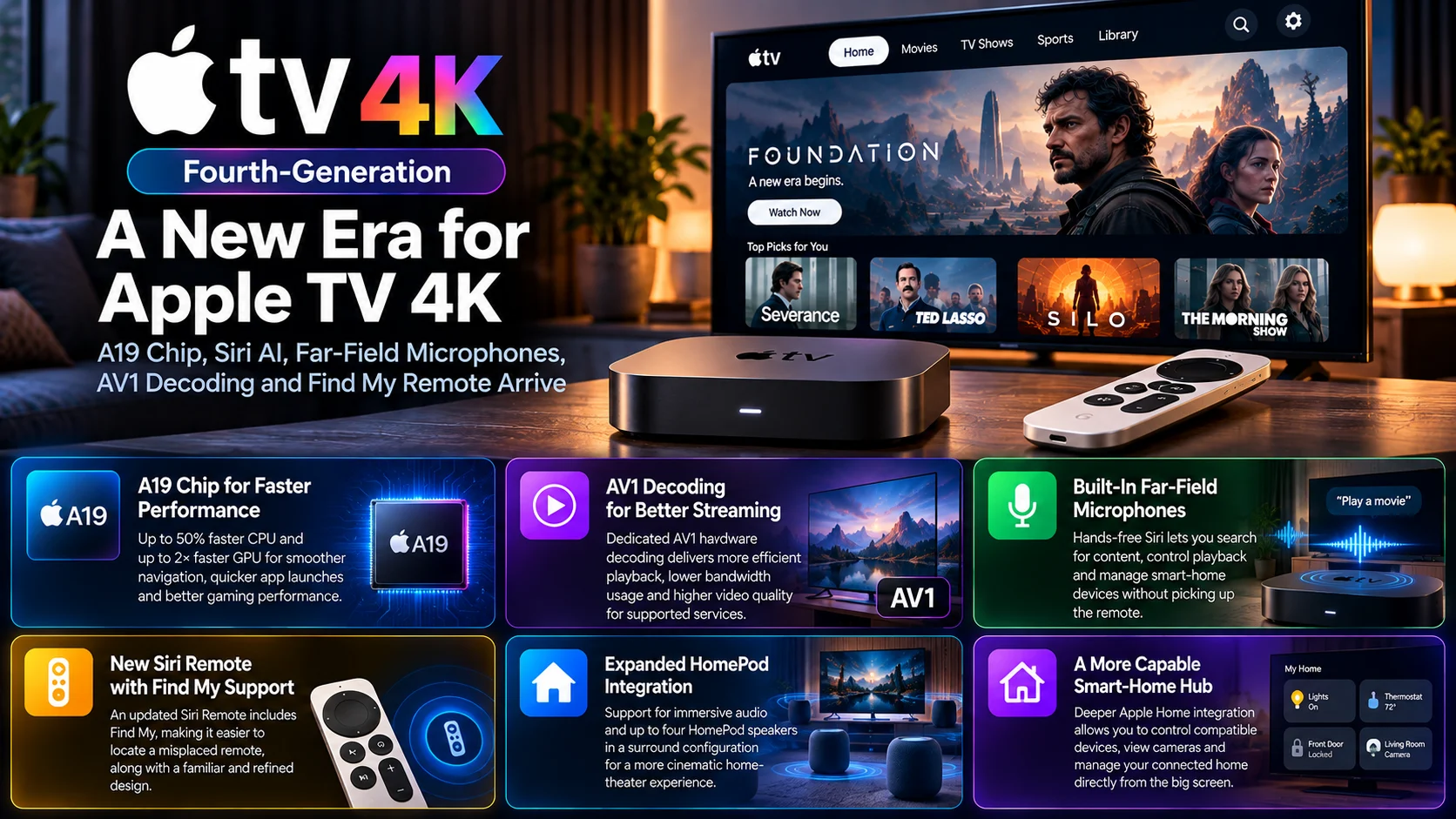
The fourth-generation Apple TV 4K represents a much broader upgrade than simply putting a faster processor into Apple’s streaming box.
The A19 chip gives tvOS more performance headroom while improving graphics capability for gaming and future applications.
Dedicated AV1 decoding prepares Apple TV for more efficient modern video delivery.
Built-in far-field microphones may be even more transformative, allowing hands-free Siri commands and making the device feel more integrated into the room itself.
The upgraded remote experience and Find My functionality solve a practical everyday problem, while deeper HomePod integration strengthens Apple’s wireless home-theater strategy.
Together, these improvements push Apple TV further toward becoming a unified entertainment, gaming, voice and smart-home hub.
For users already invested in Apple’s ecosystem, this could be the most compelling Apple TV hardware upgrade in several generations.
FAQs About the Fourth-Generation Apple TV 4K
1) What processor does the new Apple TV 4K use?
The fourth-generation Apple TV 4K uses Apple’s A19 chip, providing stronger CPU and GPU performance than the previous generation.
2) Does the new Apple TV 4K support AV1?
Yes. The new hardware includes dedicated AV1 decoding for more efficient playback of compatible video streams.
3) Does Apple TV now have built-in microphones?
Yes. Far-field microphones are integrated into the new Apple TV hardware to support hands-free Siri interaction.
4) Do I still need the Siri Remote for voice commands?
Not necessarily for supported hands-free requests. Built-in microphones allow Siri interaction without always holding the remote.
5) What does Find My Remote do?
It helps users locate a misplaced Siri Remote through Apple’s device-finding technology.
6) Is the Siri Remote also updated?
Yes. The new generation includes an updated remote experience with improved finding capabilities and continued voice support.
7) Does the new Apple TV improve gaming?
The faster A19 processor and stronger GPU should provide better performance for Apple Arcade and other compatible tvOS games.
8) Why is AV1 important?
AV1 can deliver strong video quality at lower bitrates, potentially improving bandwidth efficiency for services that provide compatible streams.
9) Does the new Apple TV work with HomePod?
Yes. Apple continues expanding Apple TV and HomePod integration for living-room audio and home-theater configurations.
10) Is the new model mainly a streaming upgrade?
No. Streaming remains central, but the combination of Siri, far-field microphones, Apple Home integration, gaming performance and HomePod support makes it increasingly useful as a broader living-room hub.
Stay Updated with the Player SDK Guide Hub
Streaming devices are evolving beyond simple video playback. New codecs, AI-powered voice interaction, faster processors, smart-home integration, advanced audio systems and improved remotes are changing the living-room experience.
The Player SDK Guide Hub tracks important developments across Apple TV, Google TV, Android TV, Fire TV, Roku, Plex, Jellyfin, Emby, Kodi and modern video-player platforms.
We cover hardware launches, player releases, codec developments, media-server updates and developer-focused platform changes to explain what changed, why it matters and what users and developers should watch next.
Follow the Player SDK Guide Hub for the latest streaming-device, media-server and video-player updates