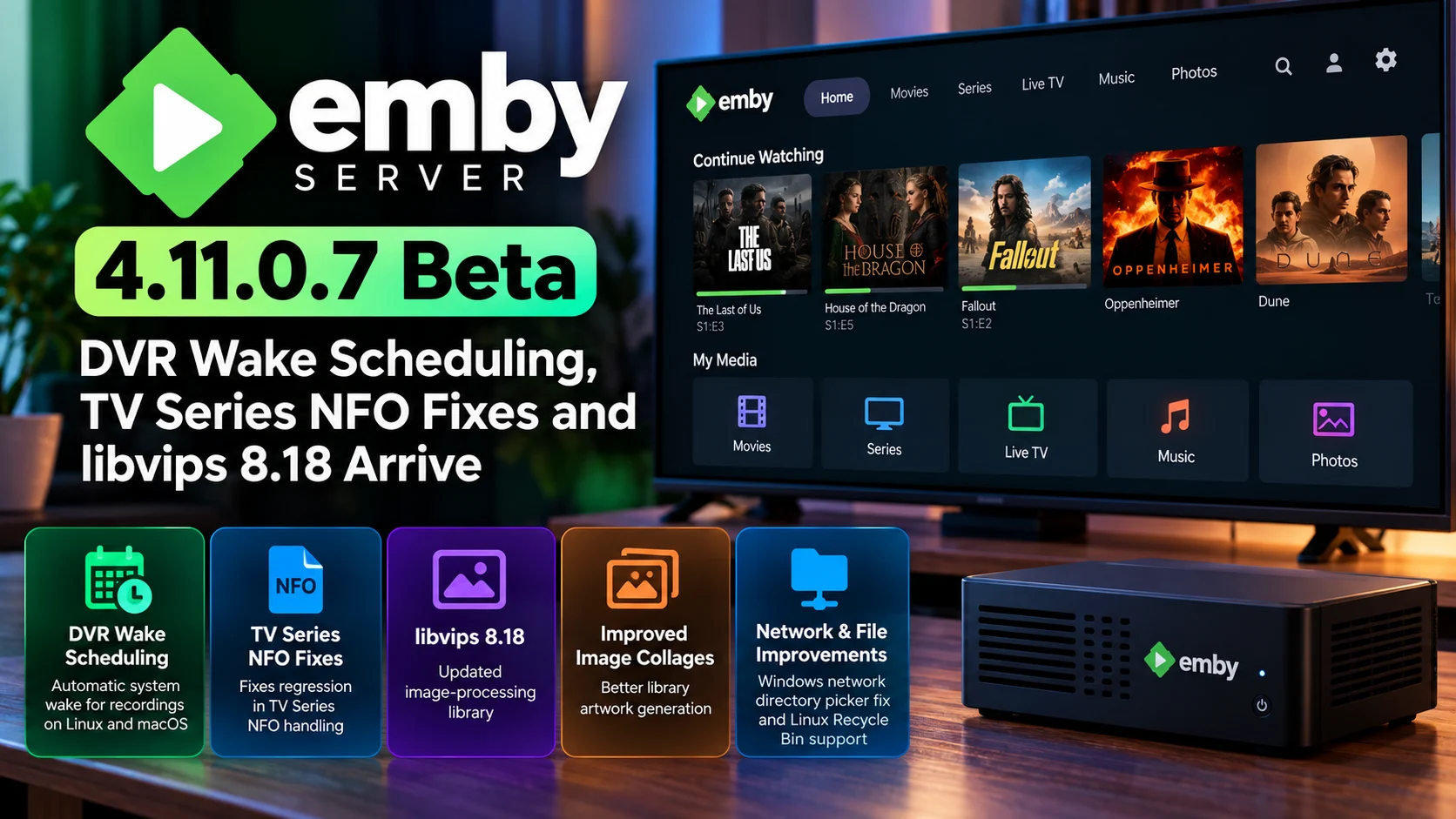
Emby Server 4.11.0.7 Beta is now available with a collection of server-side improvements focused on DVR reliability, metadata handling, image processing, library behavior, and operating-system integration.
The most interesting change for DVR users is new scheduled system wake functionality for Linux and macOS, allowing compatible systems to wake automatically when an upcoming recording needs the Emby Server to be available.
That can be particularly useful for home-theater servers that are not intended to remain powered on around the clock.
The release also fixes an important TV series NFO regression, improves album playback behavior, adds protection against overly long recording filenames, updates the bundled libvips image-processing library to version 8.18, improves image-collage functionality, and adds several platform-specific file-management refinements.
Emby Server 4.11.0.7 is still a beta build, so it is aimed primarily at users who want early access to fixes and are comfortable testing changes before they reach a stable production release.
Even so, the update contains several practical improvements that could have a noticeable impact on everyday Emby server administration.
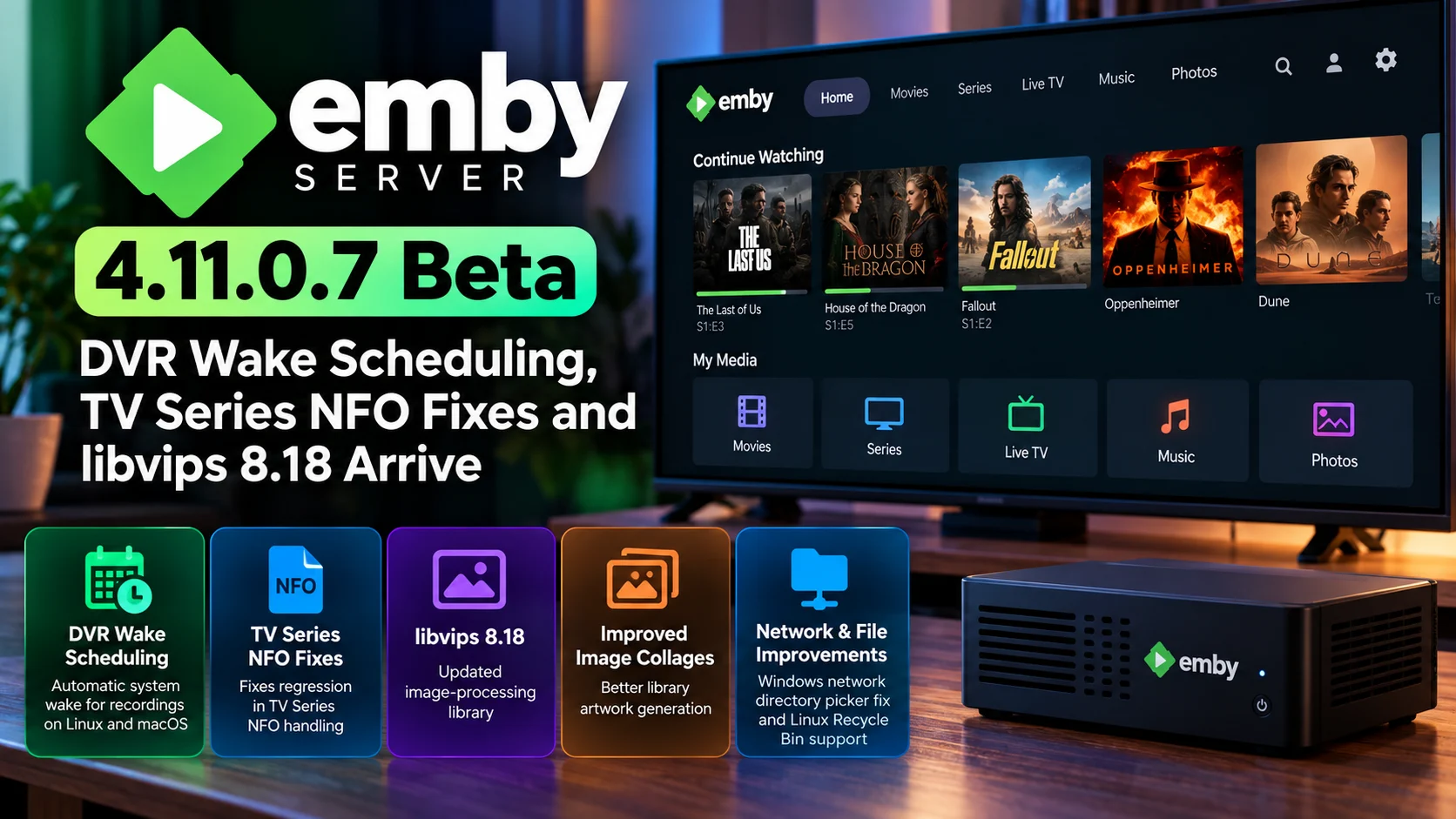
Emby Server 4.11.0.7 Beta at a Glance
| Area | What Changed | Why It Matters |
|---|---|---|
| DVR on Linux | Scheduled system wake support | Server can wake before scheduled recordings |
| DVR on macOS | Scheduled system wake support | Helps recording servers avoid staying powered on continuously |
| TV Series metadata | NFO regression fixed | Improves local metadata reliability |
| Music playback | Play from Albums behavior fixedc | Makes album-based playback more dependable |
| Recording files | Protection against overly long recording paths | Reduces failed recordings caused by filename limits |
| Image processing | libvips upgraded to 8.18 | Updates Emby’s image-processing stack |
| Image collages | Additional support and refinements | Improves automatically generated library artwork |
| Windows | Network directory picker fix | Makes network-folder selection more reliable |
| Linux | Recycle Bin support added | Improves file-deletion behavior on supported systems |
Scheduled DVR Wake Is the Headline Server Feature
For users who rely on Emby as a DVR, the biggest change in version 4.11.0.7 Beta is scheduled system wake support for Linux and macOS.
A DVR server needs to be running when a recording begins.
That sounds obvious, but it creates a practical problem for users who do not want their home server powered on 24 hours a day.
If the computer goes to sleep before a recording starts, the tuner and Emby Server may not be available when the scheduled program begins.
One solution is simply to prevent the machine from sleeping.
That works, but it increases power usage and keeps hardware running even when nobody is watching or recording anything.
Scheduled wake functionality offers a much cleaner approach.
The system can remain asleep during periods of inactivity and wake when Emby knows a recording is approaching.
Why DVR Wake Scheduling Matters for Home Servers
Many Emby installations run on small home servers, Mac minis, Linux boxes, or energy-efficient PCs.
These systems may spend long periods doing nothing.
A household could record only a few programs each week, yet the server might otherwise remain powered on every hour of every day just to avoid missing one scheduled show.
Automatic wake scheduling changes that equation.
Emby can coordinate more closely with the operating system so the machine becomes active before the recording is needed.
That makes the DVR experience more appliance-like.
Users schedule the program and expect the system to handle the rest.
They should not need to remember to manually wake the server before leaving the house.
Sleep and Wake Support Is More Complicated Than It Appears
Automatically waking a computer for recording involves coordination between several layers.
Emby knows when a recording is scheduled.
The operating system controls sleep and wake behavior.
Hardware and firmware determine whether scheduled wake events are supported correctly.
Power settings can also influence whether the system is actually allowed to wake.
That means the feature should be tested carefully on each machine.
A Linux distribution running on custom hardware may behave differently from a Mac.
Even two PCs using the same operating system can have different BIOS or power-management capabilities.
The important change in Emby 4.11.0.7 is that the server now has a better way to participate in that process on Linux and macOS.
TV Series NFO Regression Gets Fixed
Another significant change involves TV series NFO metadata.
NFO files are widely used by people who prefer local metadata stored alongside their media.
Instead of depending entirely on online metadata providers, users can keep information such as titles, descriptions, ratings, and other library details in files that remain with the collection.
This is especially valuable for carefully curated television libraries.
A user may have manually corrected episode information, added custom metadata, or moved a library between different media servers.
If NFO handling breaks, those carefully maintained details may not be read correctly.
Emby Server 4.11.0.7 Beta fixes a regression affecting TV Series NFO behavior.
For users who rely heavily on local metadata, this is one of the most important fixes in the release.
Local Metadata Remains Important for Serious Libraries
Online metadata matching is convenient, but it is not perfect.
Special editions, alternate episode orders, regional releases, and unusual series can all create mismatches.
Some users also want complete control over how their library appears.
Local NFO files provide that control.
They can make a media collection more portable as well.
If metadata is stored directly with the media files, moving the library or rebuilding a server does not necessarily mean starting from zero.
That is why metadata regressions can be surprisingly disruptive.
A small parsing bug can affect hundreds of episodes in a large collection.
Fixing the TV series NFO regression therefore restores an important part of Emby’s library-management workflow.
Play From Albums Gets a Reliability Fix
Music playback also receives attention.
Emby Server 4.11.0.7 Beta includes a fix for Play from Albums behavior.
Album playback seems simple from the user interface, but the server has to correctly generate a play queue based on the album structure.
That includes track ordering, metadata, and potentially multi-disc albums.
A problem in the queue-generation path can result in incorrect ordering, missing tracks, or playback not beginning as expected.
The fix helps make album-based playback more consistent for Emby users who also use the server as a personal music platform.
This is not the headline change, but it reinforces Emby’s position as more than just a movie and television server.
Recording Filename Protection Prevents PathTooLong Failures
DVR recording filenames can become surprisingly complicated.
A generated filename may contain the show title, episode name, season information, recording details, and folder structure.
Long program names combined with deep directory structures can eventually exceed operating-system path limits.
When that happens, recording or file creation can fail.
Emby Server 4.11.0.7 adds protection against PathTooLong problems in recording filenames.
This is exactly the kind of server fix most users never think about until it causes a missed recording.
A DVR should not fail simply because a broadcaster provided an unusually long episode title.
By making filename generation more defensive, Emby reduces another avoidable recording failure condition.
libvips 8.18 Updates Emby’s Image Pipeline
The update also moves Emby to libvips 8.18.
libvips is an image-processing library used by many applications for tasks such as resizing, transforming, and generating images efficiently.
Media servers perform far more image processing than users may realize.
Every movie poster needs to be displayed at several sizes.
Backdrop artwork may be resized for different devices.
User interfaces can request thumbnails.
Collections and libraries may generate composite images.
All of those tasks can involve the server’s image-processing stack.
Updating libvips keeps that part of Emby current and can provide compatibility, performance, and reliability improvements inherited from the newer library.
Image Collages Get Additional Attention
Image-collage functionality is also improved.
Collages are commonly used when one library tile needs to visually represent several pieces of content.
Instead of showing a single poster, Emby can create a composite image from multiple items.
This is useful for collections, folders, and other grouped library views.
The final artwork may look simple, but generating it requires selecting source images, cropping them correctly, resizing them, and combining them into a new output.
Changes to image-processing libraries can also affect how these composites are generated.
The improvements in 4.11.0.7 help strengthen that part of the presentation layer.
For large libraries, cleaner generated artwork can make navigation feel significantly more polished.
Windows Network Directory Picker Is Fixed
Windows administrators receive a practical file-management fix involving the network directory picker.
Network storage is extremely common in Emby installations.
A user might run Emby Server on one PC while media lives on a NAS or another Windows machine.
Adding those libraries depends on reliable network-folder selection.
If the directory picker behaves incorrectly, configuration becomes unnecessarily difficult even though the underlying share may be accessible.
Version 4.11.0.7 addresses this Windows workflow.
It is another example of a small server-administration fix that can matter much more than its changelog size suggests.
Linux Gains Recycle Bin Support
Linux also receives Recycle Bin support.
File deletion inside a media-server environment needs to be handled carefully.
Permanent deletion is fast but unforgiving.
If a user accidentally removes the wrong movie, episode, or recording, recovery may be impossible without a backup.
Recycle Bin integration can provide an additional safety layer by allowing deleted files to follow the operating system’s recoverable deletion workflow where supported.
For Linux Emby users managing large libraries directly through the server interface, this can reduce the risk associated with routine cleanup.
It is especially useful for DVR systems, where users may frequently delete watched recordings.
This Beta Is Mainly About Server Reliability
Emby Server 4.11.0.7 does not introduce a dramatic new client interface.
Its improvements happen largely behind the scenes.
That is typical of an important server release.
DVR scheduling becomes smarter.
Metadata handling becomes more dependable.
Recording filenames become safer.
Images are processed through an updated library.
Network-folder configuration becomes more reliable.
Deletion workflows become more forgiving.
These changes may not produce a completely different Emby Home screen, but they improve the infrastructure that supports everything users see.
Who Should Test Emby Server 4.11.0.7 Beta?
The strongest candidates are users running DVR workloads on Linux or macOS.
If the server normally sleeps between viewing sessions, scheduled wake support alone may justify testing the beta.
Users with large locally managed TV libraries should also pay attention to the NFO fix.
Windows server administrators using network shares have another reason to evaluate the build.
Linux users who manage files directly through Emby may appreciate Recycle Bin support.
And anyone running a large library with extensive artwork can benefit from improvements in the image-processing stack.
Because this is a beta release, users running critical household servers should still keep backups and avoid assuming every change is production-ready.
Final Thoughts
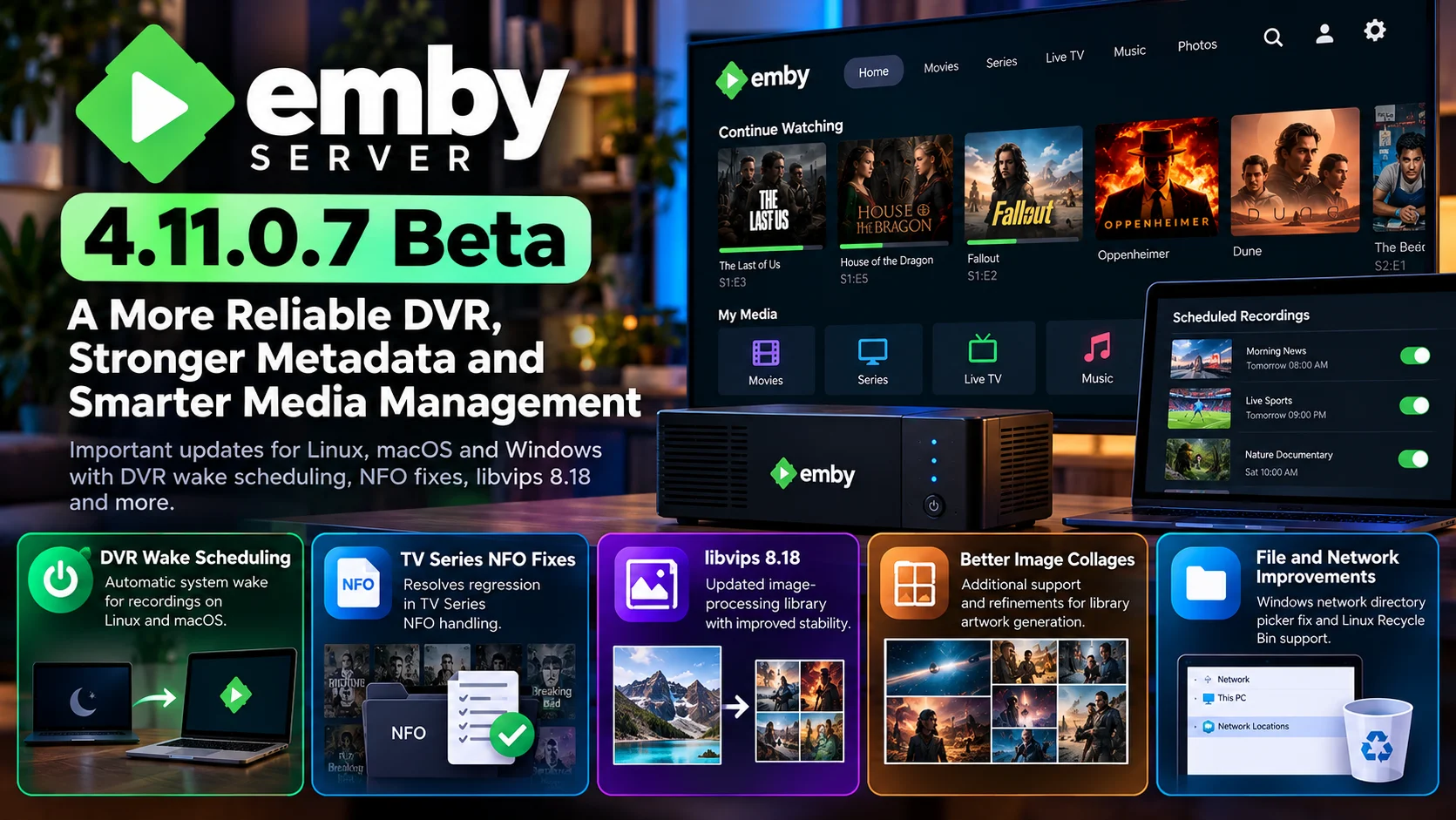
Emby Server 4.11.0.7 Beta is a server-focused update built around reliability rather than flashy interface changes.
Scheduled DVR wake support on Linux and macOS could make a meaningful difference for users who want their recording server to sleep when it is not needed.
The TV Series NFO fix restores reliability for locally managed metadata.
Protection against overly long recording filenames removes another possible DVR failure point.
The libvips 8.18 update and collage improvements modernize Emby’s image-processing pipeline.
Windows network-share users and Linux administrators also receive useful operating-system-specific refinements.
Individually, many of these changes look small.
Together, they improve the parts of a media server that users depend on every day without necessarily seeing them.
For Emby installations handling DVR recordings, local metadata, network storage and large artwork-heavy libraries, version 4.11.0.7 is a beta worth watching closely.
FAQs About Emby Server 4.11.0.7 Beta
1) What is Emby Server 4.11.0.7 Beta?
It is a beta release of Emby Server focused on DVR scheduling, metadata fixes, image processing, file-management improvements and general server reliability.
2) What changed for DVR users?
Linux and macOS gain scheduled system wake support, helping compatible servers wake automatically when an upcoming recording needs to begin.
3) Does the update fix TV Series NFO metadata?
Yes. Version 4.11.0.7 includes a fix for a regression involving TV Series NFO handling.
4) What is libvips 8.18?
libvips is an image-processing library used for operations such as resizing and generating media artwork. Emby has updated its bundled image-processing stack to version 8.18.
5) Does the release improve music playback?
Yes. The update includes a fix related to Play from Albums behavior.
6) What is the PathTooLong recording fix?
Emby now better protects generated recording filenames from becoming so long that the operating system cannot create the requested path.
7) What changed on Windows?
The release fixes behavior involving the network directory picker, which is useful when adding media from network shares.
8) What changed on Linux besides DVR wake scheduling?
Linux also gains Recycle Bin support for safer file-deletion workflows.
9) Should everyone install the beta?
Not necessarily. Users who value maximum server stability may prefer to wait for a stable release, while testers and users affected by specific fixed issues may want to evaluate the beta sooner.
Stay Updated with the Player SDK Guide Hub
Modern media servers depend on much more than simple file playback. DVR scheduling, metadata parsing, image processing, network storage, operating-system integration and safe file management all contribute to the final experience.
The Player SDK Guide Hub tracks developments across Emby, Jellyfin, Plex, Kodi, Windows media servers, Linux HTPC systems, Android TV, Fire TV, Roku, Apple TV and other streaming ecosystems.
We cover media-server releases, DVR improvements, metadata fixes, player updates and streaming-platform changes to explain what changed, why it matters and what users and development teams should test next.
Explore the Player SDK Guide Hub for the latest Emby, media-server and home-theater updates.