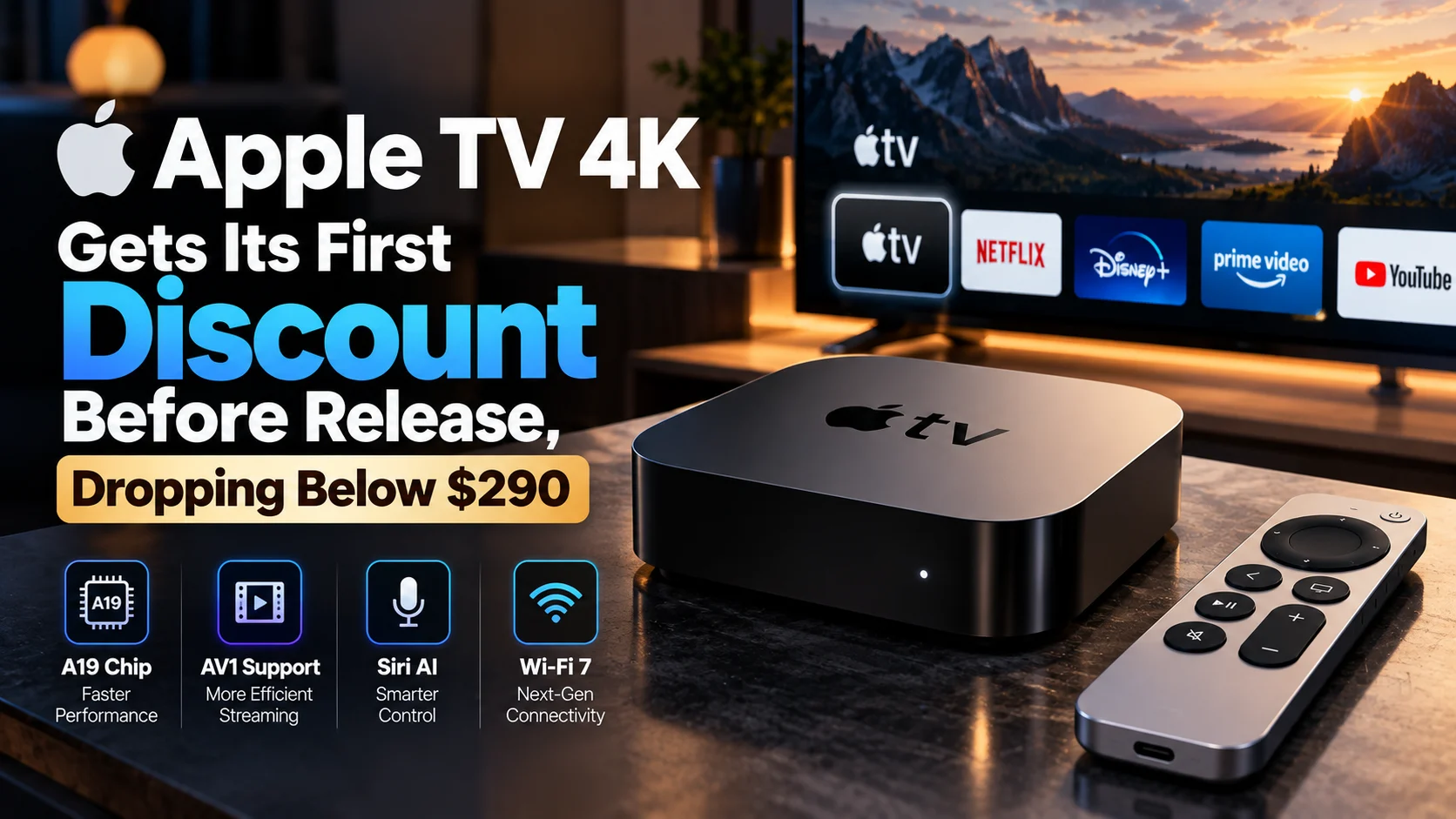
A new Apple TV 4K Dolby Atmos TrueHD workaround is attracting attention among home-theater users because it solves one of the platform's biggest local-media limitations in a surprisingly clever way.
For years, Apple TV has been excellent at streaming Dolby Atmos from major services, but advanced local-media users have had a different problem.
Blu-ray and UHD Blu-ray releases use Dolby TrueHD with Atmos commonly, while Apple TV does not natively send that original TrueHD bitstream unchanged to an AV receiver.
A new open-source playback path changes what is possible.
Instead of trying to force Apple TV to pass TrueHD directly, the player decodes the TrueHD audio and Atmos object metadata, renders the result into a fixed 9.1.6 spatial layout, and then feeds that audio through Apple's positional-audio pipeline.
The result can preserve Atmos height information and immersive positioning that would otherwise be lost in a simpler PCM conversion.
But there is one critical detail:
This isn't native TrueHD passthrough, and it isn't a bit-perfect, lossless TrueHD signal reaching the receiver. The workaround gets much closer to the original immersive Blu-ray presentation, but it takes a different technical route.
Can Apple TV 4K Now Play Dolby TrueHD Atmos?
Compatible experimental and third-party tvOS players can now decode Dolby TrueHD Atmos themselves, preserve the Atmos object information, render it to a spatial speaker layout, and output the result through Apple's audio system.
The basic signal path is:
TrueHD Atmos → decoded audio + object metadata → 9.1.6 spatial render → Apple Positional Audio → Dolby MAT output
That allows an Atmos-capable receiver or soundbar to reproduce height and surround information from the original TrueHD track.
However, the original TrueHD bitstream is not passed through HDMI untouched.
Apple's own published Apple TV 4K audio format list includes Dolby Atmos, Dolby Digital Plus, AC-3, FLAC, and other formats, but it does not list direct Dolby TrueHD bitstream output.
Apple TV TrueHD Workaround at a Glance
| Area | What Happens | Why It Matters |
|---|---|---|
| Source Audio | Dolby TrueHD Atmos | Common on Blu-ray and UHD Blu-ray |
| Decoding | Done inside the media player | Apple TV does not pass TrueHD directly |
| Atmos Metadata | Preserved and interpreted | Keeps height and object positioning |
| Spatial Render | Fixed 9.1.6 layout | Converts object audio into speaker positions |
| Apple Output Path | Positional Audio / Dolby MAT | Works with Apple TV's native audio system |
| Receiver Result | Atmos-capable output | Height channels can remain active |
| TrueHD Bitstream | Not passed through | Receiver does not receive original TrueHD stream |
| Lossless End-to-End | No | Apple Positional Audio path is not bit-perfect TrueHD |
Why TrueHD Atmos Has Been a Problem on Apple TV
Apple TV is built primarily as a streaming device.
That matters because most streaming services do not use the same audio format found on Blu-ray discs.
Streaming platforms commonly deliver Atmos through Dolby Digital Plus, which is bandwidth-efficient and works well over internet connections.
Blu-ray and UHD Blu-ray, on the other hand, can use Dolby TrueHD, which is a lossless audio format designed for much higher data rates.
Apple TV officially supports Dolby Atmos output, but the platform does not behave like a dedicated Blu-ray player that can simply send an untouched TrueHD bitstream to a receiver.
Apple's audio settings explain that Apple TV normally decodes compatible audio and sends uncompressed audio to the connected equipment, while Dolby MAT can be used to maintain a continuous audio connection.
That design works extremely well for mainstream streaming.
It is less ideal for home-theater enthusiasts who keep high-quality Blu-ray remux libraries.
What Exactly Does the New Workaround Do?
The new approach moves the difficult work into the media player.
Open-source projects such as LibTrueHD can decode the TrueHD stream and expose not only the audio channels but also the object-audio metadata used to position sounds in three-dimensional space.
LibTrueHD's project documentation says it can decode the TrueHD Atmos presentation, including bed channels, dynamic objects and object-position metadata.
That data is then used by AetherEngine to create a spatial speaker render.
Instead of discarding the Atmos objects or flattening them into ordinary multichannel PCM, the engine maps them into a fixed 9.1.6 speaker bed.
The result is then delivered using Apple's own positional-audio system.
Apple TV sends that spatial presentation through its supported audio path, including Dolby MAT where appropriate.
This is why the workaround is interesting.
It works with Apple's audio architecture instead of trying to bypass it.
Why 9.1.6 Matters
A 9.1.6 layout represents a highly detailed immersive speaker configuration.
It includes traditional surround channels plus multiple height positions.
The original TrueHD Atmos soundtrack may contain dynamic objects that move freely through three-dimensional space.
The workaround interprets those objects and renders them into a fixed 9.1.6 presentation.
Your actual home theater does not need sixteen physical speakers.
An AV receiver or compatible sound system can map the incoming spatial presentation to the speakers available in the room.
The trade-off is that the objects are no longer remaining in their original fully dynamic form all the way through the signal chain.
They have already been rendered into a defined speaker layout before being handed to Apple's audio system.
That is one reason the method should not be described as identical to native TrueHD passthrough.
Is the Audio Actually Lossless?
Not end-to-end.
This is where the headline needs careful interpretation.
Dolby TrueHD itself is lossless.
But this workaround does not send that lossless compressed stream unchanged to the receiver.
The TrueHD source is decoded first, and the spatial presentation is then converted into Apple Positional Audio.
Nuvio's own documentation explicitly labels the TrueHD Atmos spatial-audio mode as using lossy encoding and distinguishes it from passthrough.
So calling it “Blu-ray quality” is best understood as a description of the source and immersive presentation rather than proof of a bit-perfect Blu-ray signal reaching the receiver.
The better technical description is Blu-ray TrueHD Atmos source with preserved immersive spatial information through a converted Apple TV output path.
Does the Receiver Still Show Dolby Atmos?
Apple TV can deliver Atmos using Dolby MAT.
Apple's own audio documentation notes that Dolby MAT can remain active as part of the platform's continuous audio connection.
That means an AV receiver may display an Atmos indicator.
But the Atmos logo on the receiver should not automatically be interpreted as proof that the receiver is receiving an untouched Dolby TrueHD bitstream.
The distinction is important for home-theater testing.
A receiver displaying Atmos confirms that an immersive Atmos presentation is reaching the audio system.
It does not tell you exactly how that presentation was transported from the original file.
Why This Is Still a Big Improvement
The reason enthusiasts are excited is simple: previous workarounds often lost the Atmos object information.
A media player could decode TrueHD into multichannel PCM, but ordinary PCM conversion may preserve the channel bed while discarding the height and dynamic-object presentation.
The new method aims to retain those elements.
Developers using AetherEngine and LibTrueHD can preserve object metadata, render the immersive layout, and deliver it through Apple's supported pipeline.
That creates a much stronger home-theater experience than flattening an Atmos soundtrack into conventional channels.
For users evaluating local media software, PlayerSDK's media player comparison can help compare codec, audio, and playback support across different media players.
Which Media Players Are Using This Approach?
One of the most visible implementations is Nuvio's Apple TV client using AetherEngine.
The project's documentation includes an optional TrueHD Atmos spatial-audio mode on supported tvOS versions.
AetherEngine itself now documents support for TrueHD Atmos object rendering through its optional TrueHD component.
Another app, Native Player, has also been developing advanced TrueHD Atmos and DTS playback on Apple TV. Its App Store release notes mention Atmos support for TrueHD tracks and improvements to high-quality network playback.
The important point is that the feature is emerging at the player level.
Apple has not announced native TrueHD HDMI passthrough as a system feature.
Does This Work With Plex Libraries?
Potentially, depending on the player used to access the media.
The Apple TV hardware itself is not the only thing that determines whether a file plays correctly.
The media application decides how the audio and video are handled.
PlayerSDK has already documented Plex Apple TV HEVC Direct Play behavior, showing how client-side decisions can change the playback path even when the hardware supports the underlying video format.
The same principle applies to advanced audio.
Having capable Apple TV hardware does not guarantee TrueHD Atmos playback.
The player must include a compatible decoder and spatial-audio implementation.
How Does This Compare With a Blu-ray Player?
A dedicated Blu-ray or UHD Blu-ray player can send the original Dolby TrueHD Atmos bitstream through HDMI to a compatible receiver.
The receiver then performs the TrueHD decoding and Atmos rendering.
That is the traditional home-theater path.
The Apple TV workaround moves those stages around.
Instead of sending the compressed TrueHD stream untouched, the tvOS player performs the decode and object rendering first.
That makes the Apple TV approach technically different even if the final listening experience is impressive.
For users who care about exact signal-path fidelity, a dedicated Blu-ray player or a platform with native audio passthrough remains the cleaner solution.
For users who care more about combining high-quality local playback with the Apple TV interface, apps and ecosystem, the workaround is much more interesting.
Does This Make Apple TV a Better Home-Theater Device?
Potentially, yes.
Apple TV has always had strong hardware, smooth navigation, and good streaming app support.
Its audio limitations have been one reason some advanced local-media users prefer other boxes.
A working TrueHD Atmos object-rendering path reduces that gap.
It does not eliminate every limitation.
But it makes Apple TV significantly more capable for users with high-quality local libraries.
PlayerSDK's Apple TV 4K device guide provides additional hardware context, while the streaming device comparison can help compare Apple TV with competing boxes based on codecs, HDR and audio capabilities.
Is This Ready for Everyday Users?
Not fully.
The most experimental implementations still require technical knowledge.
Some versions need a Mac, Xcode, local app signing or development builds.
Nuvio's TrueHD Atmos setting is marked as beta and disabled by default.
That means this is currently more interesting to enthusiasts and developers than to someone who simply wants to install an app and press Play.
The technology is important because it proves the method can work.
The next step is making that capability easy to access in stable consumer media players.
Final Verdict
The new Apple TV 4K Dolby Atmos TrueHD workaround is one of the most interesting Apple TV home-theater developments in years.
It does something that previously seemed difficult on tvOS: preserving TrueHD Atmos height and object information while still using Apple's supported audio architecture.
The key technical path is straightforward in concept:
TrueHD is decoded inside the player.
Atmos object metadata is preserved.
The audio is rendered into a fixed immersive layout.
That presentation is passed through Apple's positional-audio system and Dolby MAT.
The result can sound far closer to the immersive Blu-ray experience than a basic multichannel PCM conversion.
But accuracy matters.
This is not Dolby TrueHD bitstream passthrough.
It is not a bit-perfect lossless path from file to receiver.
And Apple has not suddenly added native TrueHD passthrough to tvOS.
What developers have done is find a clever way to preserve much more of the original Atmos presentation using the tools Apple already provides.
For home-theater enthusiasts who want to keep Apple TV as their main media box, that is still a meaningful breakthrough.
Frequently Asked Questions
1) Can Apple TV 4K play Dolby TrueHD Atmos?
Compatible third-party players can now decode TrueHD Atmos and preserve its spatial information through an Apple positional-audio workflow. Apple TV still does not natively pass the original TrueHD bitstream unchanged to a receiver.
2) Is the Apple TV TrueHD workaround lossless?
Not end-to-end. The TrueHD source is lossless, but the spatial-audio path used by the workaround does not remain an untouched TrueHD bitstream. Nuvio explicitly describes its APAC path as lossy.
3) Does the workaround preserve Dolby Atmos height channels?
Yes. The purpose of the new object-audio path is to preserve Atmos object and height information instead of reducing the soundtrack to ordinary multichannel playback.
4) What is APAC?
APAC refers to Apple's positional-audio path used by these projects to deliver rendered immersive audio through Apple's native audio system.
5) Does Apple TV support Dolby MAT?
Yes. Apple's audio documentation describes Dolby MAT as part of Apple TV's audio connection behavior.
6) Does an Atmos logo on my receiver mean TrueHD passthrough is working?
No. An Atmos indicator can appear when the receiver receives Atmos through Dolby MAT. It does not prove that the original TrueHD bitstream reached the receiver unchanged.
7) Which Apple TV models can use this approach?
Current experimental implementations focus on recent Apple TV 4K hardware with supported tvOS versions. Exact requirements depend on the player and build being used.
8) Is Nuvio's TrueHD Atmos support officially released?
The feature exists in current open-source development and is marked as an optional beta feature in Nuvio's documentation.
9) Is a Blu-ray player still better for true lossless passthrough?
For an untouched TrueHD bitstream sent directly to an AV receiver, a dedicated Blu-ray player or another platform with native passthrough remains the cleaner signal path.
10) Is Apple TV now a better choice for local media?
For users who value Apple TV's interface and ecosystem, this development makes it more attractive. The final experience still depends heavily on the media player being used.
Building a premium Apple TV 4K home-theater setup?
Use PlayerSDK's media player comparison to compare audio, codec and playback capabilities, or explore the streaming device comparison to evaluate Apple TV against other hardware for Dolby Atmos, HDR and local-media playback.