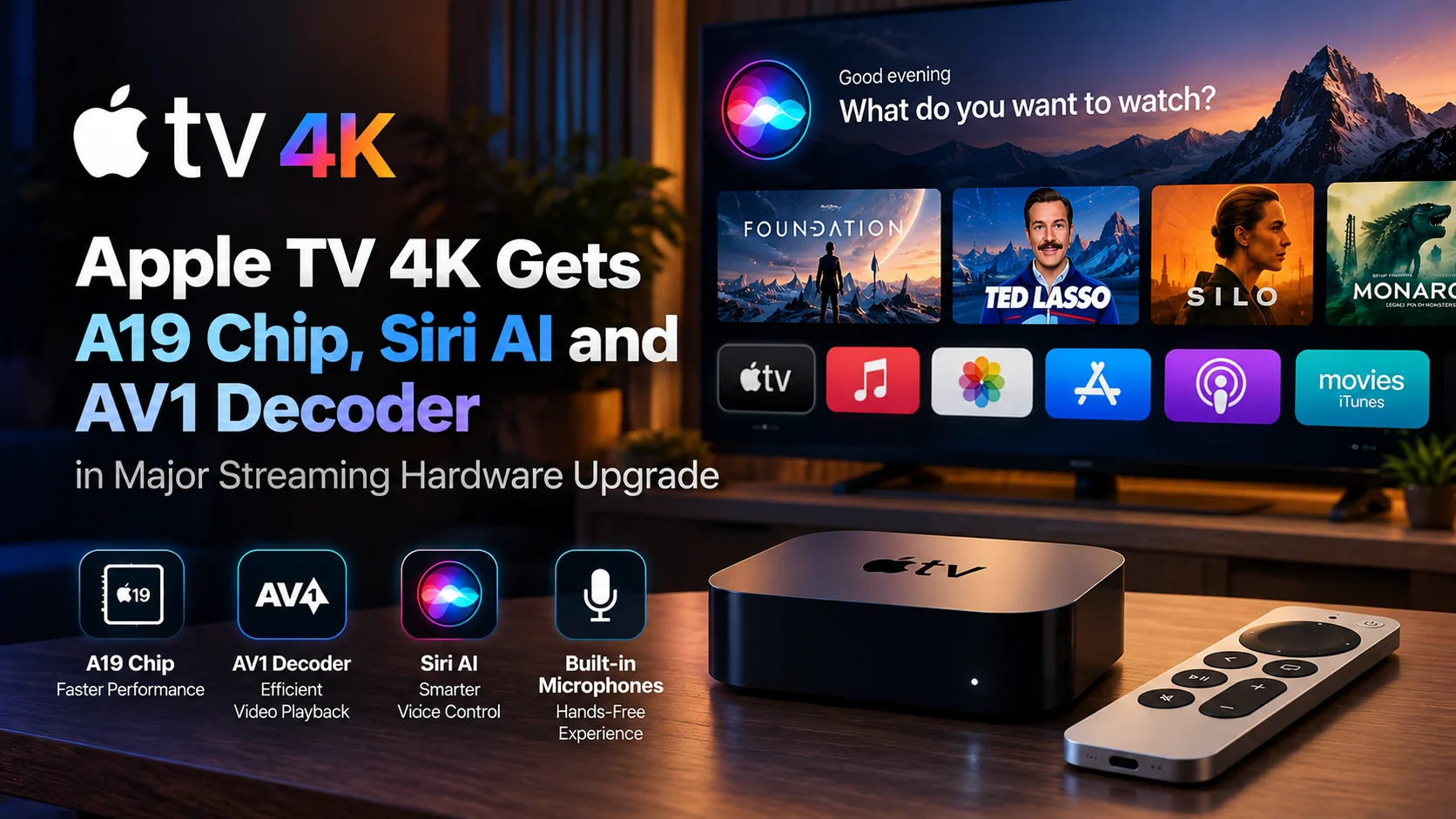
The latest generation moves to the A19 chip, adds a dedicated AV1 video decoder, brings the new Siri AI experience directly to the television, and introduces built-in far-field microphones for completely hands-free voice control.
For everyday users, that means faster navigation and a more conversational way to find content.
For streaming and home-theater users, however, the most interesting change may be something less visible: the dedicated AV1 decoder.
AV1 is becoming increasingly important for efficient high-quality video delivery, especially as streaming platforms push higher resolutions while trying to control bandwidth usage.
Apple says the new A19 processor delivers up to 50% faster CPU performance and up to 2× faster GPU performance compared with the previous generation. The chip also contains dedicated AV1 decoding hardware designed to deliver high-quality streams more efficiently.
That combination turns the new model into more than a routine Apple TV refresh. It is a substantial streaming hardware upgrade.
What Is New in the Apple TV 4K?
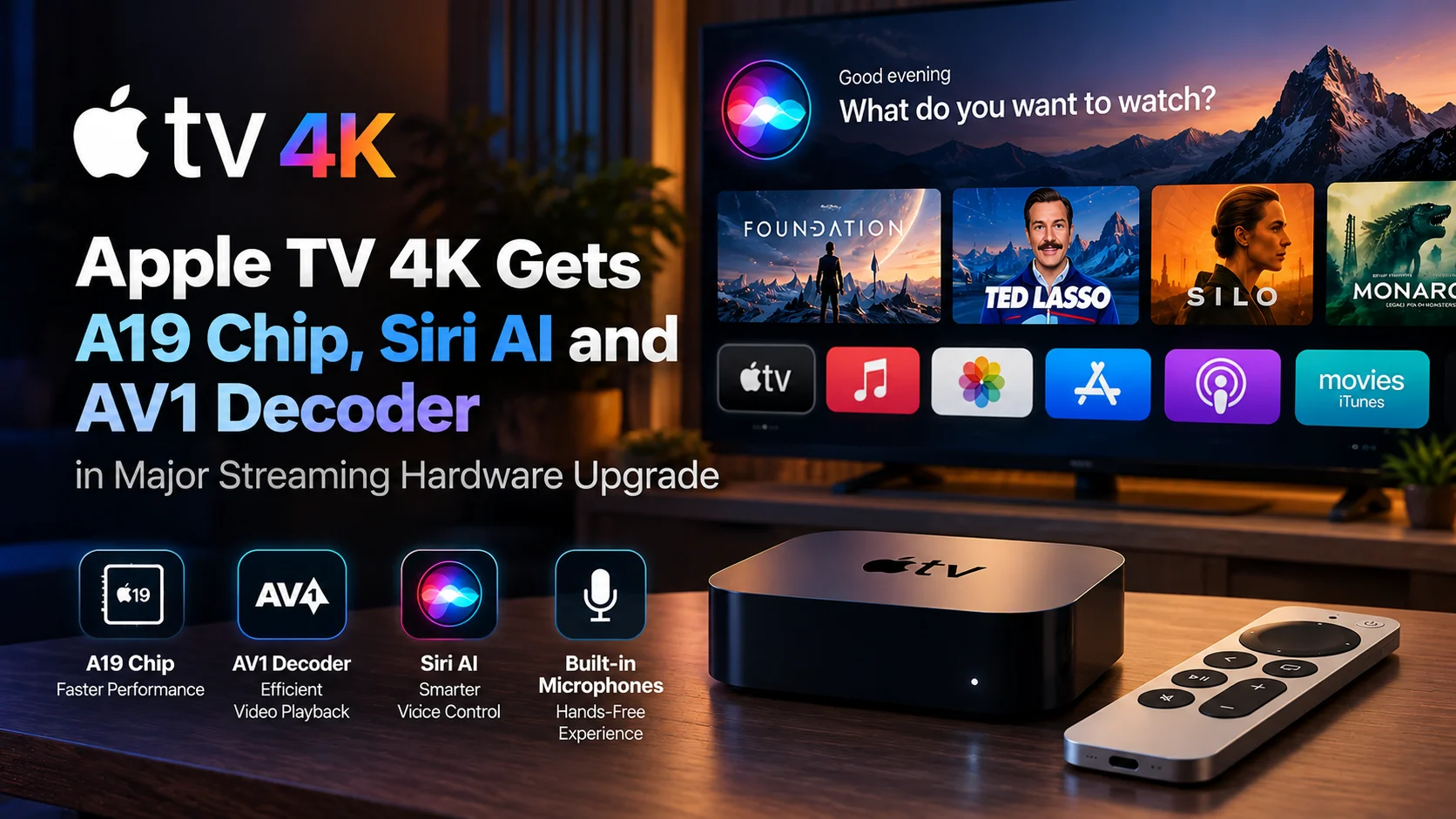
The biggest upgrades are the A19 processor, dedicated AV1 hardware decoding, Siri AI, three built-in far-field microphones, an improved Siri Remote with Find My features, and expanded HomePod surround-sound capabilities.
The A19 provides more processing headroom for tvOS, apps, games, and media processing.
The dedicated AV1 decoder is particularly relevant for video because it allows the device to decode modern AV1 streams using purpose-built hardware rather than placing unnecessary pressure on general CPU resources.
Siri AI changes how users can search for movies and shows, while the microphones remove the need to pick up the remote every time someone wants to make a voice request.
Together, these changes move Apple TV 4K closer to becoming a complete living-room hub rather than just an app launcher.
New Apple TV 4K Upgrades at a Glance
| Feature | New Apple TV 4K | Why It Matters |
|---|---|---|
| Processor | A19 chip | Faster navigation, apps and processing |
| CPU Performance | Up to 50% faster | More responsive tvOS experience |
| GPU Performance | Up to 2× faster | Smoother graphics and gaming |
| Video Decoder | Dedicated AV1 decoder | More efficient modern video playback |
| Voice Control | Siri AI | More conversational content discovery |
| Microphones | Three far-field microphones | Hands-free Siri control |
| Remote | Find My with Precision Finding | Easier remote location |
| Home Theater | Four-speaker HomePod support | Expanded surround-sound setup |
| Smart Home | Apple Home hub integration | More connected living-room control |
Why the A19 Chip Matters for a Streaming Device
Streaming boxes do not need smartphone-class processors simply to display a movie.
But modern television software does much more than decode a single video stream.
The operating system loads high-resolution artwork, recommendations, animations, application interfaces, subtitles, metadata, and background services. Applications may switch rapidly between different video formats, HDR modes, and audio streams.
A faster processor gives tvOS more headroom for all of these tasks.
Apple says the A19 chip delivers up to 50% faster CPU performance than the previous Apple TV generation. GPU performance can be up to twice as fast.
Users are most likely to notice that improvement during navigation, application launching, and graphically demanding experiences rather than during a basic movie stream.
That distinction matters.
A faster CPU does not automatically make a 4K movie look better.
Instead, it makes the complete Apple TV streaming experience more responsive while giving applications more performance headroom for future features.
For users deciding between generations, PlayerSDK's Apple TV 4K device guide provides useful context on the previous model and its existing playback capabilities.
Why the Dedicated AV1 Decoder Is the Bigger Video Upgrade
For video enthusiasts, the Apple TV 4K AV1 decoder may be the most important addition.
AV1 is a modern video compression format designed to deliver strong picture quality at lower bitrates than many older codecs.
Lower bitrate does not automatically mean lower quality.
A more efficient codec can preserve similar visual quality while transmitting less data.
That has obvious benefits for high-resolution streaming.
The viewer may use less bandwidth.
Streaming services can deliver high-quality video more efficiently.
Network pressure can be reduced.
And devices with dedicated AV1 decoding can handle the format without relying as heavily on general-purpose processing.
Apple specifically describes the A19 as containing a new dedicated AV1 decoder that enables efficient, high-quality streaming while using less bandwidth.
This makes AV1 a hardware-level feature rather than simply another software checkbox.
Will AV1 Make Every Video Look Better?
No.
This is an important distinction.
The presence of an AV1 hardware decoder does not automatically improve movies encoded in HEVC, H.264, or another existing format.
AV1 benefits appear when the source video itself is delivered using AV1.
If an application continues serving HEVC, the device will continue decoding HEVC.
If the service delivers an AV1 version of that same title, the dedicated decoder can handle it more efficiently.
The real advantage is flexibility.
Streaming providers increasingly have another efficient codec option available when delivering content to compatible hardware.
That can become more valuable as 4K streaming, higher frame rates, and richer video formats place more pressure on broadband connections.
What Does This Mean for HEVC and Dolby Vision Playback?
The arrival of AV1 does not make HEVC video playback irrelevant.
HEVC remains deeply established across 4K media libraries, streaming platforms, and home-theater workflows.
Dolby Vision playback also continues to matter for users with compatible televisions.
The new decoder simply expands the hardware's video capabilities rather than replacing every existing format.
This is important for users with personal media libraries.
A modern streaming box needs to deal with several combinations of container, codec, HDR metadata, audio format, and application behavior.
Hardware capability is only one part of that equation.
The media application must also correctly identify and use those capabilities.
PlayerSDK has already covered Plex Apple TV HEVC Direct Play behavior, where some users reported client-side changes causing HEVC media to be converted instead of Direct Played.
That example shows why powerful hardware alone cannot guarantee the ideal playback path.
The application still matters.
Siri AI Changes Content Discovery
The other major headline feature is Apple TV Siri AI.
Apple describes the new experience as a more capable conversational assistant powered by its next generation of Apple Intelligence.
Instead of using short command-style requests, viewers can ask broader questions about content and then continue with follow-up questions.
For example, the system can surface relevant shows based on a conversational query and provide information about a movie or program while playback continues.
Responses can appear in a compact overlay rather than forcing the viewer to leave what they are watching.
This could make voice search substantially more useful.
Traditional TV voice assistants are often good at commands such as opening an application or searching for a title.
Conversational context is a different challenge.
If Siri AI works consistently across real-world viewing situations, content discovery could become less dependent on manually navigating rows of recommendations.
Hands-Free Siri No Longer Requires the Remote
Voice control receives another major change.
The new Apple TV 4K contains three far-field microphones.
That means users can speak directly to the Apple TV rather than pressing a microphone button on the Siri Remote.
Apple says advanced echo cancellation helps isolate a user's voice even when audio is already playing.
That could make common commands more natural.
Someone watching a movie could ask Siri a question, control playback, or search for another title without first locating the remote.
The feature also makes more sense when Apple TV is being used as a smart-home hub.
Hands-free control allows the device to behave more like a permanent living-room assistant rather than a box that only responds after someone picks up a controller.
The Siri Remote Gets Easier to Find
Apple has kept the familiar overall Siri Remote design but added stronger Find My functionality.
Precision Finding can help locate the remote, and users can also trigger a sound when searching for it.
This is a smaller upgrade than A19 or AV1, but it addresses a very practical problem.
Streaming remotes disappear into couches constantly.
Improving location tools can have more day-to-day value than adding another button or redesigning the remote simply for the sake of change.
Apple TV 4K Becomes a More Serious Home Theater Hub
Apple is also expanding the way Apple TV works with HomePod speakers.
The new model can create a four-speaker surround sound setup using compatible matching HomePod speaker pairs.
Apple says the speakers work with Apple TV 4K to recognize their position in the room and automatically calibrate audio timing and levels.
This is a meaningful change for users already inside Apple's ecosystem.
Traditionally, someone wanting a larger home theater system would connect an AV receiver or soundbar system.
Apple is creating another path where the streaming box and wireless speakers form a more integrated system.
It will not replace advanced dedicated home theater equipment for every enthusiast.
But for users who value simplicity, wireless setup, and ecosystem integration, it makes Apple TV more competitive as the center of the living room.
Is the New Apple TV 4K Better for Media Players?
From a hardware perspective, the extra performance and AV1 decoder provide a stronger foundation.
But video player performance depends on software as well.
Different applications can use hardware capabilities differently.
Container support, subtitle handling, audio processing, HDR output, and Direct Play decisions can vary from one application to another even when they run on the same Apple TV.
That is why PlayerSDK's media player comparison can be useful alongside hardware comparisons.
The device determines what processing resources are available.
The player determines how effectively those resources are used.
For local media users, that distinction is particularly important.
A powerful processor cannot correct a player that requests an unnecessary transcode or does not support a specific playback feature.
How Does It Compare With the Previous Apple TV 4K?
The previous Apple TV 4K was already a fast streaming box.
That means the upgrade decision is different from moving away from a slow entry-level streamer.
Existing owners should ask what problem they are trying to solve.
If an older Apple TV already launches applications quickly and handles the content they watch, raw processor speed alone may not justify changing devices.
The stronger case comes from the combined improvements.
The A19 processor, dedicated AV1 decoding, hands-free microphones, smarter Siri experience and expanded HomePod integration create capabilities that previous hardware does not offer in exactly the same package.
Users comparing Apple TV against Fire TV, Google TV and other boxes can use PlayerSDK's streaming device comparison to evaluate differences in processor performance, HDR support, codecs, storage and platform features.
Is the A19 Upgrade Mainly About Future-Proofing?
Partly.
Streaming boxes usually remain in service longer than smartphones.
A user may keep the same device connected to a television for several generations of software updates.
Extra processing performance can therefore become more valuable over time.
Today's interface may not require all of the A19's available power.
Future tvOS features, richer applications, games, AI functions and new video workflows may benefit from that headroom.
The dedicated AV1 decoder is also a future-looking feature because codec adoption can increase as streaming platforms optimize delivery.
So while current owners may not immediately see a dramatic picture-quality change, the hardware is better positioned for evolving streaming requirements.
Does Siri AI Require the New Apple TV 4K?
Not entirely.
Apple says Siri AI is also available in beta on Apple TV 4K models from the second generation onward.
That is an important detail for existing owners.
Buying the newest Apple TV is not required simply to access every part of the new Siri experience.
However, older models do not gain the new A19 processor, built-in far-field microphones or dedicated hardware architecture of the newest device.
That makes Siri AI a shared software upgrade, while the newest model's main advantage is the combination of software and new hardware.
Final Verdict
The new Apple TV 4K with A19 chip is a meaningful upgrade because Apple has improved several parts of the streaming experience at the same time.
The faster CPU and GPU should make tvOS feel more responsive.
The dedicated AV1 decoder gives video applications a more efficient path for increasingly common modern streams.
Siri AI makes voice interaction more conversational.
Far-field microphones make those interactions hands-free.
The improved Siri Remote solves a small but common usability problem.
And expanded HomePod surround support gives Apple TV a larger role in the home-theater ecosystem.
For existing Apple TV owners, the upgrade decision depends on usage.
Someone satisfied with the previous model may not need to replace it simply for faster navigation.
But viewers interested in AV1 video playback, hands-free Siri, newer smart-home capabilities and Apple's expanded wireless home-theater setup have much stronger reasons to consider the new hardware.
More importantly, the update shows where premium streaming devices are heading.
They are no longer just boxes that open streaming applications.
They are becoming powerful video processors, media hubs, voice assistants and smart-home controllers built around the television.
Frequently Asked Questions
1) What processor does the new Apple TV 4K use?
The new model uses Apple's A19 chip. Apple says it delivers up to 50% faster CPU performance and up to twice the GPU performance of the previous generation.
2) Does the new Apple TV 4K support AV1?
Yes. The A19 includes a dedicated AV1 decoder designed for efficient high-quality video streaming with reduced bandwidth requirements.
3) Does AV1 improve all Apple TV videos?
No. The benefit applies when the video is actually encoded and delivered in AV1. Existing HEVC or H.264 content continues using its respective codec.
4) What is Siri AI on Apple TV?
Siri AI is Apple's more conversational Siri experience for television. It can help users find content, answer follow-up questions and provide information while they are watching.
5) Can Siri be used without touching the remote?
Yes. The new Apple TV 4K includes three far-field microphones that allow hands-free Siri commands.
6) Do older Apple TV 4K models get Siri AI?
Apple says Siri AI is available in beta on Apple TV 4K models from the second generation onward. Older models do not receive the new A19 chip or built-in microphones.
7) Is the new Apple TV 4K better for 4K video playback?
It has a stronger hardware platform and a dedicated AV1 decoder, which expands its modern video-decoding capabilities. Actual playback quality still depends on the source, application, codec, HDR format and television.
8) Does the new Apple TV support Dolby Vision?
Apple TV 4K remains positioned as a premium HDR streaming platform, and Dolby Vision continues to be an important part of the Apple TV ecosystem. The new AV1 decoder adds another video capability rather than replacing existing HDR and codec support.
9) Is the new Apple TV worth upgrading from the previous model?
It depends on what you need. Users interested in AV1 hardware decoding, hands-free voice control, more processing power and deeper HomePod integration have the strongest reasons to upgrade. Users already satisfied with their existing Apple TV may not need to replace it immediately.
10) Can Apple TV work as a home-theater hub?
Yes. The new Apple TV 4K expands HomePod integration and can support a four-speaker surround setup with compatible matching HomePod pairs.
Looking for the right 4K streaming device for your setup?
Explore PlayerSDK's streaming device comparison, Apple TV 4K device guide, media player comparison, and Apple TV playback coverage to compare codecs, HDR capabilities, performance and real-world media-player behavior before choosing your next streaming box.