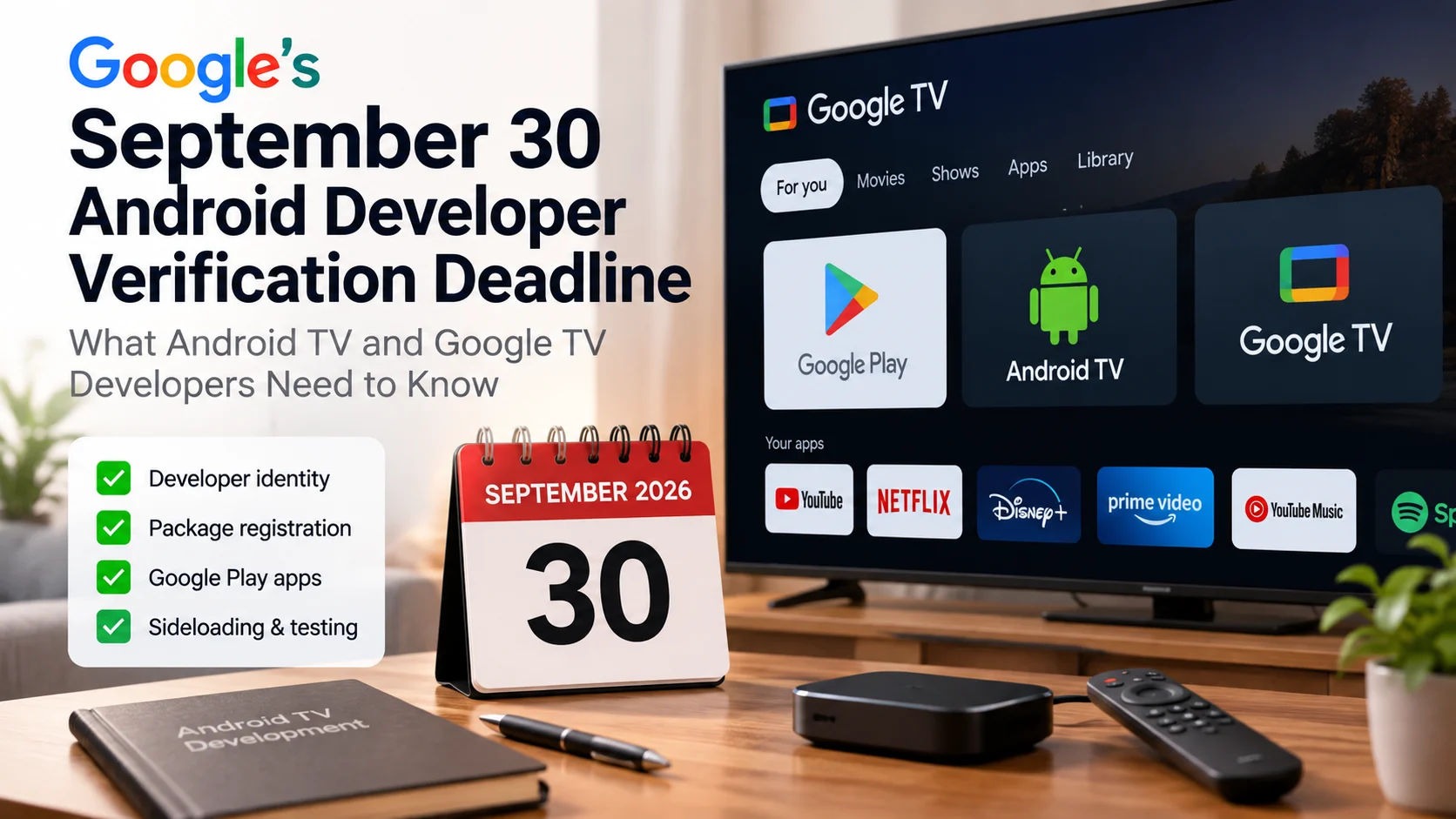
Google’s major Android developer verification milestone has arrived, introducing new requirements around developer identity and app registration that Android developers can no longer treat as a distant platform change.
Starting September 30, Android’s new verification protections take effect for users in Brazil, Indonesia, Singapore, and Thailand when apps are installed through participating app stores on certified Android devices. Google plans to expand the system globally in 2027.
However, Android TV and Google TV developers should note an important detail that's easy to miss.
The September enforcement rules do not apply to every TV app in the same way.
Google says apps distributed through Google Play need their package names registered across form factors. But for applications distributed outside Google Play, the initial regional enforcement applies to mobile and tablet form factors, while Google recommends registering TV and other form-factor apps now to prepare for the broader global rollout.
That makes today’s deadline important for television developers even though the immediate installation rules are more nuanced than a simple “all Android TV apps must now be verified” headline.
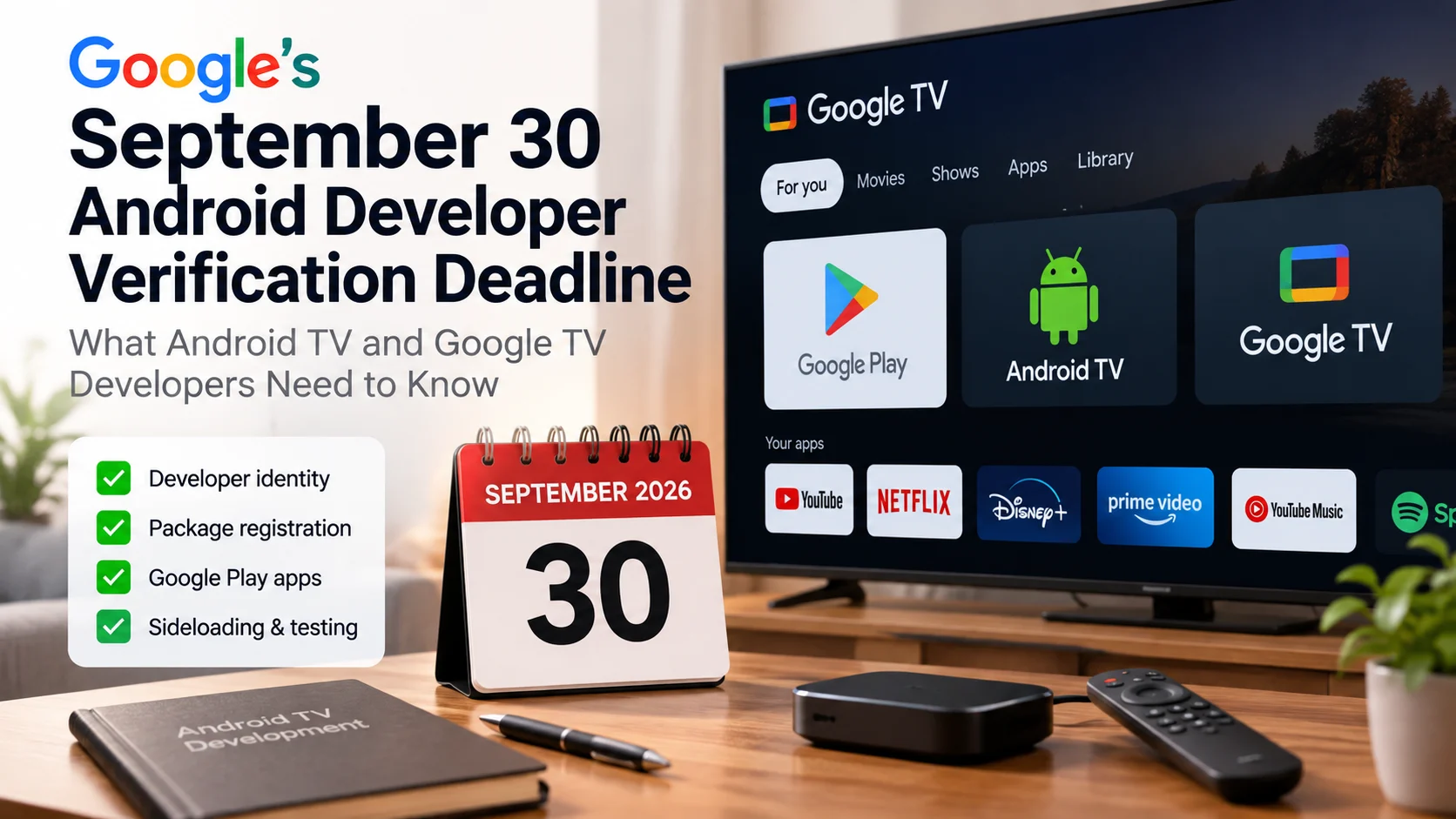
What Is Android Developer Verification?
Android developer verification is a new security layer designed to connect apps installed on certified Android devices with verified developer identities.
Google describes it as an identity check rather than an additional app-content review.
The system is intended to make it harder for malicious developers to distribute harmful software under new anonymous identities repeatedly.
The package registration links the Android package to the verified developer responsible for distributing it.
For developers already using Google Play, much of the process may already have happened automatically. Google says the overwhelming majority of existing Play apps have already been registered, but developers are still expected to check their Play Console status and complete registration for anything that remains outstanding.
September 30 Requirements at a Glance
| Developer Scenerio | What September 30 means |
|---|---|
| Google Play developer | Play package names must be registered to meet Android developer verification requirements |
| Android TV / Google TV app on Google Play | Registration still matters because Play requirements apply across app form factors |
| App distributed only outside Google Play | Developer can use the Android Developer Console for verification and package registration |
| Third-party store distribution in launch countries | Verification requirements begin for participating stores on applicable certified devices |
| Android TV app distributed outside Play | Initial regional enforcement does not currently target TV form factors, but registration is recommended ahead of global expansion |
| Direct sideloading | Advanced-user installation flows remain available |
| Development through ADB | Existing ADB development workflow continues |
| Students and hobbyists | Limited-distribution account option is available for small-scale app sharing |
What Android TV and Google TV Developers Need to Understand
The biggest potential source of confusion is the difference between Google Play requirements and the wider Android installation-verification system.
If your Android TV or Google TV app is distributed through Google Play, package registration should be treated as an immediate requirement.
Google’s updated Play Console rules state that Play packages need to be registered to comply with Android developer verification.
The company warns that Play apps that remain unregistered can face removal from Google Play.
That makes today relevant even if the application runs exclusively on televisions.
Google’s developer FAQ specifically says Play developers should register apps across all form factors.
The situation is different for developers distributing TV APKs independently.
For outside-play distribution, Google says the first regional enforcement phase applies only to mobile and tablet form factors in the selected markets.
So an independently distributed Android TV APK is not suddenly blocked on every Google TV or Android TV device today simply because it has not completed the new process.
But that exception should not be interpreted as permanent.
Google explicitly recommends registering apps across form factors to prepare for future availability requirements, and the verification program is scheduled to expand globally in 2027.
Google Play Developers Should Check Package Registration Now
Developers with a Play Console account should not assume that identity verification automatically means every application is fully ready.
Google identifies identity verification and package registration as separate requirements.
Existing Play apps may have been automatically registered when ownership could be determined confidently.
However, developers are expected to check Play Console and confirm that no remaining package requires action.
This matters for companies maintaining multiple applications.
A streaming company might have a mobile application, an Android TV application, an internal test package, a legacy package name, and region-specific variant under the same developer account.
The primary app may already be registered while an older or less frequently maintained package still requires attention.
Today is therefore a good point for teams to audit the entire package portfolio rather than checking only the newest production application.
TV Developers Outside Google Play Have a Separate Console
Google created the Android Developer Console for developers distributing apps exclusively outside Google Play.
This is separate from the traditional Google Play Console.
Developers using direct downloads, alternative distribution systems, or other non-Play workflows can use the Android Developer Console to establish developer identity and register application package names.
For Android TV developers, this becomes increasingly important as the verification model expands.
A TV application may currently be distributed from a company website, enterprise portal, OEM partnership, or custom installer rather than the Play Store.
Even when immediate enforcement does not yet apply to that TV installation path, getting the package registered reduces the amount of work required when the broader rollout reaches additional form factors and regions.
What Happens in Brazil, Indonesia, Singapore, and Thailand?
The initial enforcement begins with four countries:
Brazil, Indonesia, Singapore, and Thailand.
Google says the verification system initially covers installations from participating app stores, including Google Play, HONOR App Market, OPPO App Market, Samsung Galaxy Store, Palm Store, vivo V-Appstore, and Xiaomi GetApps.
On covered certified devices, apps distributed through these participating stores need to be associated with verified and registered developers.
This regional launch gives Google and its partners a chance to evaluate how the system behaves before the larger worldwide expansion.
For global streaming-app developers, that means the change can affect users even when the development team itself is located elsewhere.
What matters is where the app is distributed and installed, not simply where the developer's headquarters are located.
Certified Android Devices Are the Key Target
Developer verification is tied to certified Android devices.
Google’s current verification information describes the new protections as applying to certified Android devices running Android 7 or later in the initial rollout.
For Android TV and Google TV teams, certification status matters because this system is part of Google’s broader Android ecosystem rather than a generic restriction built into every possible Android-based device.
The distinction can be particularly relevant in the television market, where some devices run Android-derived software without participating in the same Google certification ecosystem.
Developers should therefore avoid assuming that every device capable of installing an APK will behave identically.
What Happens to Sideloading?
Android sideloading is not disappearing.
Google continues to support multiple paths for installing applications outside normal app-store distribution.
Developers can continue using ADB, and Google says the ADB workflow remains unchanged.
For advanced users, Android also provides an advanced installation flow that can allow installation from an unverified developer after the user completes additional security steps and acknowledges the risk.
This distinction is especially important in the Android TV ecosystem.
Power users frequently install media players, launchers, IPTV clients, development builds, and experimental applications manually.
Developer verification changes how some of those installs are handled, but it does not mean Android has completely removed the ability to install software outside Google Play.
What About Internal Android TV Testing?
Development and QA teams that use ADB for internal testing should see much less disruption.
Google explicitly says the existing ADB development workflow remains available.
That means common Android TV development tasks, such as installing a debug APK from Android Studio or using adb install on a connected television or streaming box, continue to have a supported path.
This matters for companies maintaining dedicated test labs.
A streaming team may need to deploy dozens of development builds each day across Google TV televisions, Chromecast-class devices, or other certified Android TV hardware.
Verification is primarily about distribution accountability, not preventing developers from testing their own builds during development.
Students and Hobby Developers Have Another Option
Google has also introduced limited distribution accounts for developers who do not need large-scale commercial distribution.
This option is designed for groups such as students, hobby developers, and learners.
Google says limited-distribution developers can share apps with a limited number of authorized devices without following the same identity path required for wider commercial distribution.
That may be particularly useful in the Android TV community.
Many television utilities, experimental media players, and home-automation interfaces begin as small hobby projects intended for a handful of devices rather than public app-store distribution.
The limited-distribution model gives those developers a more appropriate route than forcing every experimental TV application into the same workflow as a major commercial streaming service.
Signing Keys Become More Important
Package registration also makes app signing identity more important.
Android has long used signing certificates to determine application identity and control updates.
Developer verification adds another layer by connecting registered packages and signing information to a verified developer.
Teams maintaining older Android TV applications should therefore make sure signing-key ownership and build infrastructure are clearly documented.
This can be particularly important after acquisitions, developer-account migrations or years of staff changes.
A television app may remain installed on devices for much longer than a typical mobile application because users replace TVs and streaming boxes less frequently.
Losing access to an old signing key can already complicate updates. Verification makes good signing-key management even more important.
CI/CD Teams Should Treat Registration as Infrastructure Work
Developer verification is not only an account-administration task.
Google has introduced APIs designed to help larger developers integrate package registration into automated workflows.
That means companies operating many Android applications can treat verification status as part of release engineering.
For a large streaming service, a release pipeline might include mobile, tablet, Android Automotive, Wear OS and Android TV variants.
Instead of relying entirely on someone manually checking package registrations, engineering teams can increasingly connect verification status with internal deployment systems.
That will become more important as Android verification expands globally.
What Should Android TV Teams Check Today?
For most professional teams, the practical work is straightforward.
Confirm that the developer identity associated with the application has completed verification.
Then confirm that every relevant Play package is registered rather than assuming automatic registration covered everything.
Teams distributing outside Google Play should evaluate Android Developer Console registration even when their TV app is not part of the first enforcement group.
Finally, inventory package names, signing keys and alternative distribution channels.
This is particularly important for white-label streaming applications where one codebase may produce dozens of differently branded package names.
A forgotten package can become much more difficult to fix after enforcement expands.
This Is the Beginning, Not the End
September 30 is best understood as the first major enforcement milestone rather than the final state of Android developer verification.
The system begins regionally, with specific stores and form factors receiving the first protections.
Google says it plans to expand the requirements globally across certified Android devices in 2027 and beyond.
For Android TV and Google TV developers, that future expansion matters more than trying to find a temporary loophole in the initial enforcement scope.
Teams that register their applications and organize signing ownership now should be better positioned when verification reaches more television distribution paths.
Final Thoughts
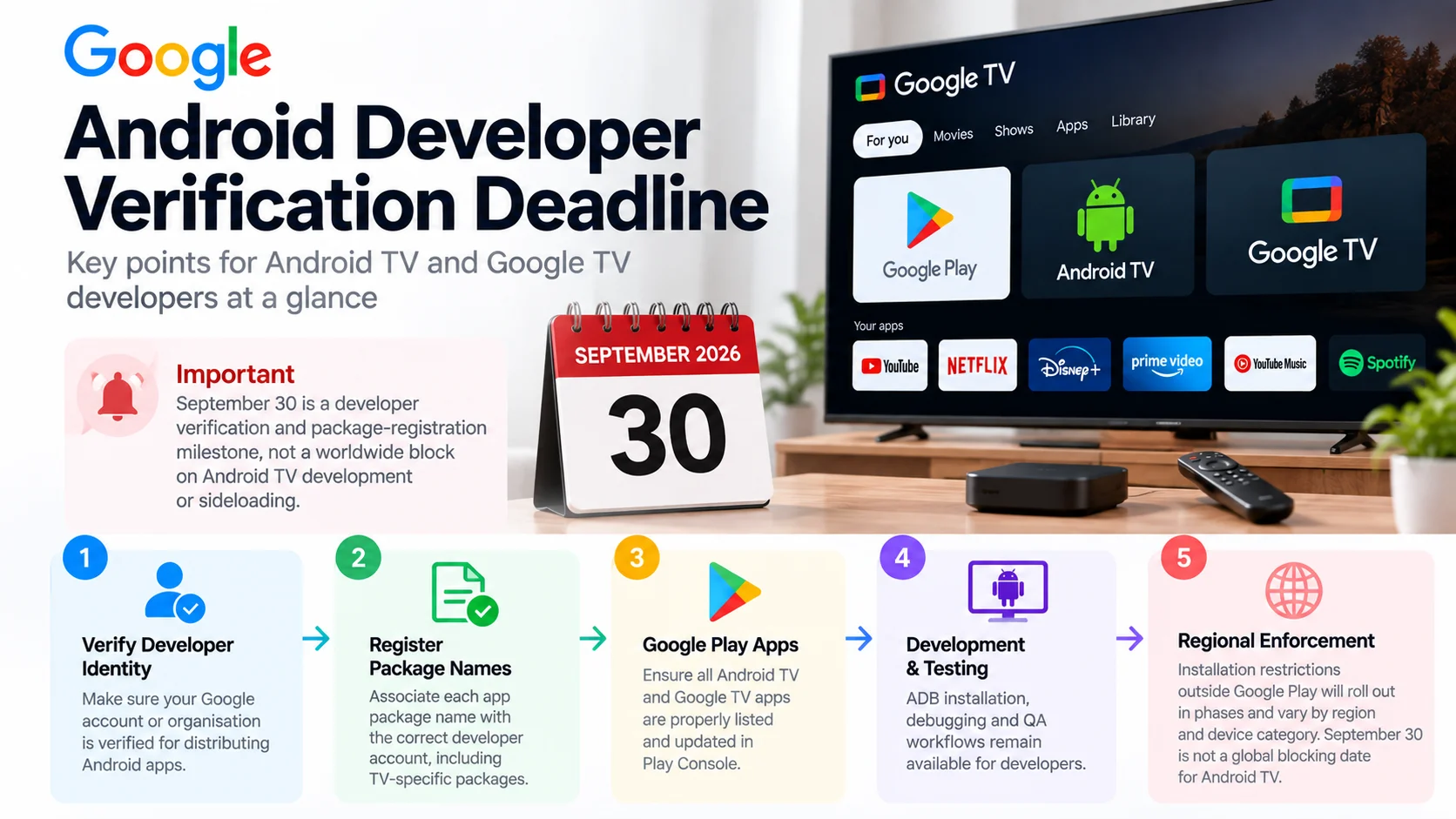
September 30 marks an important change in Android app distribution, but Android TV and Google TV developers need to understand the details rather than treating it as a universal overnight block on every TV APK.
Google Play developers have the clearest immediate responsibility: verify account status and confirm that relevant package names are registered.
Outside Google Play, the initial enforcement is narrower, with the first regional requirements focused on mobile and tablet installations from participating stores.
That means independently distributed Android TV applications are not all suddenly blocked today.
But the direction of the platform is clear.
Android developer verification is moving toward broader global coverage on certified devices, and Google has already indicated that expansion will continue in 2027.
For television developers, the best preparation is therefore not to wait until a TV-specific enforcement warning appears.
Verify developer identity, register important package names, confirm signing-key ownership and document every distribution channel used by the application.
For streaming companies running multiple Android TV and Google TV apps, this should now be treated as part of release infrastructure rather than just another Play Console notification.
FAQs About Android Developer Verification
1) Does the September 30 deadline apply to Android TV apps?
For Google Play developers, app packages across form factors need to be registered. For apps distributed outside Google Play, Google's initial regional enforcement is limited to mobile and tablet form factors, although TV developers are encouraged to register ahead of broader rollout.
2) Does this affect Google TV apps?
Google TV applications are Android applications, so Google Play package-registration requirements still matter. Outside-Play television enforcement is more limited during the initial rollout.
3) Is sideloading being banned?
No. ADB remains available, and Google provides an advanced flow that lets knowledgeable users install apps from unverified developers after additional security steps.
4) What happens if a Google Play package is not registered?
Google says Play packages must be registered to meet its updated requirements, and unregistered packages can be removed from Google Play.
5) Do developers outside Google Play need Play Console?
No. Google provides the Android Developer Console specifically for developers who distribute exclusively outside Google Play.
6) Does Android developer verification review the content of an app?
No. Developer verification focuses on identifying the developer and registering the application rather than acting as a new content-review process.
7) Does the requirement apply worldwide today?
No. The initial installation protections begin in Brazil, Indonesia, Singapore and Thailand. Google plans a broader global rollout in 2027.
8) Should Android TV developers wait until TV enforcement expands?
That may create unnecessary risk. Google recommends registration across form factors, and completing the work now gives teams more time to resolve package ownership, identity or signing-key problems before broader enforcement.
Stay Updated with the Player SDK Guide Hub
Android platform changes can directly affect how streaming applications are built, signed, distributed and installed across television devices.
The Player SDK Guide Hub tracks developments across Android TV, Google TV, Fire TV, Roku, Apple TV, Android Media3, ExoPlayer, Plex, Kodi, VLC and other streaming-device and video-player platforms.
We cover developer requirements, SDK releases, playback changes, operating-system updates, app-store policies and device-level changes to explain what changed, which workflows are affected, why it matters and what development teams should prepare for next.
Explore the Player SDK Guide Hub for the latest Android TV, Google TV, streaming-device and developer-platform updates.