Amazon is making one of the most significant changes to the Fire TV platform in years. Future Amazon Fire TV Sticks are moving away from Android-based Fire OS and toward Vega OS, Amazon's newer operating system designed specifically for its devices.
For everyday viewers who mainly use Netflix, Prime Video, YouTube, JioHotstar, and other major streaming apps, the transition may not immediately feel dramatic. The familiar Fire TV experience remains at the center of the product.
For advanced users, developers, and anyone who has traditionally installed Android APKs manually, however, the change is much more important.
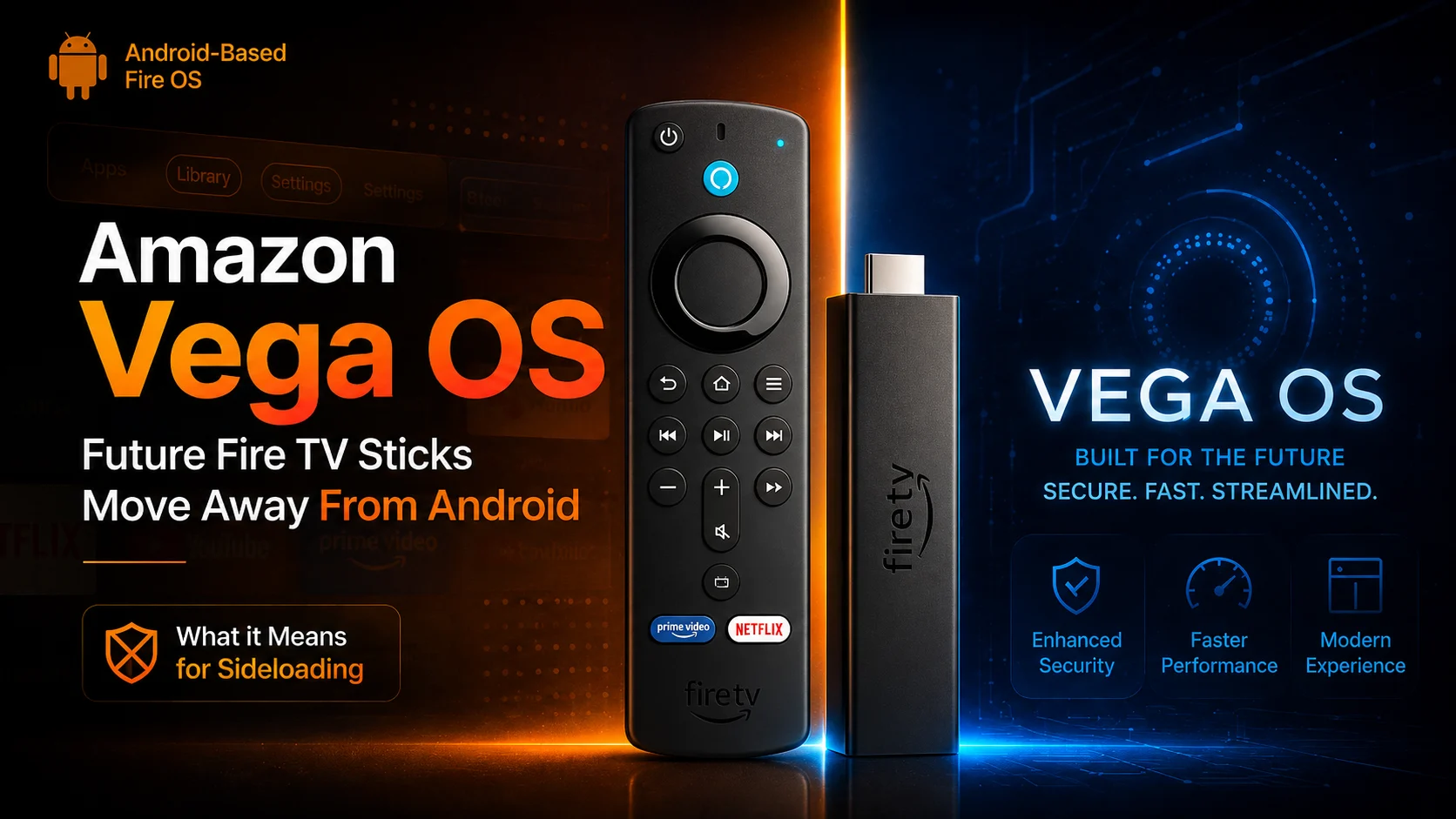
Amazon now states on its developer website that starting with the Fire TV Stick 4K Select, all future Fire TV Sticks will run on Vega. The 2026 Fire TV Stick HD has already continued that strategy, confirming that Vega OS is becoming Amazon's standard platform for new Fire TV Stick hardware.
So what exactly is Vega OS, why is Amazon moving away from Android, and what happens to sideloading? Here's what Fire TV users need to know.
What Is Amazon Vega OS?
Vega OS is Amazon's newer operating system built for devices such as its Fire TV streaming players.
For years, most Fire TV devices ran Fire OS, which is based on the Android Open Source Project. Amazon heavily customized Android to create the Fire TV interface and ecosystem, but Android remained underneath the experience.
That Android foundation had an important side effect: many compatible Android applications could be installed manually using APK files, even when they weren't available directly through Amazon's Appstore.
Vega OS changes that foundation.
Amazon describes Vega as a platform designed to provide fast app launches and smooth interfaces while retaining the Fire TV experience users already know. Amazon's recent developer guidance also shows that Vega applications use a different development stack, including React Native and Vega-specific development tools rather than the traditional Android app model.
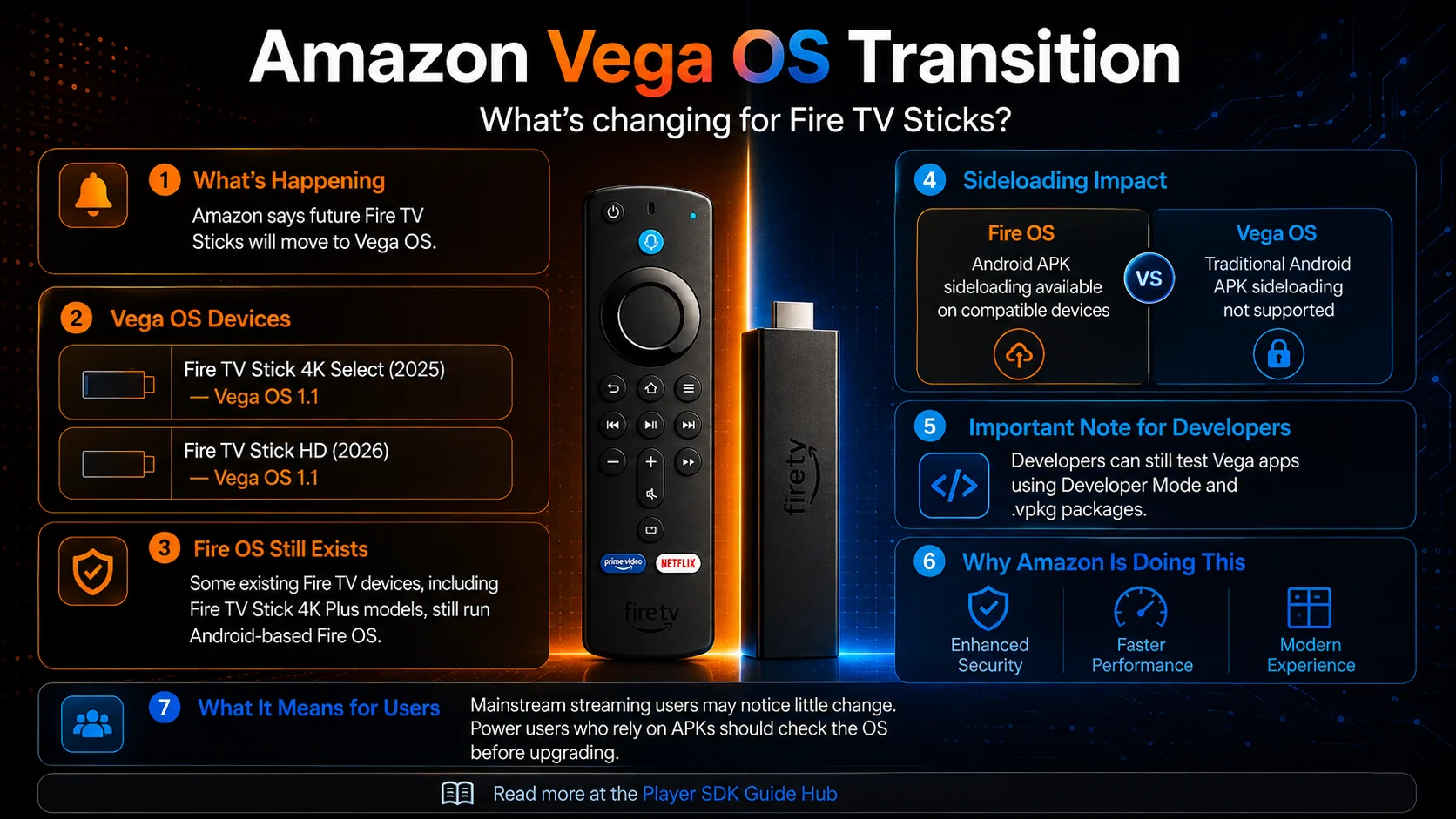
The Fire TV Stick 4K Select, introduced in 2025, became the first major Fire TV Stick to ship with Vega OS. Amazon's device documentation currently lists it as running Vega OS 1.1. The newer Fire TV Stick HD released in 2026 also runs Vega OS 1.1.
This makes it clear that Vega is not simply an experiment. It is part of Amazon's long-term Fire TV strategy.
Future Fire TV Sticks Will Use Vega OS
The biggest confirmation comes directly from Amazon.
Its Fire TV developer portal states that beginning with the Fire TV Stick 4K Select, all future Fire TV Sticks will run on Vega.
That does not mean every Fire TV device has suddenly moved away from Android.
Amazon still supports a mix of platforms. For example, its specifications show the Fire TV Stick 4K Plus (2025) running Fire OS 8 based on Android 11, while the Fire TV Stick 4K Select and 2026 Fire TV Stick HD use Vega OS. Amazon also continues to use Android-based Fire OS on several Fire TV smart televisions.
The shift is therefore best understood as a transition for future Fire TV Stick hardware, rather than an immediate replacement of Fire OS across Amazon's entire TV ecosystem.
What Does Vega OS Mean for APK Sideloading?
For power users, this is arguably the biggest change.
Traditional sideloading on Fire TV involves downloading an Android .APK file and manually installing it instead of getting the application through Amazon's official App Store.
Because Fire OS is Android-based, this became a popular way to install apps that were unavailable through Amazon, experiment with alternative software, or customize the Fire TV experience.
Vega OS does not provide the same Android app environment.
As a result, traditional Android APK sideloading is not supported on Vega-powered Fire TV Sticks. Reports surrounding Amazon's move to Vega have highlighted this as one of the most significant differences between Vega OS and older Fire OS devices.
There is an important distinction, however.
Vega OS does have a Developer Mode that allows registered developers to sideload and test applications specifically created for Vega. Amazon's documentation explains that developers can authenticate with an Amazon Developer Account and install .vpkg application packages using Vega development tools.
Therefore, saying "Vega OS cannot sideload anything" would not be completely accurate.
For the average Fire TV owner, though, the familiar experience of downloading an Android APK and installing it on the device is effectively gone
Fire OS vs Vega OS
| Features | Fire Os | Vega OS |
|---|---|---|
| Platform foundation | Android-based | Amazon's newer Linux-based platform |
| Android APK compatibility | Available on compatible devices | Traditional Android APKs not supported |
| Consumer APK sideloading | Supported on many Fire OS devices | Not available in traditional Android form |
| Developer app testing | Android/Fire TV workflow | Vega Developer Mode and .vpkg packages |
| Current examples | Fire TV Stick 4K Plus and older models | Fire TV Stick 4K Select, Fire TV Stick HD 2026 |
| Future Fire TV Sticks | Older/current platform | Amazon's stated platform going forward |
For mainstream consumers, the most visible difference may therefore be relatively small. For developers and users who depended on Android compatibility, the underlying platform change is much more substantial.
Fire TV Stick 4K Select Started the Vega Transition
The Fire TV Stick 4K Select was the product that officially introduced Vega OS to Amazon's mainstream streaming-stick lineup.
Amazon launched the device in India in October 2025 for ₹5,499, positioning it as an entry-level 4K Fire TV Stick. It supports 4K Ultra HD, HDR10+, Alexa voice features, and Amazon's Fire TV Ambient Experience. Amazon also equipped it with a 1.7GHz quad-core processor.
More importantly, Amazon specifically describes the device as being powered by its new Vega Operating System, designed for responsive performance, fast application launches, and smooth navigation.
The 4K Select therefore represented much more than another Fire TV hardware refresh. It marked the beginning of Amazon's transition away from Android for new Fire TV Sticks.
The 2026 Fire TV Stick HD Expands Vega OS
Amazon followed the 4K Select with a redesigned Fire TV Stick HD in 2026, further demonstrating its commitment to Vega.
The new Fire TV Stick HD launched in India at ₹4,999. Amazon says it delivers more than 30% faster average performance than the previous generation and adds Wi-Fi 6 connectivity. It is also approximately 30% slimmer than other Fire TV Sticks and can be powered through a compatible television's USB port without requiring a separate wall adapter.
Amazon's technical specifications confirm that this device runs Vega OS 1.1.
This is particularly significant because Vega is no longer restricted to one 4K product. Amazon is now using the operating system across different Fire TV Stick price and resolution tiers.
Fire TV Is Also Getting a Redesigned Interface
Amazon's platform changes are happening alongside a major Fire TV interface update.
The company introduced a redesigned Fire TV experience in 2026 with a cleaner layout and improved organization around categories including movies, TV shows, sports, news, free content, and live programming.
Amazon says it rebuilt underlying parts of the interface and has seen 20% to 30% speed improvements in some cases on existing hardware. The redesigned interface is now available on current-generation Amazon Fire TV Sticks and other supported Fire TV products.
This distinction matters because the new interface and Vega OS are not the same thing.
Some Android-based Fire OS devices can receive the redesigned Fire TV UI through software updates even though their underlying operating system remains Fire OS.
So an older Fire TV Stick can gain elements of Amazon's newer visual experience without becoming a Vega OS device.
Why Is Amazon Moving Away From Android?
Moving from Android to Vega gives Amazon considerably more control over its hardware and software ecosystem.
Instead of adapting Android to fit Fire TV, Amazon can design an operating system specifically around streaming devices, its application ecosystem, Alexa, content discovery, and future Fire TV features.
Amazon has emphasized fast performance and smoother app experiences when discussing Vega OS. Greater platform control could also allow the company to optimize software more closely for the processors and memory available in Fire TV hardware.
Security is another major consideration.
Amazon has cited concerns around malicious software and piracy-focused apps distributed outside official channels when discussing tighter restrictions on future Fire TV devices.
That creates a clear trade-off.
Amazon gains greater control over security, software distribution, and the overall user experience, while users lose some of the flexibility that Android-based Fire TV Sticks previously offered.
What Does This Mean for Existing Fire TV Users?
If you already own an Android-based Fire TV Stick, Amazon's move to Vega does not mean your existing device will suddenly stop running Fire OS.
The company's current documentation continues to list both Android-based Fire OS products and newer Vega OS devices.
The operating system becomes more important when you're buying your next Fire TV Stick.
If you primarily use apps available through Amazon's official App Store, the move to Vega may have little negative impact on your daily streaming experience.
If you depend on APK sideloading, Android applications, custom launchers, or other software that isn't officially available through Amazon, you should check the operating system before upgrading.
For those users, an Android-based Fire OS model may offer capabilities that newer Vega-powered devices no longer provide.
Is Vega OS Better Than Fire OS?
There isn't one answer for every Fire TV user.
For regular streaming viewers, Vega OS may eventually offer a faster, more optimized, secure, and consistent experience. Amazon controls more of the software stack and can build future Fire TV features around its own platform.
For enthusiasts, however, the loss of traditional Android APK support is a significant limitation.
Fire TV Sticks became popular partly because they offered more flexibility than many closed streaming platforms. Vega shifts the Fire TV Stick closer toward a tightly controlled ecosystem.
Whether that is an improvement depends on what you expect from your streaming device.
Final Thoughts
Amazon's shift from Android-based Fire OS to Vega OS represents much more than a routine software update.
It changes the foundation of future Fire TV Sticks, the way applications are developed and distributed, and the amount of flexibility users have outside Amazon's official ecosystem.
For mainstream viewers, Vega OS may offer a smoother and more tightly optimized streaming experience. For power users, the disappearance of traditional Android APK sideloading is a much bigger change.
With the Fire TV Stick 4K Select and 2026 Fire TV Stick HD already running Vega OS—and Amazon publicly stating that future Fire TV Sticks will follow—the transition away from Android has clearly begun.
FAQs About Amazon Vega OS
1) Does Vega OS support Android APK files?
No. Vega OS does not support traditional Android APK installation in the same way as Android-based Fire OS. Developers can install Vega-specific .vpkg applications through authenticated Developer Mode, but that is a separate development workflow.
2) Will existing Fire TV Sticks automatically move to Vega OS?
Amazon has not announced a mass conversion of existing Fire OS Sticks to Vega. Its current strategy specifically refers to future Fire TV Sticks starting with the Fire TV Stick 4K Select.
3) Which Fire TV Sticks currently use Vega OS?
Amazon currently identifies the Fire TV Stick 4K Select (2025) and Fire TV Stick HD (2026) as Vega OS devices, both running Vega OS 1.1.
4) Can developers still sideload applications on Vega OS?
Yes. Amazon provides Developer Mode and Vega developer tools that allow developers to build, install, debug, and test Vega applications on supported Fire TV devices. This uses Vega packages rather than normal Android APK files.
5) Are all future Fire TV Sticks moving to Vega OS?
According to Amazon's current developer documentation, yes. Amazon states that starting with the Fire TV Stick 4K Select, all future Fire TV Sticks will run on Vega.
Stay Ahead with the Player SDK Guide Hub
Streaming devices are evolving quickly. New Fire TV Sticks, Android TV and Google TV devices, Roku players, smart TVs, operating systems, and platform updates can significantly change how streaming apps are built, distributed, and experienced.
That's why we created the Player SDK Guide Hub. At the Player SDK Guide Hub, we cover the latest streaming device news, new hardware launches, Fire TV updates, OS changes, device specifications, platform developments, and important industry updates in one place.
Whether Amazon launches a new Fire TV Stick, a streaming device receives a major software update, or a platform introduces changes that could affect apps and playback, our Guide Hub helps you understand what changed, why it matters, and what you need to know next. Explore the Player SDK Guide Hub for the latest Fire TV and streaming device news, updates, guides, and platform insights.